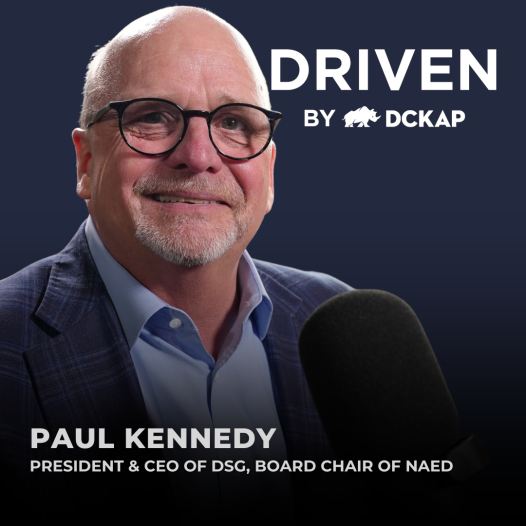
Paul also shares how NAED is equipping distributors — large and small — to compete with the AI impact in a rapidly changing landscape, from leveraging AI Automation and product training programs to championing women in the industry and developing the next generation of distribution talent. This conversation is packed with insights you won’t want to miss.
OR LISTEN ON:
Karthik Chidambaram: Paul, first off, thank you. It's great to see you
again. And before we even start this conversation, I wanna say a big thank
you. I really enjoyed my time spent in Minneapolis last year. Thanks for the
DSG tour. It was a trip I will remember.
Paul Kennedy: That's great. Thanks Karthik. Good to be with you again. And,
I followed you as, you know, got exposed to you when you came up to see us
in Plymouth. And then have been following the other conversations you're
having. So really appreciate your thought leadership.
Karthik Chidambaram: This means a lot to us, Paul, and also good to be here
at NAED in Atlanta. Congratulations on hosting a great conference. You are
the current board chair, so tell us for a distributor out there, how can
distributors leverage NAED better? What are they missing out on?
Paul Kennedy: Yeah, so my first kind of take on how can a distributor
leverage what NAED is you have to lean in, you have to engage with NAED.
It's a contact- distribution's a contact sport, and you need to really
understand all that NAED offers distributors, and they're, you know, they're
offering.
We have small distributor members, we have large distributor members, and
the needs of each of those members is different. So NAED tries to, you know,
curate an offering that kind of satisfies both ends of the spectrum. But you
need to engage. It's not gonna not gonna happen to you. You've gotta
participate.
Karthik Chidambaram: You gotta lean in, like you said.
Paul Kennedy: Yes, absolutely.
Karthik Chidambaram: I enjoyed my time spent at NAED this week in Atlanta,
and also enjoyed the general sessions as well. Great content. One thing
which was a big learning for me is learning about the data centers. And how
it's like the gold rush and how it's really helping the electrical
distribution industry.
So mostly it's like the bigger distributors who would be able to capitalize
on this, or even it's the smaller distributors can capitalize on this, or
what are you seeing?
Paul Kennedy: Yeah, so, you know, data centers, and I think we heard today
during the, during the general session that you know, price may be
secondary.
It's really about speed of delivery and, and the services that you can
provide locally to help make sure that that project gets done. On time and
in full. So I think if there's a small distributor in a local market that
can provide that level of service, then great. But otherwise you, you know,
there are large companies, large distributors across the landscape that have
built the capacity to be able to service this market, you know, more
specifically.
Karthik Chidambaram: And speed is the name of the game. And let's say the
data center is not operational on a particular time. They lose millions of
dollars every day.
Paul Kennedy: Absolutely. I don't know what the number is, but it's a big
number, you know, is basically just lost because that data center's not up
and operational
Karthik Chidambaram: And is the data center, I mean we were just talking
about it prior as well. Right. So this is, this looks strong till 2045.
That's what you know, we learned, but then there's also a lot of change
happening just in tech. Right. On how the chips are being built. And that's
something. Which was talked about in the general session this morning.
But then when that happens then the business changes as well and the need
for the different kinds of product changes. Maybe I stock up a lot of
inventory and then a few months down the line, there's no need anymore. And
speed is the name of the game, like you already said. So how do we deal with
that?
Paul Kennedy: Yeah, I think. Really open and transparent communication with
our, you know, with the, you know, the developers that are building out
these projects and also with our manufacturing partners. I mean, I think
that is really key to make sure that we're having open and transparent
conversations around timeline and what's coming and then staying curious
about how.
How the data center landscape is changing and the new products, whether it's
chips or cooling or whatever the case may be. 'cause it is constantly,
constantly changing. And, you know, a data center that's built today isn't
gonna be the same data center that's gonna be built a year from now, or five
years from now.
They're gonna look different, the footprint's gonna look different. I don't
know how yet, but we know that innovation is gonna continue to happen.
Karthik Chidambaram: Talking about innovation and also NAED owns
organizations like the idea and what are you seeing, right? I mean, being on
the distribution side of the business and also being a part of the
association.
Are you seeing a lot of distributors adopting to the latest tech that's out
there? AI and everything out there, or what is NAED doing in this regard?
Yeah,
Paul Kennedy: yeah, so I think a couple of places that NAED is
participating, one is just educating membership around the AI boom and, and
what's happening. So last year presented a white paper on electrification
and, and then how that feeds into AI and AI factories one and then two.
With the allied partners that NAED has, bringing AI solutions to membership
to help automate processes that happen every day in our businesses in
distribution.
Karthik Chidambaram: And you not just work on NAED or you not just serve
NAED, but you're also on the board of AD.
Paul Kennedy: Correct.
Karthik Chidambaram: Yeah. So how do you find time for all this?
Paul Kennedy: Well, I've got a great team back at DSG, so that's one part I
lean into these opportunities to, because I'm curious and I learn so much
and anytime I can put myself in a room with a whole bunch of people that are
smarter than I am, I, I usually come outta there learning something. And
that's been the case on the NAED board and it's also been the case on the ad
board.
Karthik Chidambaram: And what are distributors, right? I mean, I think, you
know, the larger distributors. They share the knowledge with the smaller
ones. You know, I think it really helps them, you know, it's also
inspirational in a way, right? Because let's say, you know, this NAED is not
just an association for the big players, but also a lot of small players who
aspire to get there.
So do you also have knowledge sharing sessions where, I mean, I know that's
what this conference is for, but what are you doing in that regard? You
know, so to get the smaller players up there,
Paul Kennedy: well, part of it's just creating the opportunity for, you
know, there. Creating the opportunity to share best practices and, and to be
in a room together.
Large distributors, small distributors, manufacturing partners, allied
partners. So anytime we have the opportunity to create space for those
conversations to happen, we feel like we're lifting the entire distribution
channel up. The other thing is, you know, as part of the offering that NAED
has. Is you know, there, there's input from large distributors, there's
input from small distributors.
So I think, you know, while large distributors sometimes have scale and, and
you know, there's this thought that, boy, a small distributor can't compete
with that. But a lot of times a small distributor is more nimble and you
know, can provide a level of service that may be a large one, can't. So I
think there's, there is room and, you know, for, and opportunities for, for
both to learn from each other.
Karthik Chidambaram: Yeah, I've been talking to quite a few people here, you
know, especially on the technology space and one thing I learned is. It's
kind of, you know, it's mostly the smaller, the mid-size distributors who
are gonna be leading the AI game because they're very nimble, like you said.
Right. So I think that's a big opportunity I see there, you know, for the
smaller or the mid-size distributor to leverage tech, you know, because
there's not a lot of bureaucracy there, you know, you just move fast.
You know? I think that's something I'm seeing.
Paul Kennedy: Yeah. I think as long as there's a curiosity and an interest
right. To invest in tech and, and and to be open to doing something
differently than you've always done. Sometimes larger companies move a
little bit. They're willing to make those investments maybe a little bit
sooner sometimes, but the small and mid-sized distributors that have a level
of curiosity and you know, are forward progressive thinking.
Around technology are the ones that are winning every day.
Karthik Chidambaram: And one last question here. Right. So with respect to
the new generational workforce that's coming up, I know you are doing a lot
of stuff at DSG, but what is NAED doing in this regard? You know, because.
How are you generating interest for the new workforce to take up
distribution or to get into manufacturing and all that, you know, what is
NAED or associations like NAED doing and this regard?
Paul Kennedy: Yeah, so a lot of different, there's a lot of focus on that as
we think about, you know, the exodus of this knowledge base, right? So I
think there's a couple of different ways. One is just. Driving the education
down to the lowest level, you know, talking to high schools, creating
recruitment, videos and recruitment.
So NAED is doing a lot of work around workforce development, creating
programs for their distributor members to go out and recruit. So. Attaching
value to the membership one, but two, creating a storybook about what it
means to be an electrical distribution. So, you know, a distributor member
can go out and sell it, sell electrical distribution as a, as a career
opportunity in high schools and colleges, in local job fairs and, and things
like that.
So I think that's one big piece. I think another piece is understanding that
technology can help close this gap, right? If we have this exodus of
knowledge, how does technology play into, you know, onboarding and bringing
up to speed these, this next crop of employees coming in who don't have 30
or 40 years of experience.
But, you know, how can you know, how can technology and AI start to equalize
that?
Karthik Chidambaram: Is that the NAED foundation, is that the work that does
or is there something called NAED Foundation or,
Paul Kennedy: So there is the NAED Research Foundation, so Nerf, which is a
part of NAED. So a lot of investment and, endowments have been given to, to
Nerf, to kind of, that's the research arm of NAED where they're thinking
about these types of these types of problems and developing research and,
and solutions to help their members kind of move forward in, in a new world.
Karthik Chidambaram: And one more thing, you know, which I think is very
important is women in distribution. And the more women get into the
distribution workforce, the better. So what is NAED doing on that?
Paul Kennedy: A lot. So, you know, women in industry is NAED's single
largest conference that they put on in a year. Last year I was there, there
were 1100 women there this year. The planning's in place to be able to
accommodate 1400 women.
So by far the largest conference at NAED produces. And if you think about
it, you know, women make up 50% of the population. So, you know, we weren't.
You know, we weren't catering and, and curating content to that cohort of
potential, you know, employees for the longest time. And so I, I'm super
excited that NAED has, has really stepped into that and, you know, continues
to, to broaden the reach into the women in industry.
Cohort winning teams have women in them. And so Paul, I mean there's
obviously business challenges you know, which we need to deal with. But when
you talk about business challenges, you know, it's, there are some external
climate which we don't control, you know, because there are a lot of things
happening outside our industry.
Karthik Chidambaram: The new laws are being put and all that, right? So
what's NAED doing? You know, how are you being an advocate for the industry?
Paul Kennedy: So NAED has a government relations function that we have a
person in DC who actually sits inside Nikas office. So you know, our sister
organization, the Con Electrical Contractors Association, that does.
Advocacy work on behalf of electrical distribution. So, you know, right now
some of the big topics they're tackling are the vet acts of trying to get,
it's to bring veterans into the workforce. So streamlining that and, and the
government is you know, providing assistance there. It's looking at codes
and standards and, hey, where are there opportunities that we can work with
our sister organizations?
Nika, NEMA, Nera. To have a common platform and, and advocate together for,
you know, the entire electrical distribution industry.
Karthik Chidambaram: And do you also work closely with NAW, or you do your
own thing?
Paul Kennedy: So on the advocacy front, not so much in coordination with
NAW, but there are a lot of members who are NAED members and NAW members,
and I think they each have a different value proposition.
Karthik Chidambaram: Paul, is there anything else going on at NAED, which
distributors should know about?
Paul Kennedy: All the basics of conferences and, and putting distributors
and, and suppliers together in, in environments at our conferences. I think
the workforce development that we talked about earlier is a big initiative
of NAED, I think government relations that we talked about.
So the regulatory environment and understanding what's happening there.
Leadership development. So providing curriculum to allow distributor members
to develop their leadership talent. With the help of NAED and then there's
product training EPEC, which is kind of a cornerstone of, of NA's offering
and continuing to iterate on that to make sure that we've got a trained you
know, workforce in electrical distribution.
Karthik Chidambaram: So, EPEC is the product training program that you offer
for distributors?
Paul Kennedy: Yes.
Karthik Chidambaram: Cool.
Paul Kennedy: And it's right now it had, it had been pretty manual process
and we're kind of morphing and how do we, you know, how do we start
leveraging AI in, in keeping EPEC relevant current and you know, kind of in
the format that today's you know, today's up and coming employee wants to
consume that sort of information and that training.
Karthik Chidambaram: And are you also creating video content in terms of
training? Because I think that will also help, right? Because. Let's say you
create video content and put it up, put it out there on YouTube, not just
NAED members, but other people could watch as well. Is there anything you're
doing on that regard?
Paul Kennedy: Sure. So I think NAED is doing some of that, but most of that
is, is housed in, in NAED for the benefit of our, of our members. Yep.
Karthik Chidambaram: So Paul thank you so much for joining this
conversation.
Paul Kennedy: You bet. Thank you, Karthik.
Karthik Chidambaram: Yeah.
Sign up to receive email updates
Enter your name and email address below and I'll send you periodic updates about the podcast.