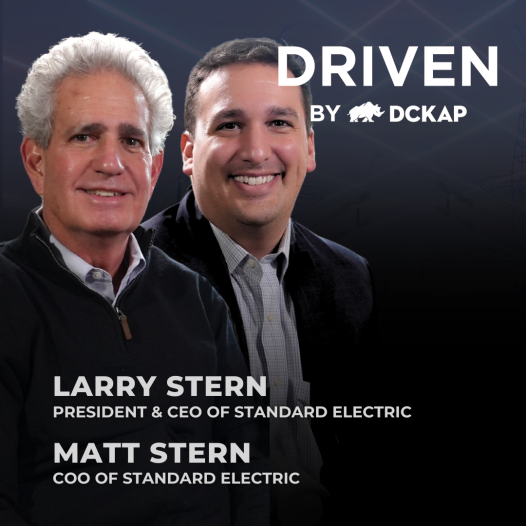
Together they talk succession planning, culture, leadership, and what it actually takes to grow a family-owned distribution business in a market that keeps trying to buy you out. If you’re an independent distributor thinking about the future of your business — or just want to hear from two leaders who are doing it right — this conversation is for you.
OR LISTEN ON:
Narrator: Standard Electric is a fourth generation family
owned business that transformed from a light fixture manufacturer into a
lasting legacy of electrical distribution in the Midwest. After buying out
the company with his father, Larry Stern became president and CEO in 1993,
leading the company over the past three decades.
His son, Matt Stern, earned his path into the company and landed on Ted
Magazine's. 30 under 35 list before being named COO at a time when family
owned distributors are disappearing fast. Their story is proof that keeping
it in the family is worth the effort.
Karthik Chidambaram: Larry Stern and Matt Stern, Standard
Electric Supply.
Larry and Matt, great to see you today. Thank you for joining me on this
conversation.
Larry Stern: Thank you for the invitation.
Karthik Chidambaram: Larry, Standard Electric started as a
manufacturer 106 years ago, and then you got onto to distribution a
business. Surviving 100 years is no easy thing. So tell us what happened
there.
Larry Stern: Yeah. It is funny 'cause I think back and I
didn't really grow up working in the business. I had a couple of other
careers before then while I was practicing law in the mid eighties. That
there was the first original three founders, and then they gifted a will,
their stock to all their children.
There were 17 owners, some in the business, some out of the business, and
obviously as you're getting older, in sixties and seventies, none of 'em had
any children involved in the business. And you have some traditional issues
with getting value out of the business. Myself and our firm, we got involved
in helping clean that whole situation up.
And that's what drove me to have the interest in wanting to carry on the
business to another generation. And so we were fortunate. A lot of
businesses aren't where they have different family dynamics, where they're
not able to carry on to another generation. But by cleaning that up and then
allowing that opportunity to, to my children and man to get involved was how
that all came about initially.
I think about back now, I've been involved over 30 years, so my history is
like a third of the history of the company, which is scary in hindsight when
I look at it now.
Karthik Chidambaram: Yeah, when you look back it looks
like, oh, I've been doing this for 30 years. I get that feeling sometimes.
It's all, yeah.
Larry Stern: I feel, yeah, and I feel like it's just a very
small part, that custodial relationship to maintain it for the next
generation.
Karthik Chidambaram: But I also think, when you clean up
like that, especially with complicated structures and all that. That also
makes it simplified in a way, right?
So it helps you prepare for the future better. And that's essentially what
you did. Totally. Exactly. In years.
Larry Stern: Yeah, exactly. I don't know if we ever
would've made it here today if we hadn't been able to clean up that
situation. Yeah. So you buy out all the other stockholders at the bottom
line. Then my dad and I went through a transition of ownership back in the
nineties.
Karthik Chidambaram: So you, your dad and you worked
together, and now you and Matt worked together. So Matt, tell us about how
did you get into the business? I was just looking up your LinkedIn and
everything. You started in the warehouse doing all kinds of little work, and
then you went out, you went and worked for Schneider Electric.
Matt Stern: Yeah.
Karthik Chidambaram: And then you decided to come back in.
Matt Stern: Yeah, it was a little more of a straightforward
path for me and my brother who's involved with the company too. But, I grew
up before the LinkedIn post, or updates. Following Larry to different
locations or NAED events and yeah, spend time in the warehouse understand
those roles and how important they are with shipping and receiving and put
away everything to function and serve our customers.
And then had a good idea. I wanted to come back and work with him, but that
was important to get out of the family company for a few years and learn
from some others and get some other experience. And my brother did the same.
He actually left the industry as a whole. Outta school and I, he wasn't
quite as sure, but then we're allowed to come back and work directly with
Larry and for some other leaders in our company before that.
And having him here and has definitely allowed us a chance to really work
our way around the company, understand from the sales side to the operations
side, and and get a kind of a full understanding of what it takes to be
successful before not working directly for Larry.
Karthik Chidambaram: But when did you first get exposed to
Standard Electric as a kid?
Or when was that? What does we though from birth?
Matt Stern: Yeah, I'd say from birth I, had been going to
the company picnics and following him to the office and sweeping up in the
warehouse on the weekends when he'd go in once in a while. So yeah, it's
been part of my life for forever.
I'd say high school is when we started actually getting some summer jobs and
understanding the work behind it.
Karthik Chidambaram: So Larry, was that intentional letting
Matt go to the Warehouse, as a kid and all that, is that intentional and
Larry Stern: I don't know if I had in mind where we are 30
years later now, but they always knew that it was a family business, that it
was part of our family and.
Like I was saying before, one of the reasons I got involved myself is 'cause
I just thought it was important to carry on that family legacy and wanting
them to give that opportunity to, to my children also if they wanted, but I
never wanted to put them in a position where they would feel like they, they
had to or forced to in any way.
So getting back to your question, yeah, I think that was all in the back of
the mind that you get exposed to it, knowing it's the family business,
knowing it's there for you if you wanna take that opportunity.
Karthik Chidambaram: Talking about family business. There's
also a lot of consolidation happening in the market, which we are all aware
of.
And family businesses get taken over by larger distributors and sometimes
private equity firms also end up buying them. So what made you make the
decision here? I wanna keep it in the family, this is the legacy, we wanna
continue.
Larry Stern: Yeah. That's a great question. Honestly, we'll
get emails, calls, voicemails. Some even call our switchboard and leave a
general message saying, Hey, I wanna talk to you about buying your business.
I don't think that's the best way to go about doing it, but in any case,
it's out there almost every day where you get that solicitation.
It honestly was never part of my thought that I wanted to entertain that.
There, there's, everybody has a different situation. There's reasons why,
and I know a lot of these old, independent companies that were sold to
change or private equity or whatever it might be also. But it was always in
my mind that I wanted to make sure my kids had that opportunity.
So I never really. Entertained any of those o offers until I knew what my
children wanted to do. And like Matt said, he is actively involved. He's
gonna be take over my position. His older brother is very active, involved
with managing our e-commerce business and strategy. They have a sister in
between who's not involved in the business at all.
She does some other things. She does her own business that she's running out
in Denver does a great job. But, she never wanted, had that interest and
again, never tried to push her and force her into it. She works some summers
in the business too, so she's familiar with it being the family business.
But I don't think it, it ever crossed my mind even knowing all the other
companies that I've known over the years that have been acquired and knowing
what all their circumstances are. Everybody's unique.
Karthik Chidambaram: But when did you first start thinking
about succession planning? Because I think that's something you've done
really well.
It's not Hey, you know what? This is gonna happen tomorrow. You really
thought about it, you thought it through. So when did you start thinking
about it and how long did that whole thing take?
Larry Stern: So I'd say my vice president of sales who
retired a little over a year and a half ago, my Mike Harvey, great guy in
the industry, he always has that, that had that forward thinking process and
whether I was talking about specifics of how it was gonna happen, he was
always thinking ahead of individuals.
For instance, in, in his role his successor Dan Knapp does a great job for
us. He was hired by Mark Mike as a salesperson, 15 or so years ago. I
remember at that time him saying, this guy could be a great guy to fill my
position. So I've been blessed to have people surrounding me that are always
thinking like that.
And of course you don't, I didn't lay on a piece of paper a specific
strategy. But there was always in the mind, as you were saying, you're
always thinking about it and looking for where people might fit into the
company. And again, Matt was not slotted in when he was in high school or
something.
It just evolved. And he has the skills, the capability, and the motivation
to wanna take this position on. So I was fortunate it just happened to work
out that way. Other family businesses are not as fortunate and they end up.
Selling or having independent from family, somebody running the business for
'em.
Karthik Chidambaram: This is a great example of long-term
thinking. There's something I've been thinking about as well, right? Even at
DC Cap, we have a lot of people who have been in the company for a long
time, right? Like 10 years, 15 years and all that. That's a very common
thing. Then I'm just thinking, I was just thinking about this.
Last week where, hey, what happens another 10 years? Because these people
are really good, but then another 10 years, we need a new set of people
coming in so that you maintain continuity. Sure. I think that's a great
example of long-term thinking. Larry, for companies out there planning
succession, just like how you did what advice would you give other
distributors out there?
Larry Stern: I don't wanna give away our secrets now. What
we are talking about already with always thinking about and planning it, you
need to identify individuals early on, whether that means five years or 10
years and always be thinking about how you structure the organization. And
we, as Matt had mentioned at one point about business being an evolution.
I truly believe that. And you constantly, as business evolves, you have to
take a step back and ask yourself who. If we're going to move into that next
generation would be the ones that are capable of doing that. And then make
sure that you have a path of training. As like Matt, he came into the
industry, worked for one of our key suppliers, worked in sales in the
Chicago market for a while, came back up to Milwaukee, got onto the
operational side of the business.
So you have to be deliberate about the training and the opportunities you
give them to be comfortable when that next time comes for the succession.
Karthik Chidambaram: So Matt tell me so family, business,
so private equity, you always have a lot of growth and all that, right? But
doesn't have to be just in private equity, so even in family businesses, you
can have a lot of growth and that's what you guys are doing. So what's the
growth path for standard Electric?
Matt Stern: I guess it's not all up to standard, but we'd
love to continue to grow. We are, we're in, we started in Milwaukee and
while Larry was there and his dad we grew to the full state of Wisconsin.
And then over the last 20 years we've gone into Illinois and then last 10
years, Indiana. And those are still new markets for us, but we have a really
great younger leadership team. That's all eager to grow, excited about
growth opportunity. So e every year we talk about, we have strategic
planning and we talk about what we want the next year, a few years to look
like how we get there.
So those markets are still amazing opportunities for us, but I. We routinely
meet with our supplier partners and ask about where they could need another
partner, a different market we're not in yet. It's hard to say, it's a lot
in the market where the, where we could potentially fit in and then work
with some of those partners.
But I can say our leadership team's definitely excited about future growth.
Karthik Chidambaram: Definitely you are expanding to other
locations, opening new markets, and you also bring in a lot of fresh
perspective, right? Because you worked outside and then it's a different
generation and you work with a new set of leaders.
So how do you approach, tech, right? So how is that helping the businesses?
And also with a lot of talk about AI and all that, are you guys already
experimenting with AI at Standard Electric and what are you doing there?
Matt Stern: Yeah. The technology is constantly changing. It
feels every week you hear about a new software that's coming up, a new way
to use the AI that's out there.
So we, we have invested a lot in the business in certain softwares vertical
lift modules in the warehouse become more efficient. But we've developed a
team and one of our younger leaders, Katie Brody is heading up. Digital
transformation is one of her titles. To make sure we stay ahead of the
curve, we see what's out there.
We're developing a AI group to continue to explore where we become more
efficient where we can look for some of those heartaches and where we can
bring in some software or some AI or ways to make us move a little quicker,
a little faster. And it's an ongoing evolution. I don't have the answer yet,
but it's definitely something we're paying a lot of attention to.
Karthik Chidambaram: Talking to both of you, you always
bring up names, right? Like for instance, you brought up Katie and different
names. It's ingrained in the culture. You guys have it's always about
teamwork. Teamwork really works. So you give a lot of credit to all these
people behind the scenes.
So tell us about that. Is that ingrained in the culture or what do you do
and how do you ensure that the culture is intact? Maybe Larry,
Matt Stern: you can both, I I think we both have some
answers. It's always been, the family culture. So going back when I was
growing up, I've known some of these, the people who worked for Standard my
whole life.
Cassie Petty, our HR Vice president. I've known her forever. Our whole
leadership team. To me there's so many weaknesses. I don't know, fin and
he's a CPA, one of his past careers, but there's a lot of things I'm not
strong at, and we have a lot of really good. Leadership that, have to lean
heavily on them to be successful.
I know you can talk more about the culture,
Larry Stern: so I always believe you have to find good
people that are smarter than you or technically better or whatever it might
be, and then nurture that relationship. I've always said that when I started
in the business, I knew this much about it other than wanting to be in a
family business.
Today I know maybe this much, but it's finding those individuals and being
motivated, like yourself, being part of the company, I think. When we look
at large organizations, whether it's a manufacturer, one of our suppliers,
or one of the large global chains, we can compete against any of 'em.
We have the size and the capabilities to do that. The difference though is
that family touch or making people feel part of the business, part of making
the decisions, implementing the decisions, and that really is what drives
the business. You can't have one person. Be able to do all that.
You're never gonna be able to grow and be successful otherwise.
Karthik Chidambaram: Especially in distribution, our
relationships matter and they make a whole lot of difference. Yeah. So with
all that happening around us, Matt, so what makes you be very optimistic
about the future?
Matt Stern: I'd say I. Coming to events like these, hearing
from industry experts manufacturing partners the opportunity they see out
there young people getting more involved.
I was sitting with some suppliers there and they're talking about ways to
promote the industry, such a great industry to get, be part of. And they're
getting more creative about how to get people in. 'cause once you get in,
they joke. You're never leaving the industry. You might bounce around to
different distributors or suppliers, but there's just so many great
opportunities.
Business continues to grow. It feels like for most distributors out there of
new opportunities coming up, all the automation happening, it doesn't seem
like there's a end in sight of opportunity.
Karthik Chidambaram: And Larry, you have served. NAD and
multiple other organizations for a long time. So we were talking about this
like 20 years, 30 years, that's ingrained in you, how do you find time for
this? Because you're already running Standard Electric, that's a busy job by
itself, but then you also spend comfortable amount of time giving back to
these organizations.
You also were the chairman of Idea. Yeah. How do you find time to do all
this and talk through us?
Larry Stern: I've found that it's actually extremely.
Valuable to our organization. First of all, you have to have a great
management team and great people that are running the business for you to
allow you to have that time and opportunity.
But I think over, over the years, as you point out, it's been probably 20
some years in different roles within NED, from regional Vice President,
treasurer educational chairman for NAD. It's been a long time. And over that
time you get to meet a lot of smart people, be able to network with other
individuals, find out what they're doing.
I don't know if I've ever had an original idea personally. But I sure have a
lot of other people, original ideas that we've taken into our company and
used in different ways to help us be successful. I think that's really
important in a leadership role to be doing that. And at the same time, it
feels good to be giving back to the industry.
I probably forgotten more than I even remember now of different initiatives
or things I've been involved in over time. That it played a key role in the
growth of the success of the industry in general too. Yeah, I, yeah. The
more you give, the more you get. And also shamelessly copy from the best,
but I had Matt now you can talk too, but he's going down that similar path
that I started down years ago.
Karthik Chidambaram: Matt, what are you doing at NAD and
other organizations? Yeah,
Matt Stern: I've gotten involved NAD has a committee called
the NAD Lead committee. It's for new leaders, younger leaders, people who
can just use a little more training when there's a conference around it.
Last year I was the chair of that. But Larry was saying. I've been involved
for about five years now, and it's been so valuable. The relationships you
were mentioning, how important to have all those relationships that I've
made through that, where I'm talking probably weekly to someone I've met
through NAD or through the lead committee with questions about how they're
handling certain situations or, talking about growth how to be successful
with that.
And so far those relationships have been one of the more valuable things
that I've gotten out of NAD and getting more involved.
Karthik Chidambaram: Last question to you, Matt, what are
some things you do outside of work?
Matt Stern: Outside of work, I'm a big sports fan, a lot of
Wisconsin sports growing up in Milwaukee. I know we, we both go to some
Bucks games, brewers games.
I love music actors and I just lost, so I was trying to ignore that one. But
music, I love to, I go to concerts, travel with friends, so stay busy
outside of work too. But yeah, I got a lot to learn before. I didn't hear
Larry Stern: anything about golf.
Karthik Chidambaram: Golf.
Matt Stern: Yeah. I love to golf too. Yeah. Can't forget
about that.
Karthik Chidambaram: Yeah. I play golf as well. Not as
good.
Larry Stern: You haven't seen me hit the ball. I don't
know. I don't wanna say I'm better at,
Karthik Chidambaram: yeah. So Larry, what do you do outside
of work?
Larry Stern: Golf. So Matt has his older brother that works
in the business too, he actually lives in New Orleans. He's married. They
have our two grandkids down there.
We're still waiting for Matt and his sister for that. But in the meantime
though, since they're down in New Orleans. We've got a place down there too,
and we go down there. We try and get down there regularly every month to be
part of their life and be part of their grandkids lives too. And that's a
fun part of as the transition is going on, to be able to do more of that.
Karthik Chidambaram: I think it's a lot of fun. So Matt and
Larry, thank you so much for joining me on this conversation. I really
enjoyed it. Thank you.
Larry Stern: Thank you.
Matt Stern:Yeah, thank you.
Sign up to receive email updates
Enter your name and email address below and I'll send you periodic updates about the podcast.