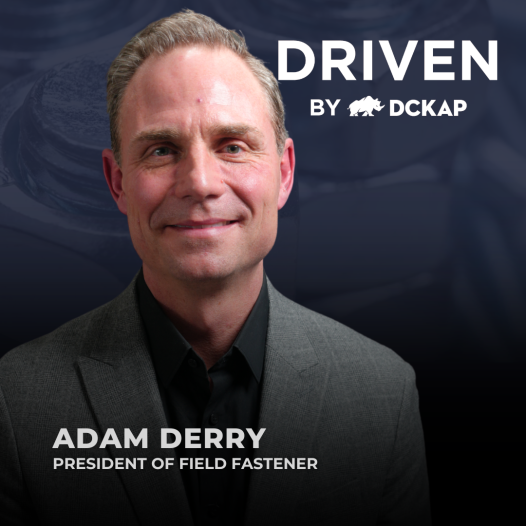
In this episode, Karthik sits down with Adam to talk about the real mechanics behind Field’s growth: a culture first operating model, 30 actionable behaviors called the Fieldamentals, and a mission to make sure every customer loves working with them.
They also get into the harder stuff — family business governance, second-generation leadership, succession planning, and what it actually means to have higher expectations for family members than everyone else.
OR LISTEN ON:
Karthik Chidambaram: Adam, thank you for joining us. Great to see you.
Adam Derry: Yeah, it's great to be here. My pleasure.
Karthik Chidambaram: So Adam, I met with your uncle, Jim, last year. And so
it was a great conversation. Enjoyed learning about Field and the business,
and the high expectations Jim has.
But great to see you. And tell us about the family business as a whole,
right? So you have a family governance, we talked a little bit about Field
last year. Now we understand what you do, the vendor inventory and all that,
right? Tell us about what is your role as President at Field.
Adam Derry: Yeah. I, we've got a 10 year strategic plan.
So ultimately, my goal and plan is to drive the business forward towards
that operating plan that we set in 2020. So the center of that is to improve
lives. That's improving the lives of our team members and their families,
helping our customers, and then really ultimately improving the lives of
those in our community as well.
And then there's five strategic pillars around that, but that's really
ultimately my goal, is to each year drive our operating plan towards that 10
year strategic plan.
Karthik Chidambaram: And execution becomes critical, right? So you have a
strategic plan, you've got to execute on it, and you guys have been growing
18% year on year.
So how do you ensure you execute, right? Because that's a challenge I had.
Say, we have a grand plan and we want to execute, but sometimes we do fall
short on numbers, but you guys have been able to do that consistently year
on year, and that's really helped Field's growth. So how do you ensure that
happens?
Adam Derry: Yeah. We talked before, like culture eats strategy for
breakfast, so we feel like we've got a really good strategy, but ultimately
culture wins and loses it to us. So I spend a lot of my time, and our
leadership team does, just focusing on protecting and enhancing the culture
that we have. Bill and Jim, when they bought the company in 1990, it was 12
people, and now we've got a little over 400.
So the company's grown exponentially, and I would say we stayed true to our
values and the core of what got us to where we are today, and that's really
culture.
Karthik Chidambaram: And you got into the business early on, right? So
you... I think, when you started, you didn't even want to get into Field.
Adam Derry: Wasn't sure, yeah.
Karthik Chidambaram: You weren't so sure.
Adam Derry: Wasn't sure.
Karthik Chidambaram: And then you decided, hey, you know what? I'll take the
job. Was it always in the family, "Hey, you know what?" Do they tell you
that day, this is something you gotta be doing? How does that work?
Adam Derry: Yeah. When Bill and Jim bought it in 1990, I was 10. So I'd mow
the yard and did stuff in the operations and things. Really just grew up in
the business. And yeah, when I graduated college, I wasn't really sure if I
was gonna join the family business or not. I worked somewhere else for four
or five years, and then yeah, the right opportunity presented itself and the
door opened and yeah, I got into a sales role in Downtown Chicago, which was
where I was living at the time.
And 20 years later, yeah, running the company, which has been an incredible
honor and quite a privilege to, to work at Field. It's a great company.
Karthik Chidambaram: And what are some of the challenges, right? Let's say
when you work for your dad and your uncle, what are some of the challenges?
I
Adam Derry: can't talk about that. I think, if there's any kind of issue in
anything at work or in life, it comes down to some breakdown in
communication, right?
I had a certain expectation and you had something different. So we try to
get really crystal clear around roles and expectations, both r- really in
the family and just in the company. Those are re- that's a really important
thing to just manage And have really clear expectations. So I would say the
fundamental component at Field is having really strong relationships so that
we can build relationships before you need them.
And what that means to me is it's really we've got a really strong
foundation, and we trust and have rapport with each other so that if there
is an issue, we can talk about it openly and work through it together. So,
really the trust and transparency and having strong relationships is really
a fundamental element of the culture.
Karthik Chidambaram: And you have cousins in the business as well. You have
other cousins in the business and yeah. And then you have the extended team
as well sometimes, right? So the reason I ask this is, there are a lot of
other family businesses listening to our podcast as well, and they would
like to know. So how does that work, right?
So you know what when I talked to Jim last year, he said, we have really
high expectations. The kids need to deliver. They need to deliver better
than the rest of the people.
Adam Derry: Yeah.
Karthik Chidambaram: Talk to me about that.
Adam Derry: Yeah, we would say the expectations are higher for Darry's or
family members than the team and that there's no special treatment, right?
We wanna have... there's no special titles or comp plans for family members.
Everybody's in it together. So we make sure that, yeah, there's really no
special treatment. So I think the advantage or what I try to make sure that
the family has is if they need training or guidance or any kind of way to
invest them, 'cause they're gonna be in the company for a long time, we'll
do whatever we can to help them develop and grow into the roles that they
aspire to be, but there's not gonna be, any special treatment.
Karthik Chidambaram: I was talking to APR Supply, another distributor, and
they also have external people helping with the whole family business. Is
that something you guys do at Field as well? So do you have an external
board, which helps you with things?
Adam Derry: So we, when Bill and Jim, my dad and uncle five years ago or so
decided to keep it in the family, they hired a consultant to help create the
structure around a family foundation and guidance around a family council
because really what's most important in the multi-generational family
business is family harmony.
So really looking at, the ownership needs, what's the needs of the business
and, what's the needs of the family and making sure that those three circles
where they interconnect, it's harmonious. So there was a consultant to get
the structure in place. And now we do have a board, so we talk about family
business at the board and the family council and those kinds of things.
But what's been really cool is that, so Jim and Bill are g- generation one,
I'm part of the second generation. We've got 22 people, family members and
spouses, in that G1, G2, and 18 of those 22 family members or spouses have
engaged in the family, the foundation, or the family council. So there's
been great engagement really across our entire family, even those that don't
work at Field, to stay connected and try to drive that family harmony.
Karthik Chidambaram: And the foundation helps with that.
Adam Derry: Yeah. Yeah, it does.
Karthik Chidambaram: And talk about the third generation. You have teenage
kids. How do you ensure that they get interested in Field? Are you doing
something to make that happen, or,
Adam Derry: I would say my, my goal as their dad is to just help them pursue
their passions in life.
And if that's at Field, great, and if not, that's okay, too. So there is an
annual meeting that they're a part of, and we, I would say, sprinkle in some
fun and talk a little bit about who Field is and the positive impact we can
have on our customers and in the community to just educate them a little
bit.
But that's the extent of it at this point. Maybe as they get older,
internships or some kind of, role. But really, I just want them to pursue
their passions, and if that intersects with Field, great, and if not, that's
okay too.
Karthik Chidambaram: And do they talk to you about Field? "Hey, Dad, you
know what's happening?" Do they do that?
Adam Derry: A little bit, yeah. Yeah. When I'm driving down the road, family
vacation- ... point out some of the fasteners on trucks and trailers.
They're not all that super excited about it at this point, but hopefully
that'll change at some point,
Karthik Chidambaram: switching gears a little bit you guys invest in
technology and, we're also, AI is like a buzzword, but are you using AI at
Field?
I know, I talked to Jim about this last year, said we were trying to
experiment, see the use cases and all that, right? So what's happened
between then and now?
Adam Derry: Yeah. We've hired an AI consultant that has met with our
leadership team and now is doing a deeper dive with every functional area in
the company to really determine a project deck to determine where to start
with AI.
So we're really in the process right now of creating kind of the
infrastructure to use, like a ChatGPT at Field and build out that
infrastructure so we can use it internally, and then figure out really how
best to deploy it in '26. So I'm super excited about that initiative this
year.
Karthik Chidambaram: And are you also working on automation, with robots and
all that?
Adam Derry: With robots, not specifically, no. But automating and innovating
is a huge part of our business. We try to get really sticky with customers
and bring a lot of value, and part of that is just how can we integrate and-
reduce data entry and any kind of manual component to how we interface with
a customer, and have done really a nice job driving automation and
innovation in that process.
Karthik Chidambaram: What's been the most exciting thing about your job?
Adam Derry: Yeah the really the best part of my job is honestly just being,
spending time with our team. Like I mentioned, culture is so important at
Field, and it's really just fun to see when we get a new customer and we're
l- at the rates we're growing, to see how our team steps up and moves into
new roles and gets promoted, and we open new branches or new facilities, and
how that creates opportunities for them and their family.
So the best part of my job is just spending time with our team and
experiencing this growth together. It's been a great ride.
Karthik Chidambaram: And how do you inculcate culture within the team,
right? So because, that's something a lot of people struggle with, and
companies which have done well, like Field, you invest a lot in culture.
But how do you do that? So how do you put that into action?
Adam Derry: Yeah, it was easy when we had one, one site- Yeah ... and we
were all together, and now that we've got 13 sites around North America and
an office in Taiwan, that became a little bit more challenging. So about 10
years ago, we converted our core values into 30 actionable behaviors that we
call the Fieldamentals.
So it's the fundamental behaviors of the company, the Fieldamentals, and the
process we go through those is we write a week- someone in the company
writes a weekly reflection, and we talk about, at the start of a meeting,
just for a couple of minutes, talking about that week's Fieldamental. It's
been an amazing bonus to our culture, especially for new team members when
they come in.
It really provides, I would say, our new team members the North Star about
the importance of taking care of customers and how that works and working as
a team and taking care of our suppliers and the importance of giving back to
the community. So the fun- the Fieldamentals has been a big part of, I would
say, protecting and scaling the culture as we cr- keep growing.
Karthik Chidambaram: So whenever you have a new hire, you pass on the
Fieldamental to them, and then they read through it, and this is what we do,
like a Netflix culture deck, something like that?
Adam Derry: Yeah. I spend- it's about a 90-minute workshop that I spend with
kind of small groups as we hire new folks. So every month or two I have a
workshop around the Fieldamentals, teaching those.
And I spend, in the first two weeks, I have a one-on-one, 20 or 30 minute
intro with every new team member in the company just to get to know them,
welcome them into the company, because again it's such an important part of
it to have all of our team members know that, yeah, we're in it together and
relationships are really important and, the leadership and ownership of the
company, care about them, and there's a solid foundation to have a good
relationship.
Karthik Chidambaram: Yeah, I like how you talk about it, like in every
meeting or every other meeting, right? Like for a few minutes and things
like that.
So one thing we do at DCKAP is we have a culture deck, the culture
presentation which everybody goes through it, not just when they are hired-
But one thing I like to do is, hey, even after six months or after five
years, we still have a culture training.
Hey, let's do it again.
Adam Derry: Yeah.
Karthik Chidambaram: And then, that really helps. That's something I've
found it to be very valuable because sometimes, when you keep running for a
long time, you tend to forget. So it's good even for us-
Adam Derry: Yeah. It's repetition. Yeah.
Karthik Chidambaram: So.
Adam Derry: Does Michael Jordan, stop practicing, free throws?
No. It's like- No ... it's part of the regimen, the discipline to always,
drive in for excellence and keep getting better. So we've, we see, yeah, the
fundamentals aren't going anywhere. They're here to stay, and we're gonna
keep talking about them 'cause there's obviously new team members coming in,
and it's always gonna be something we can continue to get better at.
'Cause as you read them, it's hard. If you read all 30, it's hard. It's
hard. They're hard to do. So that's what I love about them, too. It gives
great g- guidance and clarity to what we expect of our team. But it also,
it's aspirational in nature to stretch, stretch folks and strive for
excellence 'cause that's what our customers expect of us.
Karthik Chidambaram: And can you talk about something, where as a leader you
wanted to do something, but it did not go as planned, and then you had to
roll back and some challenges, and what you learned from it?
Adam Derry: Yeah, that's a good question. I have to think about that. That
was not the shade.
Karthik Chidambaram: That was not the shade, yeah.
Adam Derry: The thing that stands out is how we're managing inventory. It's
one of the biggest goals for us right now is to im- improve our inventory
turns, and we're doing all sorts of things to tweak the dials and drive
improvements around it and haven't really realized the results we need yet.
So it's something that's a core focus for us this year is to, yeah, have a
software and some solutions and tools and structure that's gonna optimize
our inventory performance. It's something we're trying to get better at, for
sure.
Karthik Chidambaram: So Adam, I've heard you say that good things happen
when customers love you. So how do you ensure customers love you?
Adam Derry: Yeah. It's our mission statement is to have everybody who
interacts with us love us, so customers is a huge portion of that. So I
think what that means to the customer is we wanna be the easiest supplier to
work with and the highest performing.
So to... That's what's, I think, relevant to the customer is, fast customer
service. We get back to them. They feel like they're the most important
customer. So that's the customer lens of it. What that means to us, it's
really finding and developing great people training them, empowering them,
and really getting out of their way, letting them do their thing.
So that's the big thing for us is driving empowerment and transparency
through the organization and really have the decision-making at the front
lines. The people that talk to the customer are the ones that should be
making most of those decisions. So power- empowerment is a really important
piece of driving customer love.
But it can't happen unless the leadership team's talking about it and we
talk about it as a company, and we do that a lot. So the mission statement
drives it, and it's something that is really important for our success to
ensure customers love us. Especially when, there's tariffs and surcharges
and kind of chaos, it makes things way easier when we're a high performing
supplier like we are, it makes those conversations a lot easier.
Karthik Chidambaram: Yeah, and also set high expectations from the customer
end on Field as well, right?
Adam Derry: Yeah. Yeah, 'cause nobody wants to change a fastener supplier.
Most of our customers, we're selling them hundreds or thousands of
components, so we are very integrated into our customers' facilities and p-
bring a lot of value.
So really if we do that, ensure customer love, we'll have customers for
life, which is really why we can grow at 18% a year is 'cause we hardly ever
lose a customer 'cause our team does a great job taking care of them.
Karthik Chidambaram: I'm gonna copy that, the customer love. The theme of
this podcast is driven. How are you driven?
What drives you?
Adam Derry: What drives me is my family and being a great dad and husband
and being a great leader at Field. So I'm trying to really balance striving
towards, best self and being the best version of me, and do that with a
growing business and the importance I put on being a great husband and
father to my four kids.
So it's hard to do, to always keep those three levers in balance, but that's
what I strive for. And what I'm driven towards is, yeah, I got one shot at
life, and make it a great one.
Karthik Chidambaram: And how do you keep yourself updated, right? So with
what's happening around you and to stay ahead of the game, is there
something you're reading right now, or how do you keep up with the market?
Adam Derry: Yeah, I'm really intrigued by AI. Reading a book now around AI.
Emotional intelligence is a really important thing and something I think
it's an art that, while I feel like I've made progress over the years, I can
keep getting better at. So ‘Emotional Intelligence 2.0’ is a great book. And
yeah I listen to podcasts, like Mel Robbins and Let Them Theory, her latest
book.
That's one I think has been really helpful just for me to manage stress and
relationships and again, the EQ lens of that too. Mel Robbins has been a
really helpful lever in my life. Yeah.
Karthik Chidambaram: Adam, thank you so much for joining me. Great chatting
with you.
Adam Derry: Yeah. Thanks, Karthik.
Sign up to receive email updates
Enter your name and email address below and I'll send you periodic updates about the podcast.