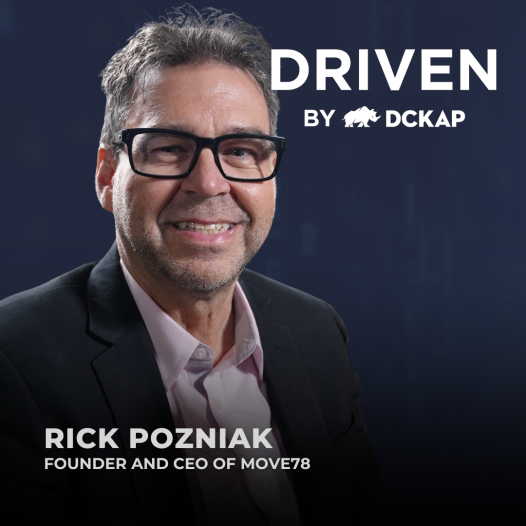
Rick walks through his Seven Levels of AI Competency framework, why mid-size distributors may actually have the advantage in the digital era, and why the biggest barrier to AI adoption isn’t the technology — it’s your people. If you’re wondering where to start your AI journey, or why previous efforts haven’t stuck, this conversation is your roadmap.
OR LISTEN ON:
Karthik Chidambaram: Rick Pozniak. Move 78. Rick, great to see you. First
off, I love the name. I was reading behind why is this called Move 78 - And
I really love the thought process behind the name. The AlphaGo Google
DeepMind. So why don't you tell us that story?
Rick Pozniak: Okay. That's, yeah. It's important to me when I first started
my own company to have the right name. And my son had me watch a
documentary, AlphaGo, and just fascinating. This was quite a few years ago.
And the movie, the AlphaGo movie was about an instance that took place in
2016, but it was early AI and humans competing against AI in the game, and
it got to the point where the AI played the Grand Champion Lee Sedol, and
the AI actually beat him, which surprised everybody.
And Lee had to completely change his thinking to compete against this AI.
And in one game, he made a move that had never been made before in the game,
and that was the 78th move. It really just proves the point that AI is gonna
change the way humans have to think. That's why I came up with Move 78, to
really show that humans and AI have got this new relationship together.
And, I'm a believer that humans with AI can be really strong. It doesn't
have to be humans versus AI. It can be humans plus AIs. So that's what I'm
running with. And I love the name.
Karthik Chidambaram: That's round four, right? So round four, move 78.
Rick Pozniak: Yeah.
Karthik Chidambaram: Okay. So I think I find that very interesting and also,
it's cool, right?
So it's not like AI is gonna win all the time. And we really interact with
AI and it's a great equation. If it's used well, it goes a long way.
Rick Pozniak: Yeah. I think we're, unfortunately, there's way too much talk
now about AI versus humans and what AI is gonna displace humans and just we,
that threat is still there.
But AI and humans can do so much with AI if we do this right, and put the
right guardrails, which, that scares me. I don't think we have the right
guardrails. Maybe not enough, but the right guardrails in place.
Karthik Chidambaram: So, just like how technology is an enabler for humans
the same way AI is also an enabler. AI is a tech anyway, and it's an enabler
for humans.
Rick Pozniak: Yeah.
Karthik Chidambaram: But like you rightly mentioned, you need the guardrails
and that's something. Which we need to work on.
Rick Pozniak: Definitely.
Karthik Chidambaram: So tell us about this, right? So you spent your whole
career in electrical distribution and then now you know, you work with
distributors, you work with electrical distributors.
You don't upskill them, you reskill them. So I really like the word reskill.
So I think all of us need to be reskilled in terms of how we were working,
let's say five years ago, even two years ago. And now the way we work today,
it's different. So tell us about how are you re-skilling distributors?
Rick Pozniak: Okay. I love that question. I love the distinction too. I
actually have some slides and some presentations that make that distinction
between upskilling and re-skilling. I've, I view upskilling as training on a
specific task and, upping your skill on that specific task re-skilling is,
completely changing your mindset.
That and taking a whole new set of skills. So the last probably year, I've
spent most of my time in the digital and AI re-skilling. When I was in
distribution, I did a lot of different roles and probably the last 15 years
I did a lot of tech deployments and I learned that the, the biggest hurdle
in getting.
Full productivity out of these new implementations was usually the people we
didn't handle change management properly. We, they weren't properly, didn't
have the proper skills and motive to use the new tools. So about three years
ago, started my own company and focusing on.
Helping, get over the hurdle and getting people to use technology properly.
So in the last year especially, I really focused on measuring skills so we
can identify gaps. And that's, it led me to create a number of different
frameworks where I'm measuring AI skills or I'm measuring I have a framework
called it's a DCM, digital Competency Measurement.
I measure digital skills in eight different facets from data handling to
communication skills, to AI to cybersecurity. And then we put it all
together and get a complete digital picture of an employee. And the great
thing about that is you can be good, you know you're great on a spreadsheet,
and.
You work good with data, but the other pieces of your digital self are not
so good. So we can get training on that. It really identifies gaps, the
other one I have that's really popular now is the seven levels of AI
competency and, I do there quick assessment. You see where a person is from
one to seven.
And then I also show them for your job role where it should be. For instance
a customer service role might be you should be between a two and a four in
your AI skills. And the great thing about that is it tells the person that
they need to move up their skills. When a company looks at it, with all
their employees, they can target training in certain areas where people are
low.
So I'm huge, a huge believer on, measuring those skills so you can do
something about it. That's where a lot of my effort has been focused. In the
last year
Karthik Chidambaram: I was reading about a tour at the seven levels of AI
competence, so that was pretty cool. But then how do you really measure?
Is it okay, let's say you're measuring for digital skills or you're
measuring for AI skills. Is it like a questionnaire you send out or is it
like a quiz or is it a test? How do you do it?
Rick Pozniak: It's a great thing. It's whenever you mention test or
assessment, people get scared. So most of my assessments are
self-assessments and not scary as I call it.
It's, i'm asking people about their own views on where they think they are.
And yes, people can, take a little liberty and bump themselves up. They're
just hurting themselves by doing that instead of giving honest answers. But
they're self-assessments. How do you use products? What are your thoughts?
So they're, they're not very threatening. And then we put that together. And
give them the results. And when we do it for an organization, we keep the
individuals anonymous and just round up the total results. And so people
give much more honest answers when it's done like that.
But the, the benefit to both the organization and the individual are great.
The person knows where they're at 'cause they get their exact score and
where they should be and things they can do to move forward. And the company
gets the rolled up version that identifies gaps and. Shows that for, their
complete customer service team, they were a little lower.
You should do some training there. So it works really well for both company
and individual.
Karthik Chidambaram: So as an individual, I'm able to measure where do I
stand, and as the company also able to measure the return on investment on
the whole thing. Okay. I'm using all these digital skills, I'm using the AI
skills. But then, what is the outcome, right?
So are you measuring outcome for the company and how is it really impacting
companies? Can you give some use case?
Rick Pozniak: Yeah. Again, good question. The, so first of all, when we do
the assessment, it's identifying the gap and then it's up to the companies.
Some companies that I leave it with them and they take a plan to, I train or
I work on those gaps with some might continue on and do some of the
training.
The best thing then do is to keep measuring. So then you apply some learning
modules or whatever, and then you measure 'em again. Has it changed? And if
not, you better do something different in your learning methods, but you
gotta keep measuring. That's the only way you're gonna tell if you did
something about the, that skills gap.
The problem is we typically don't measure after training. I mentioned that
in the talk I did yesterday. The Moneyball for distribution is that we spend
a. Some companies spend a ton of money on training and then they don't
follow up by measuring. Whether it did had any impact in the skill that they
were training on.
So again measure. I just big believer,
Karthik Chidambaram: I watched the movie Moneyball. So tell us more about
Moneyball for distribution. How do you apply the Moneyball tactics in
distribution?
Rick Pozniak: Okay. That's, I used the Moneyball story because it was, it's
a great movie entertaining that of course they get Brad Pitt, which
increased the audience anyway.
But the movie, it was. Based on baseball, but the story of the movie was,
measuring, finding new ways to measure people that you haven't thought of
before that can give you a competitive advantage. I'm, I thought that'd be a
great ID topic for my speed talk because it, talks about measuring
everything about people, and in distribution we really don't.
We don't measure people a lot. We use measurements that have been around for
decades. Most sales measurements are based around volumes. Not profitability
and all, because profitability is hard to measure. You gotta include a lot
of different factors and that's where, we were talking about the work you do
and I've been in distribution for, three decades and one of the thing, the
Golden egg that I've always tried to do is.
Measure the perfect account. But all we do is measure sales and margins.
What about how much work it takes to service that account? How do they pay
their bills? How do they, do they buy a full breadth of products? The
problem is all that data's in separate areas in your company, and it's not
integrated into a, a single source where you could go and make a decision on
a customer.
So I talk about that in the Moneyball, as, we should be more worried about.
Account profitability than account volume. But there's a lot of things in
distribution we can measure with information that's already in our ERPs, our
CRMs, our WMSs but we just don't use that information. So that's what the
talk was about.
Let's start measuring people's performance based on everything they work on.
Karthik Chidambaram: Yeah. And also money goal is also about picking the
right people. Yeah. So picking the right people based on the metrics.
Rick Pozniak: Yes.
Karthik Chidambaram: Which not a lot of people are looking at. So look at
metrics. Pick the right people and okay, some metrics are really good, then
focus on that.
And some are not good. Hey, why is this not good? But let's say, I work in
distribution. How can you, how do I know if I am digitally competent or am I
AI ready? Is it like, hey, if I know to use publicity, if I know use charge
GPD, am I good or are there other metrics?
Rick Pozniak: That's funny.
There's a term in the, in the AI world called AI flexing, where some people
think they're much better on AI than they really are because they can write
a good prompt. If you can measure a little deeper than that, are you able to
use do you, how are you able to check the work that you're doing with ai?
Can you integrate different sources and different AI tools into your
solutions? That's the kind of as when I'm doing my assessment, I ask that.
Not, can you write a good prompt? But you're right about that is we have to
measure that going forward, knowing people's AI skills and their digital
skills just as important for, as knowing their people skills for a salesman
or their.
Their response skills for an inside salesperson, the ability to source
information and get answers for people using digital methods, huge. So I
think that for distributors going forward, they have to measure those skills
if they're gonna find the right people. And finding the right, you're right,
getting the right people that's core to the Moneyball concept is you're
gonna find some diamonds in the rough that you didn't think were good.
But. When they, when you measure them, they're gonna show some skills that
pop off the chart. So that's why the measurement piece is so critical. And
on your seven levels of AI competence, I think the seventh level, you talk
about being able to create ai applications with let's say Python and all
that.
Karthik Chidambaram: How critical do you think that is? Do I need to be at
the seventh level or who should be at the seventh level?
Rick Pozniak: Yeah, that's very few people. Maybe you need one or two people
in the company. You don't even need that. You can outsource that. I really
tell people that if you can in that seven levels, if you can get most of
your people into the four and five, you're doing great.
You'll need a few sixes. But yeah, the se you don't need too many AI
developers on staff. But there's way too many one, twos and threes. When I
had a AI research assistant that I built, i'll look into all the research
out there on where people are right now, given this was a couple months ago,
but 75% of the workforce was still one, twos and threes, and we definitely
need to move that at least one level up to two threes and fours.
So it's we're getting there. I think more people are getting comfortable
using AI at home for, planning a trip or doing those sort of things. When
you bring it into the workforce, there's so much more complications because.
You're using confidential data and just the other week hearing that a, a
senior government cybersecurity expert put public information into, or
public confidential information into a public version of.
Chat. GPT is just downright scary. So you can imagine companies that aren't
controlling what people are doing with their AI are facing some of those
same problems and they may not even know about it. So
Karthik Chidambaram: definitely, yeah. I talk to a lot of distributors and
all the distributors understand this, right?
Hey, they understand that AI is a. And they really need to experiment and do
something with it. And, okay, what's a good way to experiment, right? So you
run a pilot and you see how it goes and then you double down on it. But then
you also talk about the pilot paradox, which I find very interesting.
And I think that's what's really happening there, to a great extent, right?
Because the pilot actually works. Then for some reasons they don't double
down. The distributor doesn't double down. Okay. I did it. Okay. I see how
it works. I'll just leave it there. I'll come back to it later. So this is
what I'm seeing, when I, when we talk about ai, so what's really happening
there?
What is your viewpoint on this when you talk to your customers?
Rick Pozniak: Yeah, that's, that pilot paradox is funny. I, I experienced it
all my years in, distribution. Sometimes you do a pilot and it doesn't work,
which you understand why you didn't do anything with it. But when I did a
pilot that was successful and you show the results and you still didn't get
anything done with it, I was always left my head.
I was scratching my head on that. But yeah, I think in relation to ai, more
experimentation is done than anything. But I really think a lot of cases
it's done by, the people that, it's not a. Company sanctioned experiment.
But they're doing it because they love seeing the capabilities of ai.
And that's scary in a way. It's great, we, companies should love
experimentation, but the problem when you do it with AI is exposure of
critical information in your company. Companies should, that's another
reason I try to convince people to do the AI testing in their company.
You could have somebody who's just doing a, a relatively low level, I hate
using that term, low level job, but a, inside sales job and they're doing
their role and they're great, but when they go home, they're a AI expert and
they're doing things. They know how to access information. They know how to
build.
AI agents and so guess what? They're probably gonna experiment with some of
the things they've learned at work, and they're, what you might consider
dangerous and they're not doing anything purposely malicious, but they are
probably, using information they shouldn't. And if a company doesn't know
that they have those people in their organization.
They're not gonna talk to 'em, they're not gonna discuss what they're doing
how they're using information in the company. And the company's oblivious to
this use of company data by people who are doing some possibly some really
cool things for the company, but they don't know about.
So it's good to know who's really low on the AI skillset and who's really
high. They could be just as dangerous to your company as the people who
don't know what they're doing. So that's why I think companies should know
where all their people are at. And it's more important now than ever.
Karthik Chidambaram: So Rick, you have spent over 30 years in distribution
and you're working with a lot of distributors right now, helping them with
their AI journey.
So how is distribution going to look five years from now, or 10 years from
now?
Rick Pozniak: Oh. That's a tough question to ask anybody. What, especially
10 years from now, that's I don't know, but five years from now even, it's,
definitely gonna be a mix of humans, AI agents doing work, humans overseeing
that work.
Five years from now just seeing what's happening with robotics I imagine
we're gonna have. Many more robots in warehouses both machines and humanoid
type robots. But as, as far as the mind ai, it's. I really see that, we're
gonna need people who can manage AI agents as well as people.
And that's the big change is, managing those AI agents and the work they can
do. I think a lot of, I kept talking about measurements and. One of the
things I get pushed back is we don't have the, there's a lot of work to
create the framework to measure people, and we don't have that right now.
Guess what? Let, if we automate the mundane tasks, like entering an order
working in finance, like every department has all the mundane work. If AI
takes care of that, and humans can do work on things like creating proper
measurements managing the AI agents, doing all that.
That's what I envision. I still think we'll have a lot of people involved.
It's ai a distributor's not gonna be a complete AI run organization. It's
gonna be humans managing the AI to do the mundane tasks. And then humans
hopefully freed up to do the critical thinking that's probably though the
big, question moving forward, what role Critical thinking. A lot of people
think AI is getting rid of humans' ability to critical think, which I think
for some people that is true. That's the one piece we gotta make sure we
keep developing as humans. So we have an advantage over ai. But go back to
the question.
I see a lot of AI agents in involved in doing the work that's currently done
right now, five years from now. And then humans coming up with new ways to
use AI in an organization. And of course, it's funny, I've been in
distribution for decades and it's, I've always been taught it's a
relationship business.
And you've probably heard that too. And I still think the trick is gonna be
to keep it a relationship business, even when we have a lot of AI and
digital involved. I think that's the people who are gonna win, who can keep
it human, but use a lot of AI in the background and a lot of digital.
Karthik Chidambaram: And what do you mean by managing AI agents?
Okay. Is the agent doing its job, or if it's not doing I make the agent
better or,
Rick Pozniak: yes.
Karthik Chidambaram: Rewrite it. That's What do you mean by
Rick Pozniak: that? Yeah. There's, I don't know how many years from now
that, AI is going to think better than a person, but we just, you can't
trust output. It can do a lot of things great, but if it's if you leave it
to do everything for a customer without human oversight.
That can be disastrous for you. So I don't know how many years we're away
where an AI can do that without, human oversight. But it's not gonna be
anytime really quickly. So that's why it's human plus ai and I definitely
don't want to predict anything 10 years from now because. Even the experts
can't can't figure that out.
But we can't be afraid to incorporate technology into the business. And
right now I see a real big gap between the distributors who are doing
nothing and the distributors who are trying to do a lot. And we gotta make
sure those ones in the bottom 50% who are doing not much. Get going pretty
quick, or they're not gonna be able to compete at all with the ones who are
using digital.
And maybe I'll make one more point, is that people always thought it's, the
big distributors with big pockets who are gonna win at digital. I personally
think it's the, a mid-size distributor who doesn't have the bureaucracy and
an oversight that a big company has. Who can be nimble and work quick.
They're gonna be really powerful in this digital age. So there's hope that
it's not just gonna be all the mega companies kicking butt in a digital
world. So
Karthik Chidambaram: Yeah, when you're small or medium size, being small and
medium size is also beautiful. And you can win the AI game. Yeah.
Rick Pozniak: Yeah.
If you do it right. Yeah. If you just ignore digital, you're done.
Karthik Chidambaram: So Rick, let's say a distributor is just getting
started on this whole AI journey. What are the three things they should do?
Rick Pozniak: First of all, make sure, they tell their employees that okay,
we're gonna go down this journey and we want you guys to participate.
I keep mentioning the measurement. I like that piece. I offer AI readiness
sessions that are just some really basic introductions to AI and about half
of it focuses on safety and security so everybody knows. The absolute
minimum. If you're gonna use ai, make sure your settings are correct, where
you're not sharing your information with the model.
And, I think more than this now, the LLMs have set that to default, not
sharing. They used to be all share unless you turned it off. And that was
dangerous. So the, there needs to be some very basics right off the start
is, okay, here's we want you to use ai, we want you to experiment with the
good thing about good things, about AI in writing an email with the right
tone that you can, get better action outta your customers.
Summarizing, meeting notes like, that's one of, I'm a terrible note taker. I
love using, I use order for my meeting notes and it summarizes them. Great.
So all those great efficiencies that you can get from ai. You want people to
do it, but you want to do it, you want them to do it safely.
So start with making sure that safety is looked after. Make sure your IT
team is protecting your company. I definitely recommend an enterprise
version of an LLM. Versus everyone using their own private version. Then,
walling off your data. I know, it's funny, we've heard some stories where
companies are saying absolutely no AI on our company computers.
But guess what? They're using it on their phones and downloading a file. So
you gotta, you have to assume that everyone's gonna be using AI if they're
not already. And then, the company needs to protect itself. Make sure that
everyone's using it safely, and then start to measure where everyone's at.
And you should have a, a committee in your company that meets weekly and
talks about ai. Issues, AI successes and share those throughout the company.
So you know, there's little things you can do that don't cost anything and
still move it forward in ai.
Karthik Chidambaram: I think this is some great advice.
We are gonna start doing this at DCKAP as well. I can totally relate to the
meeting notes, because we use them a lot at DCKAP, we have a lot of
meetings, a lot of it we are fully distributed. It's remote, and then we use
a tool called sibo. It just decodes the whole meeting and then we take the
meeting notes and then summarize it and edit it, modify and send it, we look
really good in front of the customer.
But those are some really great takeaways. Rick, thank you so much for
joining me on this conversation. More importantly, one of the most important
things we need to do or I need to do is go measure what's really happening.
So thanks for this great conversation. Thank you for having me.
Absolutely. Yeah.
Rick Pozniak: Thanks.
Sign up to receive email updates
Enter your name and email address below and I'll send you periodic updates about the podcast.