Brian shares insights on creating information advantage in distribution, lessons from investing too early in computer vision technology, building a learning organization, and the future of self-service in industrial procurement. Whether you’re a distribution leader navigating digital transformation, a product manager evaluating technology investments, or a B2B professional interested in AI applications, this conversation on business intelligence, analytics, data management, and more, offers practical frameworks for competing in the age of AI.
OR LISTEN ON:
Karthik Chidambaram: Hello everyone. Welcome to a new episode of the Driven
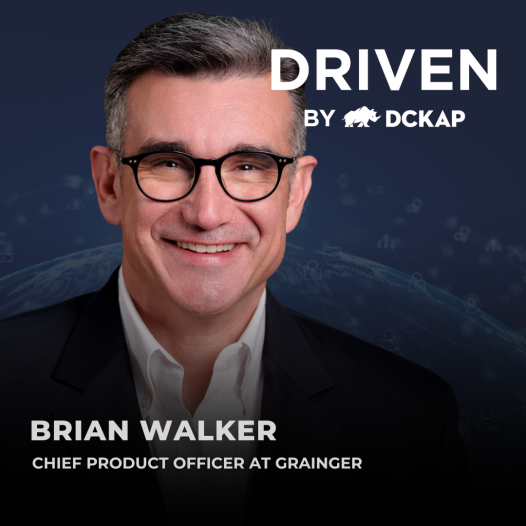
by DCKAP podcast. Today I'll be talking with someone who's changing the
landscape of distribution. Globally, a product leader, a technology leader.
Brian Walker, Chief Product Officer at Grainger. Brian, welcome to the show.
Brian Walker: Thank you for having me.
Karthik Chidambaram: So Brian, you have been in distribution for over 25
years and almost 20 years with Grainger. So how did you get to Grainger and
now, you know, how did you get to the role of the Chief Product Officer?
Brian Walker: It's not a straight path, or at least it wasn't for me. I
would say sometimes I, I get asked this question and, and I say that I
feel like I had a Forest Gumpian to my career. What I mean by that was just
that a lot of serendipity and a lot of luck was involved. But it starts
with there are very few kids that dream of being an industrial distribution,
and I wasn't one of them either.
And so as a enthusiastic but not terribly, talented baseball player. I ended
up having to find a job in the real world, and I was very lucky to land in
this industry. And so over the course of these last 25 years, I have had the
good fortune to work for two of the best industrial distribution companies
in this space.
And I've had a chance to be an operator in almost every function. The only
major functions that I haven't had a chance to operate in are HR and legal.
Those are gaps. I don't intend to close. But I've gotten a chance to sort of
see this industry not only as an operator in the different domains, but I've
gotten a chance to see it in Europe and in Asia a little bit in Central
America.
And so it's given me a well-rounded perspective. And in terms of our digital
transformation, it's allowed me to work with our operators and not only
understand the work that they're doing and empathize with the challenges
that they have to encounter but help. You know, instigate some thought and
ideas about how we might innovate or change or improve.
And so that pretty diverse background across many of the operating functions
has lent itself to the digital transformation that we have to en encounter
and and, and move forward. So been very lucky and, would would love to, to
do the journey again, although you couldn't design it.
Karthik Chidambaram: And you also worked in the UK and you also served at
other countries outside of the US while at Grainger.
Brian Walker: I have, yes. So you know, in working in Grainger's on online
model or endless assortment business line I got a chance to work in the uk
and to see, you know, how we run our businesses in Japan and across Asia
and.
It was it was very, very helpful for me to understand the global market for
industrial distribution and and see different ways in which different
cultures and, and environments and countries operate. And so in a very lucky
and very interesting chart
Karthik Chidambaram: and I think travel teaches you a lot and you learn a
lot when you travel.
So how much travel, I mean, I see you speak at a lot of conferences as well,
and I'm a fan of that. I listen to those talks online even though if I can
make it in person. But then you know, how much of a travel do you do today
and how is that helping you?
Brian Walker: I think traveling, seeing different cultures, seeing different
places it, it's like reading it, it builds knowledge.
It builds empathy. And so the more that you see of the world and the more
differences that you see the better equipped you're going to be to deliver a
generalized solution that can scale. And so yeah, I travel's a part of the
job and, and going to, going to gemba, as they say, and seeing the work
upfront helps you understand what our customer's challenges are, what our
team members' challenges are, what the market challenges are and, and build
better solutions.
Karthik Chidambaram: Brad, are you being the Chief Product Officer of
Grainger for over six years now. And as a CPO, you also work very closely
with your chief Technology Officer, Johnny Lero. It must be inspiring to
work with someone like him. What does the chief product officer do at
Grainger?
Brian Walker: Yeah. So my job is is to help shape and prioritize our
generally our custom software investments.
Also our investments in our our co systems. But the, the way Johnny and I
work is, my work is more upstream. I work with the business to sort of
reimagine our operations to reimagine the strategy and help drive
transformation. Johnny's is to help partner and make those aspirations and
dreams.
Sort of land in the, in the context of you know, developers working with our
architecture team, securing our environments and that kind of thing. So
together we work as a as the leadership team that helps drive Grainger's
technology function.
Karthik Chidambaram: And what role do you see AI playing in today's
distribution landscape, and how does this impact your product strategy?
Brian Walker: Yeah, so our, our product strategy sort of started almost
seven years ago. And we were anticipating a day where AI and ML became more
prevalent. And as we started to think about how Grainger could win we
thought a lot about creating information advantage. You know, Grainger, as a
distributor, there's not a lot of things we make.
So one of the things that we do make, that helps provide insight into the
business, insight to our operations, help us understand our customer
experience is, is data. And so we embarked on a journey starting about seven
years ago to build custom software that enabled our business in different
ways.
And within each of those custom software applications that we are building,
every one of them is underpinned by a data model. And that's a data model
that we design that fits our business context, that helps give us signal
about our customer experience and the products that we sell. And so we use
the data that we are building through custom software generally.
And so AI helps us. Scale, different solutions, different operations and
different context to sort of bring a, a better customer experience to life
by virtue of the data that we are building. And so our, our strategy is a
very integrated one. It's very related to ai. There aren't a lot of domains
or, or context in which we don't see us leveraging ai.
And and it's underpinned by a data strategy that helps us, you know, build
information asymmetry relative to our competition. If we can know more about
our products and know more about our customers than our competition we think
we'll be able to execute pretty well and, and win.
Karthik Chidambaram: Yeah. Data strategy is the key, but then there's also a
lot of hyper around ai.
But what are some of the real practical applications? Can you share some
examples on where AI has made a significant impact on your business?
Brian Walker: I mean, it, it's made a, it's made an impact on our business
for many, many years. I mean, the, the hype that I think is out there
relative to generative AI or you know, how it's changing work is certainly
present, but I'm really bullish on AI.
I don't wanna be, I don't want that to be confused. You know, if you think
about ai we, we've leveraged it in our search context. We've leveraged it in
our visual search, and we're exploring multimodal solutions. I would also
say. At the heart of our business we are an operations business. We, we
believe a lot in standard work, a lot in continuous improvement.
And the more that you understand your processes and the more that you
understand sort of how processes work across our business sort of end to
end, the more you can automate, the more you can augment the experts that we
work with and help drive productivity. And so I don't really see a.
Business operation at Grainger, that's not gonna be leveraging AI in a very
significant way. And so if we, if we've got the right data, if we've got the
right standard work, then we can drive greater automation and drive more
augmentation of our team members skills and get more out of, out of our
human assets.
And so we're, we're very excited about the potential that AI has for the
company.
Karthik Chidambaram: You talked about custom development and every product
leader faces decisions about technology constantly, and I think how someone
approaches that reveals a lot about their strategic thinking. So how do you
approach the build versus buy decision when it comes to technology or even
AI for that matter?
Brian Walker: I appreciate that. So in the, in the build versus buy
decision, there are a lot of religious beliefs out there. Some people
believe you have to create competitive advantage when you're building custom
software. One of the hazards of that argument is that sometimes when you
build, you don't know beforehand if you're actually going to compare create
competitive advantage.
So it's really hard to know when you start out whether or not you should
build or buy. You know, some people believe that. You, anything that is core
to your business that you have to be really good at, you should build. I
understand that orientation. For us, we sort of start with is there
something in the market that very closely emulates what we think we need to
enable our business?
And then it's operations. And if there isn't then we'll consider building it
if there's enough inherent leverage. And so we've been building systems that
help us manage our customer information building systems that enable us to
manage our product information systems that enable us to build how we
execute our orders more scalably our KeepStock platform.
And, you know, even using sort of generative AI in our chat space. And then
moving to other parts of our business. So we are aggressive in building
custom software. Our general aim is always to create information asymmetry,
a better customer experience, a better team member experience, and have it
fit within our.
Our, a greater technology ecosystem with all of our other applications.
Karthik Chidambaram: And you leveraged the technology you built for
Graingers business, but have you also thought about monetizing the
technology, selling it to other customers?
Brian Walker: Yeah, it, it, you know, it, it, it comes up a lot. It turns
out there aren't a lot of businesses out there that build and design
software that is specifically for industrial distribution.
And, and we do that. And so yes, I think there would be some commercial
value for the tools that we're developing. But in the same breath, those are
the things that help us compete. And so we're we're not there yet. I don't
know that we'll ever actually get there. I don't think that that's in the
set.
But we'll continue to build out the advantage and and, and develop our
custom software in, in Granters ecosystem.
Karthik Chidambaram: I think it's good for technology businesses like us out
there. So you're focused on your course so we can focus on building
technology. Innovation, sometimes I feel is an overused word.
Everybody uses it at different context. So how do you foster a culture of
innovation at Grainger?
Brian Walker: I appreciate that. The, the, you know, one of the things,
having been at Grainger right now, almost 20 years, I. What I can tell you
is that this company always aims to get better every year. And I didn't
start that, that starts a long time ago.
And it's something that I generally appreciate in our in our culture and our
DNA. I would also say that as we've gotten more and more leverage out of
custom software, it lends itself to a natural innovation cycle. And so we're
constantly looking at our processes and how to improve them.
We're constantly looking at our organizational structures and how to make
them more efficient to drive better outcomes, and as we go through that.
Path of making our business and our processes better. We can adapt the
technology to help it scale. And so it's thinking about the, what, what's
possible I think is naturally inspiring.
And and our journey in developed custom software has, has helped us drive
more innovation in recent years than probably we, we have historically. And
that was the part that was too far.
Karthik Chidambaram: I like that. I mean, you keep the team challenged.
Brian Walker: You know, I, I've been with Granger almost 20 years now.
And in that 20 years, what I can tell you is definitively part of the DNA
and culture at this company is that we get better every year. We will
iterate, we'll not, you know, sort of just stay put, but we will be critical
of our processes, we'll be critical of the outcomes that we're driving, and
we'll use that to improve the company.
As we've embarked on this custom software journey, that has fueled even more
innovation because you can start to reimagine your business processes. You
can start to reimagine your organizational structures to drive, you know,
better outcomes, more efficient outcomes. And as you think about the systems
that underpin and help at scale, we can then adapt our software to help our
customers and our team members in really creative ways.
Custom software, I think is a fuel for innovation generally. And it is just
in the company's DNA and so it's it's, it's a fun time to be
Karthik Chidambaram: totally. And you keep the team challenged that way.
Hey, build things change the way distributors do business but then talking
about digital and technology adoption, sometimes that could be a challenge
too.
How are you and your team at Granger addressing this?
Brian Walker: There's a, there's a few different types, I would say. So for,
you know, our customers aren't always on the cutting or bleeding edge of
technology. And so what is that? If you're. Somebody that's fixing things.
And you are, you know, something breaks generally speaking, that same
individual who knows how to you know, repair and, and keep plants up and
running and people safe they aren't the person that is the earliest adopter
of technology, they're not pulling out, you know, they're not using,
glasses, glasses with a lens in them to fix the mat materials quite yet. And
so we have to be judicious about what we bring to market and how it's
adopted. And we do use a lot of listening labs and a lot of you know,
customer experiences where we, where we go to markets to try to understand
what would be useful and what they would adopt.
The, the other context, which is frankly more prevalent is the change
management that we drive within Grainger. And so when we start to think
about. How an operation might change, how our KeepStock offer might change.
We can start to reimagine the way that we execute the work. And if you
reimagine the way you start to execute the work, you get into what are
people's roles?
What are people's responsibilities, what are their titles, what are their
the jobs to be done? And that can get interesting as well. You know, we
we're a very collaborative group and so we work closely with our operations
to try to figure out what the two B states might look like. And driving
innovation and change management in our operations is probably as energizing
as, as any context within our tech landscaping ranger.
Karthik Chidambaram: And how do you make sure your customers also adopt to
this change?
Brian Walker: You know, it's slow releases. I already, lemme say that
differently. Lots of releases. So making small changes constantly I think is
the key to making sure that you don't leave customers behind within the
experiences that you're driving.
And so we, we do that we, we make sure that we release often you know, many,
many, many, many times per day per team. And and if we can drive small
change, then the, the adoption curve doesn't doesn't get outta whack.
Karthik Chidambaram: Yeah. Drive small change and then. It compounds and
adds to a much bigger impact, said Brian.
So one thing that fascinates me about Ranger is the sheer complexity of your
product catalog. You're managing over a million SKUs, maybe about 1.4
million. So how do you approach product data management at scale and what
are some of the biggest challenge?
Brian Walker: Yeah. So that's a, that's, those are systems that we built
custom software to support and what we're.
Really aiming to do is to understand our products better than our
competition. And so that means. That means studying the products and the
usage that those products have in the market. That means collecting
information about application and about functionality. It means organizing
that data in highly structured, highly rigid ways at times so that when we.
Publish that information it becomes useful to customers. And so we, we think
a lot about how we describe collections of products and what makes them
unique and useful to customers. And we collect information that helps us
manage that ecosystem and, and make sure that products actually are unique.
And if they're you know, if we understand the data and the schema that we
have to describe a product, we can look at. Adjacent products to understand
what would make one different. Is it just a size, is it a performance
characteristic? Is it an application characteristic? And knowing that
through the data allows us to build an assortment, more scalably and help
also structure information that allows customers to search for the product
online.
Karthik Chidambaram: And what are the, the biggest technology gaps of missed
opportunities you see in distribution today? And where do you think the
industries heading?
Brian Walker: I think the industry's headed in general. You know, it, it's
hard to say that the industry is not gonna, you know, more and more is not
gonna be self-service and digital interfaces.
And so, you know, whether we're talking about procurement or even coming
soon at Gentech procurement, you know, I, I think Grainger's future is more
and more digital. I think that we're gonna have to leverage our data
advantage and continue to build upon it so that we can stay ahead of our
competition and help save our customers time and money.
And so doing that is just going to mean that however you interact with
Grainger. Albeit the web or ePRO systems or our KeepStock services or
through a sales person, that those experiences just are gonna be
increasingly digital. And we need to make sure that we're building
interfaces that enable our customers and team members to self-serve and be
as successful as they can.
Karthik Chidambaram: Yeah, self-service and a lot of customers are already
adopting the self-service mode at Granger.
Brian Walker: Are our customers. Are you, you asking? Yeah. Well, you know,
we would say, you know, at, at this point, you know, our CEO recently was
talking about, you know, the turn of the 21st century. At the time we had,
you know, about half the business was coming outta the branches.
Half the business was coming out of you know, our, our shipping
capabilities. Now that's flipped. You know, less than 10% of our business is
in the branches at this point. And so our, our business is in, is, is
digital almost by definition. And so it's, it is about enabling our sellers,
enabling our services, enabling our website, and where customers can
self-service.
Enabling that experience to be as frictionless as possible so that they can
get their job done and get back to the work that is gonna make their
business successful.
Karthik Chidambaram: On this show, one thing we like to ask leaders about is
failure. Four. One said, the only real mistake is the one from which we
learn nothing, and I think that's true.
Can you share a mistake or a failed experiment you have experienced and what
you have learned?
Brian Walker: That's a great question. Well, I mean, I, I think if you
change your mindset towards the learning lens, I, I think that is the right
approach. And so I, I would say that we, you know we're learning every day,
you know, whether, whether it's pushing new software and understanding the,
how customers are adapting to those new features that we're adding.
It is constantly a learning organization. If I had to sort of sit back and
think about a major failure that is, is useful or an instructive, you know,
when you, when you think about failure, I think about that as, as you do
which is every opportunity is an opportunity to learn. You are question
earlier about, you know, market adoption.
I would say, you know, we, we, we got out in front of our. Of our customers
a little bit. We created a search capability that we're still using. Still
very proud of, it's still very practical but leveraging visual search and
taking pictures of products to find a a Grainger item is something that we
invested in, got got pretty good at but there wasn't a lot of market
adoption for it.
So it was one of those things that we understood the potential of not having
to use keywords to find products or maybe using more of a mobile device and
making the friction even less for our customers. But it turns out they
weren't ready they weren't using it in a significant way in in early days.
We're still using that and it's still growing in its adoption, but I would
say we probably invested a little early on our computer vision. For visual
search, you know, but, but the more important element that I think you're,
or you are scratching at is building a learning organization that
understands failure as an opportunity to learn.
That is part of the culture in, in Granger and specifically with our
technology organization. So as we release, we have hypothesis. We test those
hypothesis. Based on the results of them, we move forward or redesign. And I
think that's just good hygiene for any business that's in the, the custom
software game.
Karthik Chidambaram: So Brian you serve on the board of Illinois Institute
of Technology in Chicago. I'm super thrilled because we went to Illinois
Tech in Chicago as well. So it's so exciting that you serve on the
university's board. So thank you for your great work there. Tell us about
the work you do at Illinois Institute of Technology.
Brian Walker: Grainger's been involved with Illinois Tech for many years
now. It's a, it's an incredibly worthy institution. They are one of the
unsung heroes of of the academic landscape. A few years ago, they did get
recognized by Wall Street Journal as one of the best institutions in the in
the country.
And, you know, we have them to thank for, you know, cell phones or home
routers and all sorts of things that, that people don't. Normally you know,
quit with them. I serve particularly on our board, the school of Design. So
ID as it's called which is one of the best design schools in the country.
And I'm also a trustee, and so I get to help the school with its mission to
you know, bring technical education to the masses. In ways that are budget
friendly and the, the history of the school is amazing. My counterpoint that
you counterpoint that you mentioned earlier, the, the counterpart I should
say that you mentioned earlier, Johnny Leroy serves on their College of
Computing and we get a lot of great talent from Illinois Tech.
Lucky to be part of that organization and I'm very bullish on their future
as.
Karthik Chidambaram: Yeah, I'm very bullish as well. I mean, I would say
that's like one of best parts of my life. You know, I really enjoyed, I
mean, I really enjoyed my time in Chicago, enjoyed my time at school. It
made me very competitive.
So yeah, I'm very thankful.
Brian Walker: Great, great institution.
Karthik Chidambaram: So, Brian, what is a book you would recommend that
every distribution leader should read?
Brian Walker: Well, when you think about distribution generally for me there
are a few different genres or categories of books that are, that are really
important. You know, books, old books like you know, the Mythical Man Month
is great for software development.
A lot of those principles still apply. The goal in understanding Theory of
Constraints is a book that is timeless. Anything where that Deming wrote is
generally useful. In a, in our modern day and, and contemporary day. There,
there are a couple books that I would recommend too. One was the book the
Age of ai.
It was a book that was authored by Henry Kissinger, where he talked about
the world and how it was ill-prepared for the challenges that we are going
to encounter leveraging ai in, in our. Society generally and I think that is
a, a pretty insightful book relative to distribution. I would say The book I
have enjoyed most this year is a book called Competing in the Age of AI, and
it talks about a digital ecosystem that's predicated on leveraging data and
information to drive outcomes.
And so very much reflects the strategy that we are pursuing at Granger. And
and I think that will be the sort of a, a general book that people will be
well served to read across the industry. So, competing in the age of ai.
Karthik Chidambaram: Thank you for these great recommendations. Brian, so
Brian, I really enjoyed this conversation.
Thank you so much for joining us today on The Driven by DCKAP podcast. Thank
you so much for your time and thank you.
Brian Walker: Thank you for your time.
Sign up to receive email updates
Enter your name and email address below and I'll send you periodic updates about the podcast.