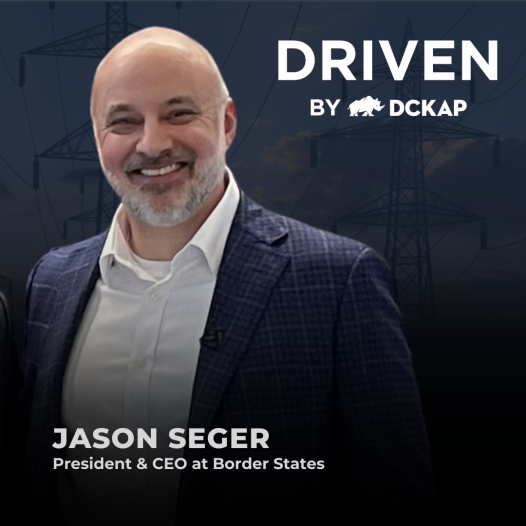
In this episode, Karthik sits down with Jason in Fargo, North Dakota to unpack the servant leadership philosophy behind one of the most unique companies in electrical distribution. From his early days as an intern in 1999 to leading 3,700 employee owners today, Jason shares the defining moments, the relationships, and the culture that have shaped Border States into what it is — and what’s driving their ambition to grow from $5 billion to $10 billion.
Jason gets candid about the moment early in his career that reframed everything — a late evening conversation with a mentor that made him realize a job could mean something far bigger than the work itself. He breaks down the servant leadership model that drives Border States’ 95th percentile employee engagement, why vendor relationships deserve the same investment as customer ones, and how ambitious goal-setting shifts the thinking of an entire organization almost overnight. He also speaks honestly about work-life integration, bringing his family into the fabric of what he does, and why focusing on people first — whether employee owners, customers, or partners — is what ultimately drives the numbers.
OR LISTEN ON:
Karthik Chidambaram: Jason Seger. Jason, I'm very excited to be here in
Fargo. Thank you for having me here. I feel like I know you well, and also
have been following Border States, your work. And also watched some of your
other podcasts. So I'm really excited for this conversation.
And thanks for doing this, and wonderful to be here in Fargo.
Jason Seger: Yeah thanks for making the trip to be here to Fargo at our
branch support center, our studio here. Appreciate having you here. Looking
forward to the conversation as well, Karthik.
Karthik Chidambaram: Jason, Border States started in 1952. And by two
people. And you guys are employee-owned.
So for the audience who are not very familiar with Border States, maybe you
can tell us about Border States.
Jason Seger: Yeah. The long and short. We started in 1952 in Grand Forks,
North Dakota actually electrifying rural Dakotas, which is pretty cool back
then, and have grown today to be a $5 billion distributor primarily in the
electrical space.
Also serve natural gas, PVF, some other niche markets as well. We talk about
three core markets that we serve across the business, which is construction,
industrial, and utility. Those three core markets are... That diversity is a
big part, we believe, of our success. That diversity creates really strong
financial stability.
As you can imagine, when one market might cycle a certain way, another is
cycling in a different, at a different time. Creates, creates really nice
financial stability across the business. We get to share best practices
across the business. We're in 32 states today over 130 locations, and as you
mentioned, employee ownership is a huge part of who we are.
We have 3,700 employee owners today who really fuel the business and drive
our success. We became employee-owned in 1984, 100% employee-owned in 2000,
and it's been, again, just a huge part of accelerating, I think, growth and
success for our business. It's really become the fabric and the DNA I think,
that drives our success today.
Karthik Chidambaram: And you started in 1999 as an intern at Border States.
I did. And today you're the CEO. That's quite a bit of transition. And I was
reading about this a little bit. You've done pretty much all the roles or
most of the roles at Border States. Yeah. And you know how it works. So tell
us about the early days, as you started, right?
As an intern. Yeah. Because, as we were chatting, I saw a couple of interns
talking to you.
Jason Seger: Yes.
Karthik Chidambaram: And you spent time with them. Hey, they got themselves
introduced. I like- Yeah ... what they did because they were not scared or
anything. "Hey, it's Jason, the CEO." They just popped in, said hello to
you, and you spent some time with them.
I found that very interesting, so I wanted to know what happened in 1999.
Jason Seger: It's, and that piece, the interaction you just saw a few
minutes ago it's a big part of our culture and who we are. We try to be
relatable, genuine, accessible. As leaders, we try to lead with a very
servant leadership mindset.
I think it translates to the culture, the engagement, how employee owners-
Interns even see their ability to see the CEO and walk in and say, "Hey, I
just wanted to say hello and see what was going on." So it's a big part of
who we are, and I'm glad you got to see the interaction because that's just
another day in the life of how we operate and who we are as a business.
Back to when I started, we were, gosh a couple hundred million dollar
business back in 1999. I started as an intern and honestly, I had no idea
who Border States was when I came here. I was going to college in Moorhead
across the river from Fargo, North Dakota, and I needed a work study
internship program to graduate.
I went to a professor I trusted tremendously and said, "Hey, Wade, where do
I go?" And he just said, "Go to Border States." He said, "They got this
employee ownership thing going on. It's pretty cool. Good people, good
business." He said, "Just trust me." And I did. I trusted Wade, and so this
is the one place that I went, to Border States.
And, thankfully they brought me on board for an internship, and it was just
an amazing way to begin to learn the business. Now different back then I
knew most of the people that worked in the business back then because there
were several hundred of us, not 3,700. And so I did get an opportunity to
see, the ground floor of the business, at that time anyways, and very close
connection to people who had been shaping the values and the culture and the
direction of the business for decades.
I have the pleasure, to humbly serve as our sixth CEO. At the time our third
CEO was still serving, and so I got to, again, learn and listen to and see
the example of someone who was only our third CEO at the time. So I just...
I really was blessed with an opportunity to see strong leaders and the
business kinda grow up.
It's been a lot of change along the way. Certainly some moments that were
probably catalysts and accelerators. But I really appreciate the opportunity
I had to learn the business in a very intimate way very early on.
Karthik Chidambaram: Very inspiring. But then, more than 25 years in the
same company, but you're the sixth CEO now, and so it's great.
But looking back sometimes it doesn't always go by plan.
Jason Seger: Yeah.
Karthik Chidambaram: Because there could be moments, hey, you know what,
should I really leave this company and find something else? Were there
moments like this in your career where, hey, you didn't feel that great, but
then what made you stick on?
Jason Seger: Yeah. I think if we're honest, we always, we all have moments
where we maybe question ourselves or what's going on around us. For me,
every role that I've probably worked my way into and hopefully earned an
opportunity at had moments probably where there was some doubt along the
way.
Can I do this? Am I the right person for it? There was a defining moment for
me. It was pretty early in my full-time employee ownership at Border States,
my first several years. Where I was really trying to figure out if I was in
the right place, and it was probably 6:00, 7:00 PM in the evening. I was
still there doing some work, and there was one of our executives there.
His name is Lex, and Lex was still plugging away doing work. And I've been
watching him for, for a couple years now doing his work, and he's so
passionate. And I just said, "Lex like, why do you do what you do? Like, why
do you give what you give? Because I'm watching you work, and I don't
understand it.
I don't understand why you would sacrifice and give so much." I didn't
understand it at the time. And his answer was pretty simple. He said "I have
responsibility for, the financial, the well-being, the welfare of all these
employee ow- employee owners and their families, and the impact that they
have in their communities that makes a difference, and they depend on me to
make good decisions and work hard for their families."
That was his answer. I had never thought about that at that age. It didn't
occur to me that was, a bigger thing we had in front of us in terms of
purpose and meaning and impact. But that was the moment for me where I began
to understand there was something bigger at work with the ESOP. I probably
didn't get it before that.
That was the moment where I went, "Okay, there's something special at work
here, and I can contribute to it, at least in a small way." So that was the
moment for me.
Karthik Chidambaram: When was this? 10 years into the job, or when was this?
Jason Seger: Oh, no, that was several years into the job. Okay. So it was
probably two to three years in- for me of kind of full-time employment as an
employee owner. But just a really ... I can recall it vividly today. I can
recall- ... the cubicle- ... where Lex was sitting, how he turned around in
his chair, where I was standing. It was a really critical moment for me to
understand How to think about a job bigger than the work you're doing every
single day.
Karthik Chidambaram: You talked about servant leadership. Yeah. I was
recently listening to Nick Saban the coach.
Jason Seger: Yeah.
Karthik Chidambaram: And he talked about transformational leadership and
transactional leadership. And in a transactional leadership, you're very
focused on outcomes. Hey, what is the number? Did you do that? Did you do
this?
Yeah. But transformational leadership is more like a process, right? So
where, hey, you focus on the process, you focus on doing the right things,
outcomes take care of itself. And what is your leadership style, and what
does servant leadership really mean?
Jason Seger: Yeah. I'm not a Alabama fan- ... but I am a Nick Saban fan.
I like Nick Saban. He's got, he got some things figured out, I think. I love
where he went with that because we have to watch outcomes. We have to
understand that we're generating strong financial outcomes. But there are
different ways to get there. One of the ways is transactional.
We state the outcome, and we drive to the numbers. We think about it a
little more simply, and we probably oversimplify it here. And how we think
about it is, if we take time to care for the employee owners, for the
customers, for our vendors, for the partners that we interact with, if we
genuinely care, then the rest is gonna take care of itself.
And when you care for someone, that's the moment where they begin, many
times, to understand their commitment to what they're trying to get
accomplished or to the effort, to the organization. When they know they're
valued, they know they're cared for. And so we don't, we're not perfect at
it, but that certainly is the effort that we put in is care for people
first.
And if we can do that, they give an awful lot, and things tend to take care
of them- So we tend to get to the outcomes we're trying to create when we
care for people first. So for me my style is definitely, I would align it to
servant leadership style which is really focus on others first. How can I,
in my role, serve the employee owners to make them more effective?
How do I serve the customers? How do I serve our partners? When we do that,
again, we tend to create the right outcomes along the way. And it's a big
part of how we think about, again, the company, the culture, the interaction
you saw earlier today. That stems from that kind of an attitude and that
kind of an approach.
People begin to get comfortable with that kind of interaction because they
know how you're thinking about things. They know the care that you have for
employee owners, so they're not shy- ... to come up and say, "Hey, I, can I
sneak in? And what's going on?" Yeah. Who's this guy that's with you?" "Oh,
this is Karthik.
We're doing a little podcast thing." Yes. And then that, that manifests
itself in strong engagement. And we've got 95th percentile strong
engagement. It's really great, but it's because you start with serving
people.
Karthik Chidambaram: And you talk about relationships, right? So
relationships with customers, your employee owners, and vendors.
How do you approach that? Because, I understand, right? So the customers,
yeah, we get it. Employee owners or employees, we get it. But I have this
question on vendors, because sometimes, I also see, because, we travel a
lot, we meet with customers.
Sometimes they really do not pay too much attention to the vendors, but I
think, that's a huge mistake, right? Because the vendor is more like an
employee, right? Because they need to really work in tandem. So how do you
approach that and-
Jason Seger: Yeah ...
Karthik Chidambaram: yeah.
Jason Seger: I'll tell you, with our most strategic partners on the vendor
side it's a simple message that we have for them when we meet with them, and
it's we cannot do what we intend to do without them.
We simply can't. We have to have strong partners who have alignment of where
we're trying to go, how we're trying to get there. When you can find that
alignment of, where you're going, hopefully some purpose with it, you can
drive really great success, but they first have to understand- ... how much
you value them.
And so we do try to look different with our vendors. Do we drive
accountability? Do we push? Do we challenge? Absolutely. And we ask the same
of them to us You know, challenge us, push us. We're not perfect in what we
do. So where are the opportunities that you see in our business to better
connect, to drive better results?
We try to make it a very collaborative partnership, and we try to make sure
they simply know we can't do what we need to do without them. We can't be on
the journey without their support. And when they know that and when they
feel that, we think it's impactful. We do, big sales kickoff events.
We bring the vendors in and make them a very intimate part of that journey
with our team because we want them, frankly, to hear what our team hears.
We're talking about what we're trying to do, what we're trying to
accomplish, the purpose, the vision, where we're going. When the vendors
know that, and again, they feel like they're a part of that journey and that
process, that creates some real value.
Karthik Chidambaram: As a CEO, you have multiple things to take care of.
Jason Seger: Yeah.
Karthik Chidambaram: And how do you allocate your time? So what does a
typical day look like? I know every day is different. Today's different.
We're spending time like this. But how do you allocate your time across
different things?
How do you decide, "Hey, I need to spend this much time here, this much time
there"? Is there a method you follow which - Yeah ... other people can copy?
Jason Seger: Yeah. Every day is different. I think every person and company
is different as well. I think if I lean back on one principle, make sure I'm
doing the things that only I can do, and I'm not perfect at this.
Someone's gonna watch this who works with me- ... and they're gonna go, "Oh,
it's a good philosophy." Do you always hit that mark? I don't always hit the
mark. But philosophically, the idea is do the things that only I can do. The
things that the team can do, that others can do, coach them, make sure
you've got strong li- but let them do that work.
And we can do that, and I'm focused on things that only I can do, then we're
in the right place. The big strategy things that are going on it could be
work we're doing, in mergers and acquisitions. It could be what are the
constraints in us trying to double our business in the next five years?
Which is an ambition for us, from 5 to 10 billion. So what are those
constraints? Put my time there where it's the things that only I can do. I
think about, places that are going to need focus. Certainly technology is
gonna have to continue to be, agile and a big part of how we enable success
going forward.
So spending some time in that space where I can be impactful in ways that
maybe only my role can. And then with talent. There's... Everyone knows the
talent shortage that's out there. If we're gonna grow the way we intend to
grow, we've gotta have really talented people that fuel that. In fact, if we
don't have that, we simply can't achieve those results.
And so how do we make sure the machine we have running is doing a great job
in attracting the right people, retaining the right people, developing that
talent? And we think we've got the most talented team in the industry, and
we're pretty proud of that and we're focused on driving that forward as
well.
Karthik Chidambaram: 5 to 10 billion, right? So that's a big goal. Yeah. But
then strategy plays a very key role, like you said. Yeah. How do you come up
with that strategy?
Jason Seger: I'll tell you what, it's, We've got a really long history,
number one, of building strategic plans. I still recall the first time we
stated a numeric goal that felt like a really big stretch, and that was a
billion dollars.
I still recall the discussion in the room where we were talking about, do we
go from, 700 million to 750 or, 800, or what does that look like? And
someone said, "Why are we talking about that? Why don't we talk about a
billion dollars?" And so we've had a long history, one, really good
structure around building strategic plans.
One of the key elements has been being ambitious. 'Cause I'll tell you what,
when you go from incremental kind of thinking around how you wanna grow the
business and what the future looks like, and you move to a more
transformational, ambitious goal, the thinking around you begins to
instantly shift. When we even shifted from a billion to two billion, to
targets around five billion, even you can look the next week and people are
showing up with ideas that are different than they had the week before
because they have to stretch how they're thinking about the future of the
business.
And so ambitious goals has been really important. But then you've got to
build, obviously, a plan you can execute behind it. We've invested in
strategy enablement, teams that can help guide us into how do you build, a
structured way to go execute. And frankly, if you look in our industry,
there's probably not a ton of secret sauce for what you need to go do and
maybe even how to do it, but the ability to execute matters tremendously,
and that's where we've found a lot of value is the ability to execute within
those plans.
Employee ownership has a lot to do with that. We've got employee owners who
are really vested in the success. They know their role. And I would tell
you, we have 3,700 employee owners, like we mentioned. If me and the
executive team are simply pushing a strategic plan into the organization,
we're gonna get a certain amount of success.
If 3,700 employee owners, if they understand where we're trying to go and
why it's important to get there, they're gonna pull us in ways we don't even
understand today, to places we can't even comprehend today. So when they all
know, they begin to pull us along that journey, which is a pretty powerful
message.
Karthik Chidambaram: Tell us about employee ownership. You talk about being
100% employee-owned. Yeah. We are aware of ESOPs. What's the difference
between an ESOP and being 100% employee-owned?
Jason Seger: Yeah I'll tell you what it means here. And so 100% employee
ownership for us means that the only people who have a stake in the
ownership of Border States are active employee owners.
So when someone retires from the business- They get rewarded with the years
of hard work with a distribution out of that ESOP. So the only people that
have an ownership stake are the current active employ- which is pretty, it's
pretty empowering, and it's pretty motivating. So that's employee ownership
for us.
And when I think about, if you wanna really oversimplify this, if you own a
car or you rent a car, which one do you treat, better? You treat the one you
own- ... differently for most of us- Sure ... than we probably treat the
rental car. And I'll tell you what, I think we have 3,700 employee owners.
I think they're living a piece of the American Dream by being an employee
owner. They are working for the company that they have an ownership stake
in, which is pretty powerful. So they share in the responsibility, they
share in the rewards. So they know when they put in the hard work, they're
gonna get the reward, and we've got a lot of transparency.
I was telling you earlier, we share a lot of information internally 'cause
we want them to know. We want them to know the progress we're making, the
impact their work is having. We're getting to be a big organization, a $5
billion business, but the reality is we are made up of 3,700 individual
components and people who are doing the right work every single day, working
hard to create those results.
When those individuals understand that responsibility and what the reward is
on the other side, they tend to give an awful lot of effort along the way.
So if I make one more statement on that, Karthik, I think they're living a
piece of the American Dream. And if I fast-forward that, as we become a $10
billion business or more in the future, we are creating opportunities for
future generations to live the American Dream, which is a pretty impactful
and meaningful piece of work that we're doing.
Karthik Chidambaram: No, that's huge. But what I find very fascinating is,
let's say you retire from the business.
Jason Seger: Yeah.
Karthik Chidambaram: Then you're no longer an employee owner
Jason Seger: Yeah. It is, right? And but again, that means the people that
are there, they carry the responsibility. Now what's pretty neat is past
CEOs, for example, who aren't employee owners anymore, we still stay very
connected.
They're still part of the legacy of who we are. They built. Frankly, we
stand on the shoulders of people who for many decades built this business.
And who we were can't dictate what we're going to be in the future, but
there absolutely is elements of value and culture that we have to bring with
us.
And they help us do that.
Karthik Chidambaram: Yeah, I was talking to Tammy Miller. She advocates a
lot for employee ownership-
Jason Seger: Yeah ...
Karthik Chidambaram: for a lot of companies, but I can really see that in
action here, so at Board of States, yeah.
Jason Seger: Yeah. Tammy was a great mentor for me personally. I've had the
blessing of some really amazing leaders to learn from, and she was
definitely one of them along the way, who was our fourth CEO and just did an
amazing job helping guide the organization as well,
Karthik Chidambaram: so Jason the theme of this podcast is driven. Yeah. So
what drives you?
Jason Seger: It's probably not very complicated. At the core of it, my
family my faith that's who I am when I'm ... even when I'm here, that's who
I am. That's, I bring my whole self all the time to work, and that's who I
am, is my family and my faith.
But bigger than that, it's what we just talked about. It's a belief and the
knowledge that we do have a responsibility to make sure 3,700 people, our
employee owners, that we make a positive impact on their ability to live the
life they wanna live. And for many of them, they end up creating wealth,
through the ESOP they never imagined they could do, growing up, which is a
pretty amazing story.
And what's super impactful, you think about an individual employee owner
and, going home to whatever their family, circle looks like- That wealth
tends to impact families. And when families are positively impacted,
communities are positively impacted. And it's a really amazing ripple
effect.
And so as we think about growing this business, that's what is driving me,
is what a huge opportunity to make an impact. And I think, there's a lot of
things going on in the world, and to have a place like Border States who is
really working hard to do the right things the right way, to care for people
the right way.
Again, we're not perfect. We stub our toe, but we try to acknowledge when we
do, to fail, to learn fast. But certainly trying to point the right
direction, do the right things, and care for people along the way, and the
ability to create that opportunity for hopefully thousands of more people in
the future, that's that's motivating.
Karthik Chidambaram: You talked about family. Yeah. I was watching your
podcast with Eric Hoplin naw. It was a really good podcast and I think, when
Eric asked about family work or work-life balance and all that, right? So I
think you put it straight. Which I really love. Hey, for me, family comes
first- Yes ... and I tell it, right?
Yes. So I thought that was really cool, so that's the priority number one,
and work comes next and, it's more integrated. Can you talk a little bit
about that and how is... obviously, you do well at family, then, you know-
Yeah ... you do well at work. Because I think, that message needs to go out
more.
Jason Seger: It's funny. One of my kids had a friend over actually last
weekend, and they pulled me out on the patio and they said, "Dad, we got a
question. How do you think about work-life balance?" They were talking about
it. They're trying to figure out their professional career. How do you think
about it?"
And I said I really, work-life balance really probably isn't a thing.
They're just, they're the same." And they be- when you integrate the two,
they become, I think, more effective When you say that, what I've always
said, and I try to live by this for myself and hopefully support others in
this journey as well, if the family life ever gets broken, I'm not gonna be
worth a whole lot for my work family.
And so really wanna make sure that we focus there first, and work will
always be there. We sacrifice a lot for the work that we do here for the
employee owners, but we gotta take care of the family first along the way.
But integrating those two things together is really critical. If you... If
my family was here, they could probably tell you an awful lot about Border
States.
And you would feel them bleeding a little bit of red and blue probably- ...
because it's what they know. In fact, we had our leadership conference a few
months ago, and we had several hundred people together, and I had the
privilege of kicking off that conference, the keynote on stage, and my wife
was able to join right in the front row.
One of my sons, one of my daughters joined for them to be a part of it
'cause they hear about it, they see about it they get to hear me talk about
it. And to be there and be a part of it was really a special opportunity
because we try to make it kinda one and the same,
Karthik Chidambaram: there are a lot of things to learn here, right?
I love it, especially when kids get exposed to the work you do and your
family being a part of your work. I think it's amazing, and it also makes
you work better at home, right?
Jason Seger: Yeah.
Karthik Chidambaram: So yeah, it's amazing. So-
Jason Seger: W- when my daughter, by the way, when she left that, the
conference that day, she texted me from ti- from school and she said, "Dad,"
"that was really cool."
My daugh- my daughter never says- ... that I'm cool or I have cool stuff
going on. Yeah. She's "That was really cool. Said, "I've never shaken so
many hands as I did in the hour that I was there." "It was awesome." And
then her and I had lunch a couple weeks afterwards, and she was asking about
the people she had met and how they got to where they were at in their
career.
So it got her thinking about, "What are all these opportunities that I have,
in front of me?" Which she didn't have exposure to before. So the more we
integrate those things and they become one, I think just the more impactful
we are.
Karthik Chidambaram: Jason, I would like to end with this question. How do
you keep yourself updated, or what book are you reading right now?
Jason Seger: I try to learn from people. I try to listen and learn and ask
questions and... But for books, there's probably... There's two I'm reading
right now. One of 'em I've gone back to, I'm rereading, and that is Who Not
How. Don't know if you've read that book or not. No. It's a good one. And
Dan Sullivan is the author.
It's a really simple premise, and it's instead of asking the question, "How
do I do this?" ask yourself, "Who should be doing this?" And the whole
notion is as you're growing a business and you're trying to figure things
out, we sometimes just naturally as human beings will spend- Hours, days,
weeks banging our head against the wall trying to figure out how to do
something.
The right answer in many cases is who understands how to do this the right
way? And if we can find that person, engage them, learn from them, that's
the fastest way and probably a much more effective way to the result you're
trying to produce. So who not how is that one. The other book I'm reading is
called Create Amazing.
Actually, it's on employee-owned company. So it was written by Greg Graves,
who was a past CEO of Burns & McDonnell out of Kansas City area, and
it's just a really interesting read about the impact of employee ownership,
the journey, the impact on culture. And when I read it, there's just so many
similarities for us and the journey that we're on.
Really impactful one. If someone wants to learn more about employee
ownership, that's a great book to pick up as well.
Karthik Chidambaram: Thank you so much, Jason. People make all the
difference. I really enjoyed this conversation. Thank you for joining me on
the Driven by DCKAP podcast.
Jason Seger: Thank you. I appreciate it.
Sign up to receive email updates
Enter your name and email address below and I'll send you periodic updates about the podcast.