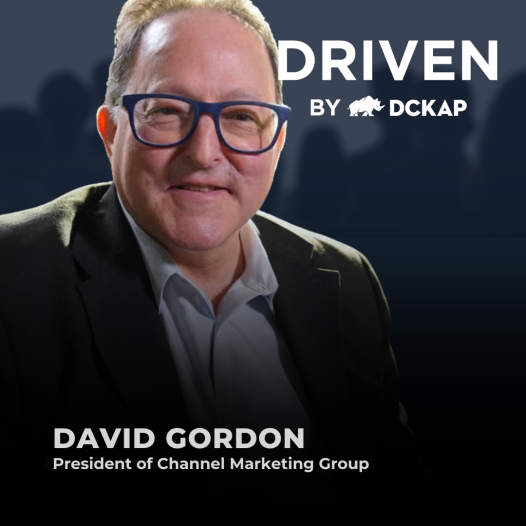
David shares why people will always be the number one differentiator in distribution, why it’s important to focus on customer relations above all, why e-commerce is a facilitator and not a driver, and where AI’s real low-hanging fruit actually is.
OR LISTEN ON:
Karthik Chidambaram: David Garden, Channel Market Group. David, great to see
you.
Dave Gordon: Great to see you, Karthik. It's been a while.
Karthik Chidambaram: Yeah, it's been a while. I can't believe this is the
first time we are meeting.
Dave Gordon: Yeah, I think we talked, I think we did a web call earlier this
fall.
Karthik Chidambaram: Yeah, and also on camera David, I want to thank you.
I want to thank you for introducing Sonia Coleman to us. So it's been great
working with Sonia, so thank you for that-
Dave Gordon: Oh, you're welcome. Yeah. I've worked with Sonia for many a
year.
Karthik Chidambaram: David, any time we have questions on the industry,
"Hey, what's happening on the electrical distribution industry?"
Or, "What's happening on distribution?" We talk to you. So tell us what's
happening in the industry.
Dave Gordon: The industry's having, continued to having good growth. It's
ended up last year low single digit, low to mid single digits. Those in the
data center have had double digit growth. Looking forward this year, pretty
much gonna be around mid mid single digits for most.
Here again, people in the data center, high single digit to double digit is
what they're looking for. More growth ma- south of the Mason-Dixon Line.
Industrial's gonna be strong. Contract is a little bit all over the board.
So we're looking for a good year. Awesome. The consolidations continue.
Karthik Chidambaram: There's a lot of talk on data centers, and you talk
about some distributors taking part in that growth and some not.
Is location the primary criteria on they being a part of that growth or not?
Or why are some distributors not being a part of that growth?
Dave Gordon: Location makes a difference. Size of distributor makes a
difference because these data center projects are big, so you gotta be able
to handle the credit issue.
There is also a lot of services that the better distributors have, and it's
calling on... It's not bidding just from electrical contractor. It's getting
down, up to GCs and other technical support.
Karthik Chidambaram: So what are GCs? GC is a general contractor.
Dave Gordon: General contractor.
Karthik Chidambaram: Okay.
Dave Gordon: Yeah. And there's a good chunk of the business that goes
through the data center, what they call the gray space, that also goes
direct.
So the Schneiders and the Eatons and the transformer companies and some of
the large wi- wire orders, that all goes direct, does not go through the
channel. So is there not a manufacturer rep involved on those deals and
transactions?
In about 30% of the gray space is the rest of the bill of materials.
So that'll get the rep involved. That'll get the distributor involved.
Karthik Chidambaram: Okay, but why is that? Sometimes manufacturers go
direct, and sometimes they don't go direct. What is the metric, and is that
the relationship? Hey, you know what? How does that work?
Dave Gordon: It's because of the technical nature of the products.
It's because... And sometimes they're getting into doing some of the early
design stage. Sometimes it's the size of the order. Sometimes it comes down
to just the cost. And the other issue with some of the real large stuff,
especially on a transformer and switchgear, is there's long-term backlogs.
So these hyperscalers or the EPCs, engineering procurement companies, if
they're involved, or a GC They're involved maybe a year and a half ahead of
a data center even being announced. So those commitments are being made very
far in advance.
Karthik Chidambaram: And you help companies with strategy. You help a lot of
distributors and manufacturers with strategy.
So typically when you go to electrical distributor or any distributor for
that matter, what exactly do you do?
Dave Gordon: On the strategy side, it's, it could be anywhere from one,
three, five-year plans. Strategically, where are they trying to go? 'Cause
if you're looking at three and five years, that's more looking long-term
strategy.
What could be their organizational structure? What markets do they wanna be
in? What geographic? Sometimes it gets into profitability, sometimes it's
strictly growth. If it's a one-year, it's more thinking mo- a little bit
more tactically. What are your sales and marketing strategies or key
verticals you're looking at for going into for the next year?
So we have a growth planning process that we put people through where we're
analyzing their data and seeing where their growth opportunities are. We'll
do some research with their customers, some market research, some
competitive intelligence, gain some insight from their people, even talk to
the manufacturers if we're doing this for a distributor, and then start
crafting out, here's where we see the opportunities, here's marketing plans
to go after those opportunities.
And with a manufacturer, it's a little bit different because it comes down
to the size of the manufacturer. Depends upon what levels of strategy we get
involved in, whether it's putting together distributor programs, helping
product launches, different initiatives in that environment.
Karthik Chidambaram: And are you seeing a lot of manufacturing coming back
to the US?
Dave Gordon: It's coming back. It's also a fa- a case of companies needing
to expand, so they're expanding here. So they're pulling stuff back in from
the Asian markets and there's still a decent amount in Mexico, and a lot of
the Asian companies moved to Mexico too So that, that has worked, but
there's a lot of pharmaceutical that's going on in the country now that a
lot of that either came over from Asia or has come from Europe, and those
are multi-billion dollar projects that are happening too.
Karthik Chidambaram: And talking about strategy, you talked about strategy,
how you come up with a one-year plan, three-year plan, five-year plan. So
you work with the executive management and you work on a strategy together,
and what do you do to ensure that's executed?
Dave Gordon: It really comes down to the distributor.
We have opportunities that we will stay involved with the company to help
them on... Since we've helped them craft the vision, we can help them and
their people and guide their people on what needs to get done. And then
you've got other clients that, quite frankly thank you, they take the plan
and they're gonna execute it themselves, and you wish them well.
Karthik Chidambaram: And can you tell me an example or a use case of where
you went on to a distributor and a manufacturer and, or a manufacturer, and
how you helped them and how it helped their business?
Dave Gordon: We had a, I'll give you one that's a company that no longer in
business because they sold. So that was a nice problem to have.
We got involved with them when they were a $25 million company at six
locations, and initially developed marketing plans for them for more towards
a one year, and they had never done any marketing. So we crafted out what
the strategy needed to be, got their suppliers involved, helped them stay,
and stayed involved throughout the entire year of crafting that.
That then evolved into developing a three-year and then a five-year plan for
that. And part of that, and we were looking at their data and we identified
their customers and identified strategies to focus on their unassigned
accounts, focus on their assigned accounts, put in an incentive program. But
then we were looking longer term, and the key in their local market was, all
right, how do we affect the next generation of businesses?
And we crafted the concept of hiring someone who would call on general
contractors, end user developers, really the influencers in the marketplace,
and they hired that person to basically be almost like a subject matter
expert. We had no idea if it was gonna close business or not. He ended up
influencing a third of their new business that would come in because it was
so far in advance in being able to position the products that the, naturally
the business fell to the contractors that they were working with the drive.
We took that bus- helped them take that business from 25 million to 75
million in four years.
Karthik Chidambaram: It's a great story
Dave Gordon: There's opportunities for all sorts, and, we've got existing
clients that I just can't talk about now- ... because if I started giving a
little bit of an overview, but, we've got some, we're doing executive level
planning, five-year plans of companies that are looking to double.
Sometimes involves M&A, some of times it's just opening loca- new
locations, sometimes it's just organic growth.
Karthik Chidambaram: So you talked about data centers and how some
distributors are very much into it, capitalizing it, and some are not, and
the reason for that is also size. Size of the distributor matters.
So what is that... Let's say a distributor is not very big, small or
midsize, and they're not doing data center projects. What is that they need
to be doing to get onto that?
Dave Gordon: They don't necessarily have to go after data centers. There's
still other business, plenty of other business.
Depends upon where you live, too. You're in the southeast, southwest, you're
also benefiting from migration, people moving down, so there's still
commercial activity, residential activity. Some markets there's housing
activity. The K through 12 schools, still there's activity. There's lighting
retrof- so the core business is still there.
So it's then how do you focus on taking market share? How do you get more
share within your market? How do you get more share inside of that
particular customer? How do you do various, what they call gap analysis, see
what you're selling, what you're not selling, but that also ties to the
talent that you have on your people, and what are the marketing tools?
So we'll start looking at some of those things and targeting the initiatives
based upon that.
Karthik Chidambaram: And how can distributors compete better? Is it mostly
people are the biggest differentiator? Or what's the thing-
Dave Gordon: It's people, it's product knowledge, it's taking friction out
of the business for the customer, so you're easier to do business with.
Because dealing with contractors, dealing with a rela- with industrials,
it's still about relationships. People buy from people is number one.
Because products, they all know what the products are. Price, they all
pretty much know where the pricing is gonna be. So who do you wanna work
with and who's easy to work with?
So that's where some of the technology stuff is coming into play, both from
the AI, where the low-hanging fruit really for AI is really business process
optimization, so that's driving it. There's some aspects where it can be
used for identifying opportunities from a market research viewpoint. There
are people who've launched e-commerce, but it's interesting with e-commerce,
it hasn't been a business driver, but it's a business facilitator.
And what I mean by that, it's easier for people to go online to get spec
sheets, to see availability. No contractor signed up to be a data entry
expert, so they're not looking to do hunt and peck on a website, but they
use it as an information resource, and then there's other ways of processing
those orders.
Karthik Chidambaram: So mostly distributors are using the website as an
information resource, the e-com as an information-
Dave Gordon: Yeah ... resource. Because if you look at the percent of
revenue that a distributor does through their website, it's relatively
small. Some of them get some good transac- some good activity through their
site, and if you look at the metrics, it's product information, it's spec
sheets, it's availability, and it's price, but it's not consummating the
order.
Karthik Chidambaram: Totally. We are a ERP-first integration platform,
right? So DCKAP is an ERP-first integration platform. It's a very important
piece of the whole puzzle. More like the brain, eRP is like the heart, we
are the brain for the distributor. So what advice do you have for us?
Dave Gordon: So here's where the flip side of that is. In the world of AI,
and with all the... And we've got a book coming out, I think later this
week. It's an e-book on AI for distributors. To start talking about a
pathway. Essentially, let's think of it as a primer, and we've got 40 or 50
companies that are mentioned in there as potential resources that are
distribution-focused.
One of the challenges for many of them is access to information from the
manufacturer. Reps are looking at the same thing. They wanna use AI in their
system. Here again, they need information from the manufacturer. In the rep
world, it's via portals. Distributors can get information via portals.
There's a three-letter word that is a challenge for most manufacturers: API,
right?
How can you help manufacturers, how can you help distributors and reps pull
that information in and pull these AI systems, which are really bolt-ons to
ERP systems? That's where the next generation opportunity is. So how can
DCKAP help there?
Karthik Chidambaram: That's a great question. So one thing which is really
unique about our platform is if an API exists, we leverage that API to make
systems talk to each other seamlessly.
But then, like you rightly pointed out, there are a lot of ERPs and there
are a lot of systems where APIs do not exist, like you said. So what we do
is, this is where, which I'm very excited about, right? So we are not like a
typical IPAS. It's not like an integration platform as a service. We
understand the ERP very well.
That's our bread and butter. So we can write the API. So that's what our
team does. So no, no API, no big deal. We will write it for you, and we'll
make your systems talk to each other.
Dave Gordon: So we need to flip that around so that man- so that you're able
to do that for manufacturers to help them write the API to the distributor
or to a manufacturer rep, because that's a huge industry roadblock right
now.
Karthik Chidambaram: Thank you for that feedback. This is great input. I
really appreciate it David. As always I learn when I chat with you. Thank
you, David, for this great conversation.
Dave Gordon: Enjoyed it. Thanks a lot.
Sign up to receive email updates
Enter your name and email address below and I'll send you periodic updates about the podcast.