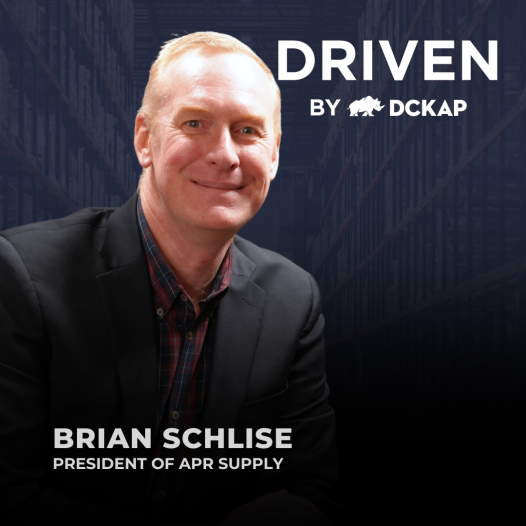
Brian breaks down how APR Supply automated 50% of their warehouse operations with AutoStore and robotics, why their 2025 company theme was “be bold — fail fast,” and how RFID technology could revolutionize the wholesale distribution industry. He also shares his philosophy on stewardship, what coaching 35 softball teams taught him about leading people, and why he believes industrial automation creates better jobs — not fewer.
OR LISTEN ON:
Karthik Chidambaram: Thank you for joining me on a new episode of the Driven
by DCKAP podcast. I'm joined by Brian Schlise, President of APR Supply.
Brian thank you so much, and it's great to see you.
Brian Schlise: Thank you for having me today. I appreciate it.
Karthik Chidambaram: So Brian, now tell us about APR Supply.
You're the president of the company. You work with the Weaver family. It's
been a four-generation business, getting into the fifth generation, as we
talked about. And tell us about the APR Supply business, and what is your
role there as the president?
Brian Schlise: So APR Supply has been in business for over 100 years.
We are moving our way through generations, and I was able to join the
organization this past year as president, helping move the organization
forward from a leadership perspective, and also be able to be a part of that
succession planning to make the next generation successful in their
leadership roles.
So APR Supply is based out of Lancaster, Pennsylvania. Grew up just up the
road in Lebanon, Pennsylvania, where we were engaged in the plumbing
wholesale business, moved into HVAC, and have continued to expand into
industrial PVF, our showroom products of decorative brands, as well as
irrigation.
Karthik Chidambaram: And you work with the Weaver family closely, and but
then, when it comes to family, so you're an outsider.
But how does that work, right? Because there would be some family members
who are interested in the business, and, you jokingly talked about the fifth
generation, six months old, planning to get them on and all that, right? But
some people may not even be interested to get onto the family business.
So what is your role there? How do you work with the family? What are the
family dynamics at play? How do you make that happen?
Brian Schlise: So my journey to joining APR I say I started about eight
months ago, really probably started about 10 years ago when I started to get
to know Scott in other industry events, and we've been connected.
We've shared ideas. We- we've worked together in, in different capacities,
so this was a long journey to, to this point of joining in a leadership
role. As somebody from the outside, I really look at that as an honor and a
privilege to join the company as a non-family member in such an important
leadership position.
And that is something that I really look at as being special and again
humbling. So a- as far as a role goes, it really comes from understanding
where the generations have come from, understanding what's important to them
in regards to culture, history, and where they'd like to be able to
continue.
It- it's really been wonderful to join and learn about the governance that's
been put in place and the importance of that governance to really manage and
guide the family business and the relationships. It's made it significantly
easier to, to navigate those waters and understand where the family has
come, what's important to them, and how they would like to see that business
continue to move forward in the future.
Karthik Chidambaram: And I think it does help a lot to have an external
member, who's not a part of the family kind of work through this, because I
think this is a great thing, other family businesses could take on as well,
right? Because if everything is in the family, then, And you talked about
governance and all that.
So it does help a lot having an external member like you.
Brian Schlise: I think having an outside perspective and a different view
from business, from the community, a- as well as family is an important
piece. Ultimately, at the end of the day, the Weaver family will make
decisions that are in their best interest and will ha- will take care of
things, but they're very open to conversations insights, and inputs from
others.
Also, part of that succession planning and experience that generations are
going through has been having outside experiences, so formal education,
connections, training but also experiencing work at other companies and not
always just being in the bubble and a- and seeing the world from a very
controlled and limited perspective.
As we, we have family members coming in, as we have leadership coming in
those perspectives are important that that they're bringing from other other
points of view.
Karthik Chidambaram: And at APR, you invest a lot in automation. You guys
deploy a bot you deploy robots as well. 50% of your warehouse operations are
automated.
Brian Schlise: A couple years back, it's been about three years ago now, we
invested in the AutoStore process inside of our distribution center. So we
have just over 30,000 SKUs that are inside of that particular AutoStore that
is moving product, bringing it to our folks for picking, packing and being
able to to put product into the hands of our customers.
It has a- absolutely advanced us and moved us forward in two big areas. One,
productivity, but the other side has been accuracy. The level of accuracy
and the experience that our customers receive because of that has gone up
tremendously and really brings an advantage. The other area that we've moved
into from automation has been the use of robots.
Moving product from one point in the building to another point moving it
from receiving to put-away areas, and then from picking and packing to
outbound doors. Again, really moving us forward in different ways and in
applying that technology has been a great learning curve. But we've been
able to advance that, move that forward, and we're looking forward to
applying it to other areas of our business as well.
Karthik Chidambaram: And these require significant investments, right? So
some of this may not even yield a good ROI immediately. It might take a
period of time. So how do you evaluate that and, what is the thought process
behind that?
Brian Schlise: So as we look at it we think about how is this helping us, A,
become more productive, but B, more importantly, where does it help us
redeploy our folks?
Where do we take our teammates and move them into areas that become more
about thought process versus repetitive tasks? How are they able to become
more ingrained in the business and bring value to the decisions that they
make, and where do they move that forward? Other considerations that we look
at when it comes to bringing technology in place is what might we learn from
it that was not directly believed to be our end result?
So a- as we've looked at technology, our thematic goal for 2025 as a company
was be bold. And one of the aspects of being bold was our willingness to
also fail fast. And in technology, it's one of those areas where we look and
we say, "This is the desired outcome that we would like to have. We are
willing to invest money, but we're also willing to admit that this is not
necessarily working the way that we want."
And we've had some experiences with that. However, it was still money well
invested because we learned other things about our business. We learned
other ways to handle and process product that we would not have been exposed
to had we not gone down the path in leveraging some of those technology
areas.
So for us, the balance really becomes how do we look at being on the leading
edge versus the bleeding edge when it comes to technology leveraging those
dollars in a positive way, even if it is a failure. And and that becomes
perfectly acceptable and part of our culture. Another piece of ROI that we
look at now in, in going forward with using the AutoStore technology is it
really starts our our sales team thinking about what are the products that
we would like to offer and move into the marketplace.
So if I can find items that are this big and can go into an automated
system, I know that our overall profitability on that particular SKU is
gonna be greater than something that requires forklift traffic through the
building, manually lifting and putting that product up on pallet racking and
bringing it down and moving it to the truck in a different way.
So it's starting to lead our thought process in a different way, which was
not just about productivity, but how is it now impacting product selection
where we're offering product to our customers, and how that leads into our
overall profitability.
Karthik Chidambaram: So the learning is also the ROI, right? So even if you
do something and, you fail fast, I can totally relate to that, especially
when it comes to technology investments.
Hey, do it. It's not gonna be easy. That's why you're investing. But then,
you fail fast. Hey, it doesn't work. Cut your losses, just move on. Yeah.
Brian Schlise: We also look at technology as something that if we are
managing individual things in a granular way w- we're not gonna be
successful.
We look at it as investing in a portfolio. We're gonna invest in multiple
things with an understanding that a certain percentage of them are not gonna
yield positive results. But because we've been entrepreneurial, because
we've been willing to be on that front edge and making decisions, we know
that the entire portfolio of technology investments will pay off and be
positive in the long run.
Karthik Chidambaram: You talked about AutoStore, and we also briefly chatted
about this last night, right? So you even envision a store where, hey,
there's nobody there. Somebody, whatever you order, it automatically picks
it up, or, you get a curry to- ... pick the shipment, just get it delivered.
So you see that happening?
Brian Schlise: So I think one of the next big steps that that we're gonna be
able to take, and I think this is really gonna take an entire industry
movement to get there is really gonna be going from the standard UPC barcode
on products to understanding how we can leverage RFID technology and have
data and information embedded in that tag that is applied to all of the
products that we handle.
And that will revolutionize the way in which we do business from the point
of receiving and being able to understand what product is coming into our
building, being able to put it on shelves and have tracking of where that
product is inside of the buildings cycle counts and physical inventory
changes, and then the customer experience changes.
If it's being delivered, how we can track a particular item at a SKU level
and where it's moving throughout the course of the supply chain process but
also getting to the point of customer experience, where we envision the
opportunity for some of our best partners to be able to have access to a
store of products 24 hours a day, seven days a week, and they can self-shop.
They can self-serve, take the product they want, and by simply grabbing it
and essentially walking out the door through a scanning portal, it will
identify who that customer was, what product they took, and be able to
attach it to an invoice, and they can move on and move forward. So there's a
lot of different opportunities and right now I envision that connecting, but
having to go back and really finding the true partnership in the entire
supply chain of how that product is labeled and how data and information is
carried with it.
Karthik Chidambaram: Yeah, with face recognition technology and all that,
right? But then let's say this happens, and this is happening right now.
It's beginning to happen. So obviously there's gonna be a lot of job losses.
Brian Schlise: I don't see that as job losses. I see it as a way then which
we can become more effective, more productive.
But again, we have invested in technology. Our head count has never gone
down. As we've brought these technologies in, it's allowed us to grow
further with our existing group of teammates, but also, again, redeploy them
in positions in which they can be more effective in driving the business.
From a distribution center standpoint, it goes into how are we being better
at quality checking?
From a customer-facing standpoint, it's how do we spend more time eyeball to
eyeball building relationships and connecting with people versus handling
keystroke work? That becomes really the way that we look at things. So I
don't see it as as the loss of or a reduction of teammates and staff
members.
It's a matter of how do we redeploy them into more effective roles to,
again, create a better experience for our customer? And at the end of the
day, that's what we're driving towards. Our world is all commoditized. The
products we sell are commodities. The major service items that we support
are commoditized.
What will make a difference is how we differentiate around the customer
experience, and that's something that we're gonna do with our people.
Karthik Chidambaram: Yeah, it's definitely good for the people as well
because, they get to do more interesting work. It's not just the same
mundane work. Yeah.
And are you already experimenting with this at APR? Are you guys already
doing that? When do you see that happening?
Brian Schlise: So those are things that we've been discussing. In a previous
life we had tested and moved forward with with that proof of concept- ...
with a couple of outside suppliers.
At APR, we're now talking about where does this fit into our strategic plan?
How do we leverage that, and how do we move forward in the near future?
Karthik Chidambaram: You also spent a considerable amount of time at AD,
right? You were on the board of the Affiliated Distributors for the HVAC.
Brian Schlise: Correct.
Karthik Chidambaram: And how is that experience helping you?
And also tell us about the AD, for the audience who are not too familiar
with AD or-
Brian Schlise: Yeah ...
Karthik Chidambaram: how does that help?
Brian Schlise: So Affiliated Distributors is a, is an organization that's
been around for several years. W- it would generically be called a buying
group. However, it goes well beyond being a simple buying group.
It is a network of of entrepreneurial companies that come together with v-
what they call a spirit of independence. And we believe that when we come
together we become stronger as a collective group, not just in purchasing
but also in networking in terms of connecting and understanding the business
world, the challenges we face, how we bring resources together and scale
them together that we might not be able to do as independent organizations.
That really w- was motivating to me. So as AD has come together and
continues to grow, it is in multiple verticals, not just HVAC and plumbing
that we happen to be in, but also electrical, decorative brands, drywall,
safety, all kinds of other divisions. That has been a powerful organization
to help APR grow as well as all of the other independent distributors that
they support.
From a leadership perspective it, it was an honor to be able to serve as the
the chairman of the HVAC divisional board. Thinking about our members, what
is important to them, how do we negotiate and find solutions and
partnerships with our key suppliers? Being able to bring those people to the
table and not just represent our own individual companies, but acting on
behalf of membership as a whole for me, it was a tremendous learning
experience to be able to connect with our supply partners.
But also to be able to sit on that board with really intelligent, smart
business owners and leaders that I was able to learn from. When I left that
that position a couple years ago I almost felt guilty because I think I took
a little bit more than I gave. But I look forward to being able to to
continue to give back into that community going forward.
Karthik Chidambaram: You've served on both sides, right? Both on the AD side
and also on the distribution side. But let's say I'm a distributor and I'm a
part of the AD network. How can I leverage AD to the fullest?
Brian Schlise: Yeah. You know what? I really think it all comes down to
looking at the service providers, understanding where people come together
to again, truly partner and build relationships that can grow the business
beyond just buying at the best price.
Being able to connect and network with folks for me was the biggest. How do
I find like-minded people with an entrepreneurial spirit that are looking at
growing their business faster than the industry as a whole? And the vast
majority of of value that I got was what our owner calls the hallway talk.
It wasn't always sitting in a room listening to guest speakers. It was the
connections that happened in the hallway. What did you think about that? How
are your challenges happening? Hey, is it okay if I pick up the phone and
call you in a couple of weeks and see if I might be able to connect my
marketing team with your marketing team and really work through some of
these different issues?
Or connecting our IT teams in a similar way. That's where we really found
the true value.
Karthik Chidambaram: Switching gears a little bit and talking about
leadership. You talk about stewardship, and also you were coaching a
softball team, and how does all this play into the role you're doing right
now?
Brian Schlise: I look at and I come from the perspective that stewardship is
really my way of approaching the business and the team.
That probably comes from a background in faith where I look at and I
understand things from that perspective. Stewardship to me is an important
piece, particularly in the role where I am today. It, it comes with the
notion that we may not have necessarily built this thing but we own it for a
certain period of time.
We're responsible for supervising, tending to it, and making sure that we're
able to transfer that on to the next generation in a better place than what
we accepted it and brought it on to begin with It also comes with a certain
level of accountability. We're not just asked to take care of something and
maintain it in the same status in which we received it, but instead, how do
we take our talents and the gifts that we have and the resources that are
made available to us to grow and move it forward in a more meaningful way?
And the third piece of stewardship that I look at is purpose. What is our
purpose, and how are we trying to improve it beyond ourselves? This is not
something for us, but it's for the next generation. It's for the existing
teammates that are there. It's for the community in which we operate. Those
become important pieces of stewardship as I look at it.
As we go through and and we take care of those things I, I look at that from
the role that I stand in today. I'm a part of an organization that has been
built over 100 years and has been inside of family leadership, and I've been
given an opportunity to lead and have been entrusted to take that and not
just manage a PNL and drive bottom lines, but instead understand how do we
look at the people?
How do we understand the succession planning of the organization as a whole?
How do we understand making it better and knowing that I have a small time
or a small mark in time to make an impression and move that into the next
the next generation f- so that it can last another 100 years into the
future.
Karthik Chidambaram: And yeah, you always have to make it better. How are
you contributing? How are you- ... making the whole thing better, right?
Said. But then how do you manage time? Because, we talked about, you coach a
softball team, and then you also give back to the church.
Brian Schlise: Sure.
Karthik Chidambaram: But one question a lot of times, a lot of people have
is, hey, I'm already in a full-time job, but, where do you find the time or
how do you
Brian Schlise: balance? Sure. So over the course of 11 years, I coached
about 35 softball teams between my three daughters, and it was something
that I looked at was A, wonderful to be able to connect with and be a part
of my family.
B, it was an opportunity to do something outside of work, and it grounded me
in a different way, and I think that's an important piece of being able to
give back and have connections in the community, understanding what we're
there for. I was not coaching softball in a recreational league to produce
future all-star players.
It was to be able to connect be able to grow a community and help transition
young adults into the world to be great members of society by, A, learning
how to win, B, more importantly, how to lose- ... and still have a
competitive spirit. But how I looked at that opportunity really came from
and the excitement was not...
w- was understanding the process and this is where I take this back to
stewardship and connections inside of APR Supply and my leadership. And I
don't know that I would have had these opportunities if I was only inside
the company. But looking and saying with softball, it starts with teaching
mechanics.
How do we go through the basics of mechanics? Then it was, how do we
understand the rules of the game, and how does that work? But then what
became really more engaging to me and more rewarding was as I worked with
these young ladies over time and had seen them grow, we then got into
strategy and philosophy of the game and application to the point where now
they were starting to think ahead, and they were making decisions on their
own, and they did not have to always look back at a coaching staff member to
say, "What am I supposed to do?"
They were looking ahead and thinking about that themselves, and we would
then empower them to go out and make decisions about how to play the game.
And I think that's the same type of thing that I look at inside of APR
Supply and my leadership there. How do we take and clearly define what is
important, what is our goal?
How do we make sure that we work with people on the mechanics and
fundamentals? How do we explain the rules and the guidelines inside of which
we want to operate inside of our core culture? And then how do we ask them,
"What do you need to be successful? What are the resources that you need?"
And then empower them to go do that job.
It's very rewarding to see things like that happen and and come together.
Karthik Chidambaram: Yeah, it is very rewarding. I can relate to this. We
run something called the DCKAP family or called the DCKAP school where, I
interact with students a lot and then... it's also learning for us, right?
Because you also wanna do things outside of work. It can be work all the
time, but like you rightly said, when you work with these students or when
you teach these students, you are actually building the future. You're
building a younger generation. And they'll turn out to be smarter than you,
and I think that's a great feeling.
Yeah.
Brian Schlise: And I think that my experience through coaching as well as
work through our youth group at church has really given me a different
perspective on the world. Again, it takes us outside of our little bubble.
It helps remind us that our work and our job is not our identity. Yeah. It
is...
Y- that does not define who we are and gives us an experience to see things
from a whole different lens. I've learned a whole different side of empathy.
I've learned a whole different level of patience a- and I've seen the world
through a different lens that I'm able to take back and then apply into the
business world.
But I think those are important pieces that that we take away.
Karthik Chidambaram: No, totally. I think it's very important for every
leader to do this, and not just leader. Any professional to do things
outside of work.
Brian Schlise: And
Karthik Chidambaram: it gives you a great different perspective, like you
rightly said, empathy. And there's a whole world outside who's not using
tech, who's not- doing big things, but small things, but it's big for them,
and we learn that as well. Yeah.
Brian Schlise: And it's made some wonderful connections that we apply even
at APR that- ... that we probably would not have seen if we stayed inside
the walls of the office. Getting out and connecting with people, seeing the
challenges that they face, understanding what gives them purpose and how
they're motivated, understanding the needs of our community by being inside
of it and asking questions, participating.
Again, I feel that I learn more than what I'm giving. And it comes with that
open mindset of how am I here, why am I here, and h- what am I looking to
take away from the experience? And between serving in the community, mission
trips coaching, connections it is vitally important that leadership
understand those things and be able to take that back in.
I think that's one of the reasons that we've been successful, and I'm really
proud of one of our programs at APR Supply, which is called our Dreamers
Fund. This was something that was established in previous generations with
the Theis' where they identified human needs And understood that the company
was there and able to help bridge the gap outside of a paycheck.
And how do we connect with people? So as an example, our Dreamers Fund is
not to necessarily support individuals in financial issues, although
finances do come into that. But probably one of the most rewarding
opportunities we had is we have had a longtime teammate who had some medical
issues and challenges that affected his dental health and teeth.
And that is one of those things that can impact a person beyond just the
medical side, but psychologically, how confident are they and how does that
play? And we were able to pay the bills and help that individual have an
entire new set of teeth put in. And it wasn't about giving them those teeth,
it was the confidence that came with a smile being able to drive forward in
the community in a different way that he'd not been able to experience.
And those are wonderful connections that again, if we were just inside the
building, if we were just inside the business, if we were just operating off
of spreadsheets and financial statements, we would not understand those
connections and being able to make those. And again, that gets us into the
community as a whole.
Karthik Chidambaram: The theme of this podcast is driven. So how are you
driven?
Brian Schlise: So for me, it is again, looking at it from a standpoint of
stewardship and service. My purpose, the way that I look at, is how do I
take an existing team? How do I help align them? How do I bring them
together? And how do I empower them to become independent and do bigger and
better things that they were able to do before?
I understand that I'm not gonna be able to accomplish everything on my own.
We can only do that through our teammates, and understanding how to cascade
that through an organization, that to me is what drives me, both in the
business world as well as outside. And when I can take and under- and be
able to work with people, coach them, train them, get them up to speed, and
then I think the big connection is getting them to understand application.
What is this knowledge that we've been able to give and be able to provide
resources? The real power then becomes what is the application? How does
this connect to my life? How does this connect and what does success look
like? And then we let them go. We empower them and unleash them into those
places.
That to me is where my passion lies.
Karthik Chidambaram: Yeah, it's about the team, yeah? How do you keep
yourself updated with what's going on around the industry? Is there a book
you're reading right now?
Brian Schlise: You know what? From an industry standpoint, these type of
events where we go to industry events, we stay connected with people, we sit
on boards, those are big pieces.
For me- I'm constantly l- reading, but it's usually around self-improvement
or self-help For, so f- right now there's two books that I'm looking at. One
is called The Daily Stoic, and it is a- Is that
Karthik Chidambaram: Ryan Holiday, or?
Brian Schlise: Yes. Yeah, okay. And understanding Ryan Holiday's view and
perspective.
And- ... and that helps me stay focused on life and stay f- stay connected,
right? Understanding that, A two big pieces I take away from that theory and
philosophy, things in and of themselves are neither positive nor negative.
We as people assign those values to things that happen. The individual
activities and happenings simply are what they are.
It's how we approach them. And the other big piece is how do we look at and
how do we understand our role, which is identifying the things that we can
control and the things that we cannot control. And being able to separate
those and saying I'm not gonna worry about this, but I'm gonna be focused on
the things that I can control and what I can influence in my life."
The other place that I'm focused on right now is called Daily Meditations:
Calling It a Day, Daily Meditations for the Workaholic, and that was
copywritten in 1990. Wow. And it's out of print right now, but to be able to
go through that and look at the things that were referenced over 35 years
ago, and be able to go, "They're still relevant today."
And how do we balance and how do we manage ourselves becomes really key, I
think, to, to being able to move on an even keel and lead.
Karthik Chidambaram: I recently read one of Ryan Holiday's book, Ego Is the
Enemy, I think. I think that's a good one as well. So Brian, thank you so
much for doing this. I really enjoyed this conversation.
Thank you.
Brian Schlise: It's been my pleasure. Thank you so much.
Karthik Chidambaram: Thank you. Yeah.
Sign up to receive email updates
Enter your name and email address below and I'll send you periodic updates about the podcast.