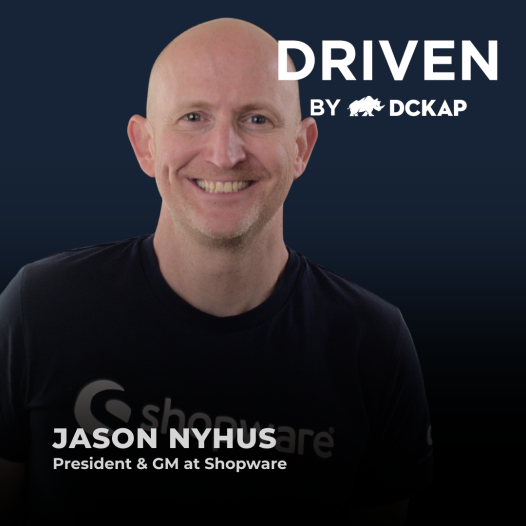
In this episode, Karthik sits down with Jason Nyhus, President of North America at Shopware, to unpack one of the most critical inflection points in B2B e-commerce. Jason brings 20+ years of industry experience and a front-row seat to how AI and agentic commerce are reshaping the e-commerce landscape faster than most distributors and wholesalers realize — and why the industry is at an existential fork in the road around it.
From agentic commerce and Shopware’s Digital Sales Room to why ERP integration is the air every distributor breathes, Jason breaks down what it takes to build a B2B commerce strategy that fits your business — not the other way around. Plus, what the fastest-growing e-commerce platform in North America is doing differently with AI, and why the underdog mentality is still driving it forward.
OR LISTEN ON:
Karthik Chidambaram: Jason Nyhus, thank you so much for
joining me, Jason. Excited and looking forward to this conversation.
Jason Nyhus: Thank you. We love being partners with you
guys, and thrilled to be on the pod.
Karthik Chidambaram: Thank you for the partnership. I love
working with Shopware. So Jason you're the president of North America for
Shopware.
What does the president of North America do?
Jason Nyhus: That's a great- every day is different. Every
day is different. No, so Shopware, just as a way of introduction, is a
market-leading e-commerce platform, German roots. And about four years ago
they raised about $100 million from PayPal and Carlyle to take that really
well German-engineered product to the rest of the world.
And it was through that discovery that I had heard of the company, and they
brought me on board to basically take the business from zero to something
more meaningful. And today we think we're the fastest-growing commerce
platform in North America. And so what does that mean on a day-to-day basis
for me?
It means I gotta do whatever it takes. Some days it's doing podcasts with
you- ... others it's helping create pitch decks and everything in between.
Karthik Chidambaram: So you were working at Digital River
prior to this?
Jason Nyhus: That's correct, yes. Yeah. Yes. I worked there
for 20 years.
Karthik Chidambaram: 20 years?
Jason Nyhus: Yeah.
Karthik Chidambaram: And how did Shopware find you?
Jason Nyhus: A recruiter actually. And I actually remember
the call. They said, "Hey, we have this leadership role at Shopware." And I
said, "Who the hell is Shopware?- ... and why does the world need another
commerce platform?" And it was through that journey and discovery that I
really figured out there was something special here, and some real clay we
could mold for the US market.
And we're doing it.
Karthik Chidambaram: So why does the world need another
commerce platform?
Jason Nyhus: Oh, what a great question. What I started to
notice is that we... In my time at Digital River, we had pivoted from being
a commerce platform to being an app inside of everyone's app store. So it
was a payment centric with payment fraud, tax compliance, business entity
all wrapped into one.
And it was through that journey that we became an app inside of Salesforce,
inside of BigCommerce Woo, Adobe, SAP, et cetera. And in order to be
successful with that new venture, we had to sell with all of those partners
and their agencies. And it was through that discovery and that process that
we realized, or I realized, that it...
we were starting to get this monoculture. Everyone was copycatting everyone
else's best practices. And so everyone was charging it a r- a revenue share,
'cause it's great for the platform. Everyone was trying to force you to use
the payment engine they want, 'cause it's great for the platform. They were
mostly closed systems where they were responsible for delivering all the
innovation.
And frankly, it looked like a market that was ripe for dis- disruption. The
other thing that we had discovered, or I discovered through the process, is
th- those platforms were all a- acquisitions. You think about Demandware was
acquired by Salesforce, Magento, Adobe, et cetera. And it was through that
process that R&D had changed.
Not necessarily slowed down, but fundamentally changed. More around moving
product up- upmarket into enterprise, better SLAs, more cloud
infrastructure, et cetera. But they weren't delivering any new meaningful
features. And so it was through that process that I realized there was a lot
of white space in the market to partner different, price different, deliver
different, and it's been working.
Karthik Chidambaram: So I was chatting with a prospect.
They needed integration, and they needed systems to talk to each other, so
they reached out to us. But then they were also looking to change platforms-
Yep ... e-com platform, and we recommended Shopware to them as well-
Jason Nyhus: Nice ...
Karthik Chidambaram: to take a look at it. But then they
had another platform.
They paid a lot of money. It worked, but after three years, they realized
that, "Hey, you know what? We're spending too much, and there's not a great
ROI on the platform," and they really wanna move to another e-commerce
platform. So what is the problem here? How do you think distributors- Yeah
can get it right the first time?
Jason Nyhus: Well- First of all I just wanna say I, I feel
that distributors are in a, have been in historically in the last few years
in a pretty tough spot. You've got the rising cost of fuel, the rising cost
of- ... you got inflationary measures, you've got the cost of capital.
All these things have gone in the wrong direction. And for distributors who
largely are, the definition of a middleman surviving in, thin margins, it's
a tough spot. And the first thing I would say with regards to e-commerce is
mission one has- is how do we take all the things that you have in place for
your business processes and make them more efficient?
And that includes the sales reps. And so sales reps for a distributor are
probably responsible for 96, 97% of the overall revenue. Maybe, it changes,
it varies. But the sales reps at these companies usually spend 25, 30% of
their time selling. And so our world with helping B2B distributors with
digital is around giving sales peoples better tools to make more money.
And that includes elements of commerce, absolutely, but it includes
automation around how they follow up on quotes. It includes portals at which
their buyers can log in and self-service. It includes a lot more than just
classic e-commerce. It requires a change in thinking.
Karthik Chidambaram: Is the digital sales room a feature?
And- Yeah ... what is the digital sales room, and is that made for B2B or
distribution?
Jason Nyhus: Yeah, absolutely. So Shopware has this unique
utility- ... built into the product called the digital sales room. And the
digital sales room is really an aggregation of a whole bunch of tools all
packaged up beautifully so that it's easy to use for both the customer and
the distributor.
The digital sales room is, in essence, is like telehealth is to healthcare.
You take a very complex transaction, and by doing it virtually, you're able
to see, the patient history, in other words, the things you've bought.
You're able to curate the catalog down to the things that you think would be
relevant and make recommendations.
You're able to see them virtually, and you're able to co-browse and co-shop,
and, you're you see the products you're supposed to see at the prices you're
supposed to see, and the sales rep has this god-level view, which also
includes where's the inventory available? How quick can I have it? Can I
give them free shipping?
Are they eligible for promotions? And what's my margin on these
transactions? So it's bringing all these things together in a way that
allows the rep to make more money. And that's why distributors really love
it. That's the name of the game.
Karthik Chidambaram: And you have a lot of reps using the
Shopware platform today?
Jason Nyhus: Oh, absolutely. Yeah, so the lion's share of
the Shopware ecosystem in the United States really supports complex
commerce, which is an aggregate of the examples around B2B, so wholesales
and distributors, but you also see categories such as regulated industries,
so alcohol, tobacco, firearms, healthcare, all the things that play by a
different set of rules.
And so Shopware's product is really designed to serve those complex use
cases. Complex for whatever reason. And the digital sales room is one of the
tools in the toolbox to solve those complexity.
Karthik Chidambaram: So what is agent e-commerce? Because
that's something- Yeah ... we hear all the time. So what is agent
e-commerce, and what is Shopware doing on the AI space today?
Jason Nyhus: Yeah. AI is hot. I think... I was talking to
an analyst this morning, and we talked a little about the industry. And the
truth is, if you look back 10 years, the names of virtually of half of the
companies in e-commerce have changed from 10 years ago, and in 10 years from
now, the same thing will be true.
And the big change agent, in fact, it'll be more true in 10 years than it is
today, it's AI. So there's a whole bunch of systems that are ma- I'll call
them legacy. It's not a great word, but these are platforms that have, that
were created in the 2000s, early 2000s, that have, for the most part,
figured out how to refactor their product to take care of mobile commerce,
social commerce, marketplaces, headless APIs, web hooks, et cetera, all
those kind of fundamental shifts in the way commerce is done, but we're at
an existential fork in the road around AI.
And so I'll just give you Shopware's view. Our product was launched in
December of 2019, which means it's a six-year-old product. It's the most
modern product on the market that serves the e-commerce use case. And so our
ability to integrate AI into it is relatively simple, and we did it first,
and at this point, I think the most of anybody on the Gartner Magic
Quadrant.
Our approach with using AI is how do we use generative AI to go into, to
perform the tasks that people do on a daily basis, adding images,
descriptions dealing with reviews, running up reports? How do we add utility
at every stage to reduce the amount of blue-collar work being done by
white-collar people?
And I've never met anyone who has e-commerce in their title that can get
through their list of things to do in a day. And so our vision with kind of
round one of agentic AI is how do we take those automatable tasks and
automate them so that they can focus on more strategic things? We think
human in the loop as part of our process for agentic or for AI.
Now, you asked a question around agentic, which I think is really
insightful. So agentic, the definition of it is, again, I oversimplify, how
do you ask an agent to perform a task that goes across multiple systems and
has the context of what it learned along the way, and then come back and
complete the task?
Shopware has built and is building more agents that our clients can opt into
or vibe code their own on top of Shopware. What these d- will ultimately do,
there'll be a massive unlock with regards to efficiency at how distributors
and wholesalers kinda go to market. An example that comes up very frequently
is an agent that we use around competitive pricing.
So what you would do is inside of the agent, you would describe what
websites your competitors are. You would describe the products, if they have
the same exact units or if they have related or similar items, and the
system every day could go out at whatever frequency, check those prices on
those sites, come back, and inform you automatically.
And the question becomes, do you want the system to automatically take those
prices and adjust? Or do you wanna stay within a range, or do you wanna
notify and you make manual choices? But it's these types of agents that
today are third-party services which are really expensive that can simply be
vibe coded or agents that exist inside of a, a commerce solution.
So it's that example times 100.
Karthik Chidambaram: And that would be an add-on cost on
top of the platform?
Jason Nyhus: The cost to vibe code on top of Shopware is
nothing. You do what you wanna do. If you wanna use any of the agents we
have, the cost to use them is nothing. B- however, the bandwidth e- expense
relative to using it, there is some expense.
For our customers, we figure out how to do something that's not eating too
many tokens, that's efficient in the way that it deals with compute, and
there's a slight expense incremental, but it's relatively small compared to
the benefit you get.
Karthik Chidambaram: Let's say I'm a plumbing or a HVAC
distributor.
Jason Nyhus: Yeah.
Karthik Chidambaram: When should I choose Shopware, or what
are my alternatives? Who do you compete with?
Jason Nyhus: Yeah. We like to overly simplify. A- and if
you're a distributor or a wholesaler of any kind, the simple question that
we like to ask is, do you want to change your business processes to fit into
a multi-tenant SaaS commerce platform into the system?
If the answer to that is yes, we are willing to change the way we do
business to fit inside of, let's say, Shopify, who's an amazing company- If
you're willing to do that, you should buy from Shopify. We kinda call that
standard B2C or simple B2B. The Shopware merchant, the answer to that
question is, we want the platform to adjust to the way we wanna do business.
We have, if you're a, a distributor, you might have different ship tos. You
might have different processes around approval of quotes. You might have all
sorts of different things that are unique to your business that you have to
adhere to and it makes you special. With Shopware, you don't have to
sacrifice those.
And so that's really the line that we draw. Do you want the platform, do you
wanna change your business to fit the platform, or do you want the platform
to change to fit you?
Karthik Chidambaram: So let's say if I'm a business- Yep
... and if I want the software to customize to the way I run it, I choose
Shopware- Yep ... not the other way around.
So you fine-tune your business to the software. Correct. So the business is
always the key. Correct. Technology is just a enabler. So talking about
partnerships we love working with Shopware, so thank you for the
partnership. Where do you think integrations play a big role? Because in a
Shopware merchants, we integrate Shopware with other ERPs like Profit21 or
Eclipse.
Jason Nyhus: Yep.
Karthik Chidambaram: So what is the need for it on a
commerce perspective? Where do you see integrations?
Jason Nyhus: Yeah. I love that. It is absolutely mission
critical, which is why we love DCKAP as well. You guys have been a
tremendous partner. In the world of B2B, on Maslow's hierarchy, on the
bottom rung it's food, water, shelter-
all those things. Then later you care about having a Corvette or something,
but at the base level, you care about food, water, and shelter. That is the
integration layer into ERPs for distributors and wholesalers. It's just the
air that you breathe. Part of our commitment in a sales process is all
software companies are deeply motivated by new wins, and will do...
They'll say just about anything to win a logo. And so our kind of ethos at
Shopware is don't tell them, show them. And so we invest in proof of
concepts in a lot of our sales processes with our agencies. And in B2C use
cases, we have to show a front-end experience, and they care a lot about
merchandising and marketing and how you kind of optimize conversion rate.
In B2B, the thing that you can't get past is how are you gonna change a
price in an ERP and have it show up in the commerce system? If you can't
elegantly demonstrate that, everything you're showing is slideware. And so
we really value the partnership with DCKAP because it gives us that
integration layer to make the ERP extendable into commerce and vice versa.
So that's the value. You guys are the proof point that these systems can
communicate and talk.
Karthik Chidambaram: Yeah, I would like to say ERP is like
the heart, DCKAP is the brain. So yeah we just make systems talk to each
other. So you talked about Shopware's growth and growing through
partnerships. What role do agencies play in your growth?
Jason Nyhus: Yeah. We talked a lot about technical
partnerships, and DCKAP fits into that category on the integration to the
ERP. But just as important are these agency or system integrator
partnerships. And you look no further than how we got together with the good
people of American Eagle.
People like Brendan over there saw a need that one of the mission critical
priorities of the project is seamless integration of an ERP into Shopware,
and that's how we got to know each other. To me, companies like American
Eagle really are the truth speakers to the merchant. There is a lot of
options and a lot of great marketing in the world- And the agency's ability
to actually get to know the merchant, their pain point, and recommend a
solution that solves it is why there's such a vital role in our ecosystem.
Karthik Chidambaram: I love American Eagle. I visited them
in Chicago in January. Yep. Just like you talked about feet on the street,
right? So when we were chatting. So they are very much feet on the street.
They are there at every event- That's right ... meeting with a lot of
customers, partners. We love working with them as well, and we are thankful
for the American Eagle partnership, and also for recommending Shopware, to
DCKAP.
Yeah. Yeah. It's an exciting three-way combo and partnership. Yeah.
Jason Nyhus: Yep. That's the power of community. When all
of us recognize that we're better with help from the community, we all do
better, and that's ... I love DCKAP for that reason. I love American Eagle
for that reason.
Karthik Chidambaram: The theme of this podcast is driven.
I see you're very driven, so how are you driven?
Jason Nyhus: I like the underdog story. When I joined
Shopware... Actually, when I joined Digital River in the year 2000, this was
when people said that you'd never put credit cards online. And so I like
that I'll prove them wrong mentality.
I stayed there a long time, and I joined Shopware. Again, no customers in
North America. And so for me, it's not the financial reward that's
benefiting. It's building out a team, building this partner ecosystem,
sharing in the economics, winning together, meeting people at events. So to
me, it's the love of the game And I like proving people wrong.
I like to be the underdog.
Karthik Chidambaram: And how do you rapidly grow? You
talked about Shopware starting in 2019.
Jason Nyhus: Yeah.
Karthik Chidambaram: And you have over 50,000 merchants
today.
Jason Nyhus: Let me give you a little caveat. Shopware 6,
which is the product we're- we run on, is launched in December of 2019.
Shopware the company was founded by two German brothers in the year 2000,
and those two founders are deeply involved in the business today.
One is the CEO, and the other operationalizing AI across our business. So-
Karthik Chidambaram: 26 years, a long-term
Jason Nyhus: gig ... It's 26 year old. So you got a
26-year-old company- ... with the founders deeply involved, and a new
version of the product which kind of brings the scar tissue of the past and
the learnings into a very modern solution.
So we have some built-in advantages. My job is to take advantage of them.
Karthik Chidambaram: Awesome. And when you launch in 2019
Shopware 6-
Jason Nyhus: Yeah ...
Karthik Chidambaram: then what happens to the people on the
old platform?
Jason Nyhus: Yeah, so that's a great question. So it was
called Shopware 5, and it was before my time, but there was a pretty
aggressive incentive to move people from the old Shopware 5 product to the
Shopware 6.
We are now on the last version of Shopware. Everything now will be
point-based releases that kind of change out the components of the code over
time. And so it is the latest and greatest, and will always be for any of
the merchants who work with Shopware. We use the name because that's part of
the origin of how we got there.
But yeah, 90-some percent of the, the value, the gross merchandise value
that was on Shopware 5 has been migrated.
Karthik Chidambaram: Yeah, Epicor is moving from on-prem to
cloud.
Jason Nyhus: Yeah.
Karthik Chidambaram: Yeah. So similar story. Jason, I would
like to end with this question. How do you keep yourself updated with what's
happening in the industry?
Is there a book you're reading, or what would you like to share with our
audience?
Jason Nyhus: I always feel like I'm falling behind. So
there's this this mindset that I should probably know more, learn more, et
cetera. I listen to podcasts. And I listen to podcasts about technology, and
I love business, so I watch CNBC.
And I pay attention to what the analysts say, Forrester, Gartner, IDC, and
Paradigm. And and then most importantly, I'm skipping everything else, most
importantly, I travel on site and I meet merchants, I take warehouse tours,
and we sell with partners. And so it's really not a one kind of trick of
where I get all my information.
I'm just trying to be out there, driven, and absorbing everything I can.
Karthik Chidambaram: Feet on the street.
Jason Nyhus: Feet on the street.
Karthik Chidambaram: So Jason, thank you so much for
joining me, and great chatting with you.
Jason Nyhus: Yeah. Yeah, likewise. Thank you for your
partnership.
Sign up to receive email updates
Enter your name and email address below and I'll send you periodic updates about the podcast.