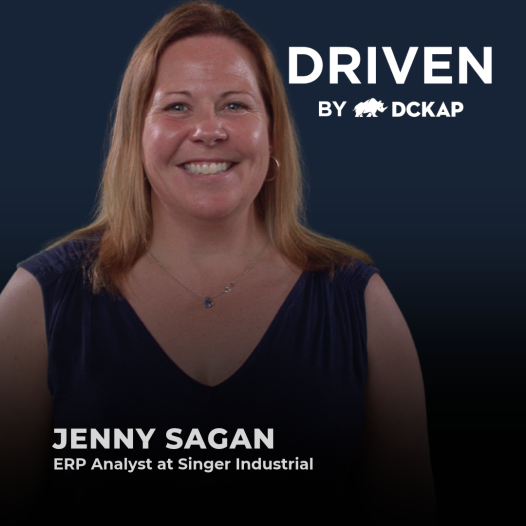
In this episode, Karthik sits down with Jenny to talk about what it really takes to get an ERP rollout adopted, not just deployed. Jenny’s answer centers on empathy. When you’re asking someone to abandon a system they’ve used for years, she says, you have to recognize the human cost of that transition and meet people where they are.
They also dig into the state of women in distribution, the honest industry conversation around Epicor’s on-prem to cloud migration, what mindful AI adoption actually looks like in a distribution environment, and how Jenny has built a career by leaning in, expanding her boundaries, and continuing to learn.
OR LISTEN ON:
Karthik Chidambaram: Jenny, great to see you and looking forward to this
conversation.
Jenny Sagan: Yes, me too. Thank you for having me.
Karthik Chidambaram: So Jenny, I really love what you do especially how you
have transformed in careers. You know what I mean? Especially, we talk a lot
about women in tech and women in distribution. And I think you are a living
example of that.
So tell us about- I'm very curious to know how you started, and tell us
about your transition journey. Did you always want to be in distribution? I
know we have met a few times in Cleveland, Ohio. So tell us about your early
days, and how did you transition careers?
Jenny Sagan: Sure. I started out actually in a different industry in
distribution.
I was in an electronic distribution, and I was there, took a little bit of a
break, and then I- when I went back into that same industry, then I
transitioned into the industry, distribution industry, that I'm in now with
Kohler Rubber, and then I started at the bottom. I was just a little
clerical person helping them out and stuff, and then moved up slowly and
then ended up being, systems operations, operations manager really, and also
a part of their finance team.
And it really helped with the role that I'm in now at Singer, where I deal
with the businesses in every aspect of the business. I'm also working with
their warehouse people, and me having that experience from Kohler, it helps
me with relating to those people all the way up to the general managers and
regional managers.
I have that- a capability now.
Karthik Chidambaram: Love how you expand boundaries. It's not like just one
piece of the job. Okay, I'm a data analyst, I'm just gonna do that work.
It's not like that. You really expand boundaries, and we did see that
working with you at Kohler Rubber. You were responsible for the site and the
integration and...
But that's just not the job. You did a lot of other things in terms of
running the business and helping run the business and other things. And
then, like you said, you transitioned into Singer. Tell us, why, I think
this is something, I see a lot, right?
So there are some people who lean in. I was talking to Paul Kennedy the CEO
of DSG, and he was saying, you have to lean in, and those who lean in, they
get more opportunities and that's how it happens, right? So tell us about,
how do you lean in, and why do you do what you do in terms of expanding
boundaries?
Because there are some people, "Hey, I'm just gonna do this. I'm not gonna
do anything else."
Jenny Sagan: Yes. Yeah, that's very true. I am very passionate about helping
people, and I take that with me when I care about the people that I work
with. They are people. They're just trying to do their job, and I'm coming
in at a very stressful time in their job.
They're transitioning off an ERP system that they knew they could, ask, do
their daily tasks without even really thinking about it. Now I'm asking them
to do their daily task in something that they're not familiar with. So I-
Take that into consideration. I help them, so I lean into that and show them
that compassion in there, and it really kinda helps.
And I think a lot of that from, taking on those different jobs when I was
in, and tasks at Kohler, the website and just dealing with all of that, it
really helped me in where I'm at now.
Karthik Chidambaram: So have a sense of empathy towards people and help them
be more successful?
Jenny Sagan: Yes, absolutely. That goes a long way.
You just kinda hear somebody out and just take the second and it really goes
a long way when you have a little bit of empathy.
Karthik Chidambaram: And it's not just work that you do, right? So you also
expand outside of your work, which is something I love. The- you're the
president of the P21 Lake Erie User Group.
Jenny Sagan: Yes.
Karthik Chidambaram: And tell us about your responsibility there, and what
is that you do for the group, and that's outside of your core job.
Jenny Sagan: Yeah. So what the Lake Erie User Group, as, as president of
that, I'm in charge of organizing the meetings. We try to have a meeting
three times a year, and w- what that d- we bring in speakers to help.
We pick a topic. We go off of that. We pull from three different states, and
it's a great community, and it's just making sure that we're all in
communication, having that community where we can lean on each other with,
we're experiencing some, some issues, right? We're working on this project.
Oh, I know such and such company went through something similar to that.
So yeah, that, being president of that is all-encompassing of doing the
meetings, gathering, that stuff, and then also trying to keep the community
of companies that we have in feeling like they're all a part of that.
Karthik Chidambaram: A sense of belonging and a sense of a community, and
let's say something you're working on, you're not really sure.
You lean into the community and find out, hey, you know what? I'm having
this problem, how do I do it?
Jenny Sagan: Yes, exactly, and I think that's a great aspect of the local,
We see it on as a whole- ... with things like the P21 WWUG and, things like
Insights and stuff like that.
But, to have something local that you can just, you know you can reach out
to them and it really makes them comfortable and it makes them feel
comforted to know that, oh, we're struggling with this? Somebody else did,
too, and they don't have to struggle as much because somebody found a way to
help them,
Karthik Chidambaram: yeah. When we worked with you together at Kohler, we
definitely saw that, you really have a great sense of ownership. You take it
on you and then- ... you really expand on it, right? But then you also say
yes to different things, so but then- I think, I see a big transition.
I love how you lead and how you have transitioned. But tell us about, let's
say, if it's Jenny starting 20 years ago, what would you tell the young
Jenny,
Jenny Sagan: I would tell the young Jenny to stay focused, stay driven, be
confident. It will pay off in the end. I think that was something that I
probably didn't realize that I needed.
That's definitely what I would say to my younger self.
Karthik Chidambaram: Stay focused and driven. But how do you stay focused?
Especially, when you're young, there's definitely a lot of distractions. I
faced it myself. But then, how do you stay focused? Obviously, with age, you
become a little more mature and you know what's right and what's wrong.
Yes. But when you're young, in your early 20s, you really wanna be there and
have fun. There's a lot of distractions out there. Yes. But how do you stay
focused?
Jenny Sagan: For me, it's a lot of finding some balance, right? Work hard,
play hard. But that work hard is working hard.
Set yourself goals. I do that on short-term goals, where I wanna be. And not
just long-term career-wise, where I wanna be as a person, how I- Each
project that I take on, what do I wanna get out of it? Because I try to,
even though I'm working for, the project is for the benefit of the company,
I also can get benefit out of it, so what do I wanna get out of this?
And that's, I think that's important to... That helps stay focused, right?
Take something, everything that you're working on, and make sure that you're
taking away something from that. You need to learn from something,
everything that you're doing.
Karthik Chidambaram: Always keep learning.
Jenny Sagan: Always keep learning, yes.
Karthik Chidambaram: Talking about women in distribution, you see a lot more
women in distribution today compared to, let's say, 20 years ago.
So how has the industry changed? Are they embracing women more? And do you
still see challenges in the workplace today?
Jenny Sagan: Absolutely. We're no longer a male-dominated field. You have
women that are out in the warehouse. They're fabricators. They're in the
office. We're not just in clerical positions anymore.
You have them in upper management, everywhere in between. And I think,
there's still struggles. There's still some of that, you know, old school,
if you will, thinking and but us as women, we're just, showing up, doing
what we're doing and proving that we belong there.
Karthik Chidambaram: And another thing I like about how you approach work
and even travel, right?
I see you travel a lot and you're at different conferences in different
places, and you visited our, I think, in Dallas we hosted a roundup- Yes ...
and you were a speaker at the event as well. But one thing I've noticed is,
you always have your husband travel along with you and I think it's more
like a wa- vacation kind of a thing.
Jenny Sagan: Yes.
Karthik Chidambaram: So is that always planned that way? And, I'm sure it
helps a lot, in terms of relationship building and all that.
Jenny Sagan: Oh, yeah. Absolutely. Our kids are older now. So we get to take
advantage of this time. And it's great support for me traveling a lot. I
don't get- It doesn't feel like I'm traveling, just a daunting task.
I try to make the best of it- have him come along, experience new things,
and we've gotten to experience and see some wonderful things while
traveling.
Karthik Chidambaram: Excellent. And let's shift gears a little bit and talk
about the buzzword, AI. Yes. All right? So what are you seeing, and are you
using AI in your day-to-day work at Singer?
And how are you seeing the industry evolve with AI?
Jenny Sagan: I am using it, but I'm using it mindfully. Things like, "Can
you polish this a little bit more?" In an email when I'm responding to
something, or I'm making, some sort of presentation. 'Cause I don't like the
verbiage, but my mind is just on one track.
So using it that. And I think we need to, as a society, come up with a happy
medium. We've gotta use it. It's here. It's not going anywhere. But we have
to use it in a way, especially for businesses, that hold true, build a solid
foundation with AI now, and hold true to our core business values. We all
have, as businesses, we all have those core values that we like to stick to.
As long as we can incorporate AI and they stay within those, I think we'll
be okay.
Karthik Chidambaram: And technology's plenty, but adoption is the key. How
do you ensure that you adopt, right? So not just you, but your team and the
company adopts to the technology you buy in? Because, you work a lot on that
space, especially with ERP and all that.
How do you ensure that the entire team in the company adopts? What do you do
for user adoption?
Jenny Sagan: Yeah. A lot of it is giving them the knowledge that yes we can
use AI. It's there. Embrace this. It's okay to change. It's- And ease that,
because there's, if you will, the scared aspect of AI's gonna take over my
job.
Just easing that aspect, fear for them, as no, it's not gonna take over your
job. It'll only make you a little bit better. But don't just... I always,
when, because our businesses and things of that, they're like, "Oh AI said
this," and okay. Put it into practicality. You st- Even though you're using
AI, you still need to have your own thought processes behind it.
Does this make sense? Think about it for a minute. And that really helps the
adaptation to using AI, and then people have that ease of fear. Oh, I still
need human contact with this.
Karthik Chidambaram: Yeah, human context is the key. Yeah. And yeah, use it
to polish your work, but then just don't blindly- Copy it?
Jenny Sagan: Yes.
Karthik Chidambaram: Like reason, you reason it, yeah?
Jenny Sagan: Yeah.
Karthik Chidambaram: So it's awesome. And you talked about being driven, and
the theme of this podcast is driven. So how are you driven?
Jenny Sagan: By learning. I think we have so much that we can still learn
and do as a person. Even, like I said, every single day try to take
something away, learn from it. Every new task, that's how I definitely stay
driven, have my goals make sure that I am achieving those, not just putting
my goals out there, achieving them, dri- driven to stay focused.
Karthik Chidambaram: And how do you track your goals? Do you write them down
or how do you do that?
Jenny Sagan: No, I'm not that good. I try, I have them mentally. I speak
them out loud too. I let somebody else know what my goal is. My husband is a
huge supporter of that and I, let him know, my team members, my boss,
especially work goals, and that's how I stay accountable.
I let somebody else know them so that it's out there, and now I've spoken
them out loud, I really do need to come through and do what I say I was
going to do. I
Karthik Chidambaram: can totally relate to, right? So having public goals,
you make yourself accountable. Hey. Yeah. It's out there. You've told this
out loud, so you have to make it happen.
Jenny Sagan: Yeah.
Karthik Chidambaram: So Jenny college is getting expensive and a lot of
people wanna choose careers in tech, but there are a lot of opportunities in
distribution as well. Can you talk a little bit about that? What
opportunities are in distribution for people graduating or considering
distribution as a career?
Jenny Sagan: Yeah, I think distribution offers a plethora of exposure within
a network of people, and it makes great connections. In where you think you
are gonna start you don't necessarily end up just because of the people and
the connections that you make within the distribution community.
Karthik Chidambaram: Make, move, and sell economy, so that's how the whole
world operates, yeah.
Jenny Sagan: That's right, and that's it. It works for the distribution
community as well. That's how it works. Like I said, I started out with a
different industry within distribution and went to comp- something
completely different.
Karthik Chidambaram: And let's say you wanna start off with distribution,
right? Let's say I wanna start my career in distribution.
Depends on my background, but where can I start? So, I can start right from
anywhere, or, do you have any-
Jenny Sagan: Yeah, don't be afraid to start from anywhere. You have a lot,
people have a lot to offer in there. And then you learn as you go- get in,
and you go.
You learn the business, and then you learn the product, and then that helps
you advance in your career and decide what pathway you want to take within
that.
Karthik Chidambaram: Yeah, and also it's like, you really see what you're
doing, right? So let's say you're in a warehouse, you're really picking it,
shipping it, packing it, shipping it, so you're able to see what, how
business operates.
Jenny Sagan: Yes, absolutely. And I think that's great. That helps you along
the way as you're moving up or moving around in the distribution world to
see it, feel it, know that this is going to a customer.
Karthik Chidambaram: Jenny, as the president of the Lake Erie User Group,
what are the users saying in terms of the on-prem to cloud migration?
Even at Singer, you guys are on-prem, and Epicor has announced that there
will be no more support for on-prem in a couple of years or a few years from
now. So what are the users saying, and how are they reacting to it?
Jenny Sagan: I'm gonna be very honest. It's a little bit of a shakeup.
Definitely within the local user group we've had lots of conversations about
this and what businesses are doing and their take on it.
And those, I think the cloud version is great for your smaller companies
that don't have a lot of the technical support. They don't have the means to
manage the data that's there and what's behind it. But your other companies
you have that are maybe a little bit larger that it just does not work for
their business model because there's modifications that they've done.
They have the people that are behind the scenes and making the end users, if
you will, the actual daily users of the Prophet 21. I think that's where the
big difference is and a lot of people are feeling that kind of pain, if you
will. Again, I see benefits to both.
I think really truly it should be offered still as an option, to be able to
have on-prem. A lot of it comes into data security, too
Karthik Chidambaram: Okay, but it also depends, right? I think like you
said, it's both good and bad. Depends on who you talk to.
Jenny Sagan: Yes.
Karthik Chidambaram: But I think on an Epicor perspective, maybe they are
doing the right thing because they don't wanna focus on too many things and,
they just wanna focus on the product on the cloud, so it just makes it
easier for them to scale, and it's more like long-term thinking as well.
Jenny Sagan: Yeah, and I get... I agree with that. A- absolutely, I
understand because I think part of their challenges is, and I'm not speaking
for them- ... in any way, but I... hearing even from the user group, we try
to tell everybody, go around, introduce ourselves and what version of P21
that we are all on.
And from a managerial standpoint from a software company- I can definitely
see that there's major challenges because you have companies that are not
moving forward and upgrading, and Epicor has put so much time and effort
into the upgrades, and you have people that are not doing it. So from that
standpoint, absolutely I can see the benefits for that, always being on a
newer version.
Karthik Chidambaram: Absolutely. And also one thing I do like about how they
approach this is they gave us some time. It's not like, "Hey, I'm gonna- ...
do it tomorrow," right? Yeah. So it's like a three-year window, so that
gives distributors enough time to evaluate different options or evaluate the
cloud and decide what's best for the business.
Jenny Sagan: Absolutely. The timing is definitely necessary for your
businesses. They need to be able to prepare- get everything in, their ducks
in a row so that when that migration happens, this is operating their
business, so you want to be sure when you make the move, if you're on-prem
to cloud, that your business is not gonna go down.
Given the options, it would be nice to have the options for on-prem we do
have the communication through channels to get through to that for Epicor,
and hopefully they can hear some of this feedback, take some of it, and make
some considerations off of that. Ultimately, it is their choice but it is
nice to at least know that there is a venue to get the voice heard out
there.
Having the channel through the worldwide user group that talks to Epicor for
feedback like this, I think that really helps, and at least as users, it
makes us feel a little bit more comfortable and voices heard.
Karthik Chidambaram: Yeah. I love Epicor as a company. They definitely
listen to feedback, so yeah. That's great feedback, so thank you, Jenny.
And so Jenny, I would like to end with this question. What book are you
reading right now?
Jenny Sagan: Right now I'm reading the book called Verity, and it's from
Colleen Hoover. It's a great suspenseful book. Went for a little bit of time
not reading anything.And summertime is a great time to start reading again.
And I have one that is next on the docket too. So, yeah keep on reading-
Karthik Chidambaram: Readers are leaders
Jenny Sagan: That's right.
Karthik Chidambaram: Thank you, Jenny. Enjoyed having you on this podcast.
Thank you for joining me.
Jenny Sagan: Thank you, Karthik. I appreciate it.
Sign up to receive email updates
Enter your name and email address below and I'll send you periodic updates about the podcast.