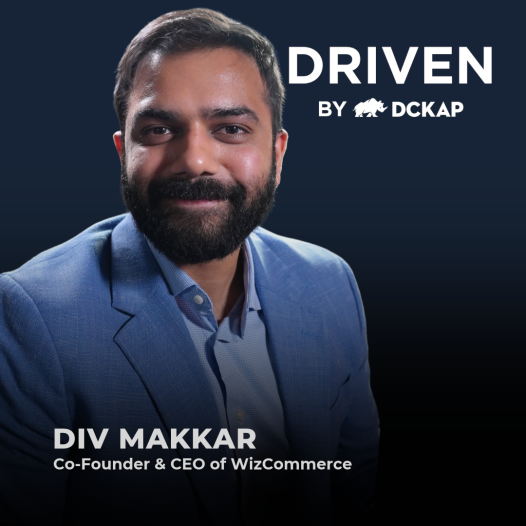
Div Makkar, Co-Founder and CEO of WizCommerce, joins Karthik to break down where that gap shows up and what it costs. While consumer-facing ecommerce platforms like Shopify prioritize speed and simplicity, the B2B commerce landscape runs on complex contract pricing, long-term relationships, ERP integrations, and buyer expectations that off-the-shelf solutions weren’t designed to handle. WizCommerce customers typically see their active customer base climb from 25–30% to 60–70% once their wholesale and distribution operations are aligned with how professional buyers actually want to do business.
This conversation covers practical ground for leaders in wholesale distribution and supply chain: where AI is delivering real ROI right now (one customer saved $500,000 in six months on product content), why your SMB long tail may be your highest-margin ecommerce opportunity, and what the shift toward AI-driven order and quote automation actually looks like in a B2B environment.
OR LISTEN ON:
Div Makkar: We don't look at ourselves as a commerce platform. The way we
think about Wiz Commerce is that we're building an AI operating system for
the space.
Karthik Chidambaram: So how are you competing in this space?
Div Makkar: Commerce in general, it's always been thought of from a B2C
lens, whereas B2B just fundamentally is different.
Karthik Chidambaram: Is that what you're seeing as well in terms of
adoption? Because that's a challenge, right? What is the ROI?
Div Makkar: I think that's where we see the strongest adoption of
e-commerce, and it's one of the metrics that we track for with our customers
is the percentage of customers that are reactivated.
Most of our customers go from a 25, 30% active customer base to 60, 70%.
Karthik Chidambaram: Internally, are you using AI as well for developing Wiz
Commerce tools like Copilot and all that? Are you seeing significant saving
of time?
Div Makkar: We've built a full AI native CRM- ... a full e-commerce
platform, two AI agents and a full product engine.
All of this we've done in, what, two and a half, three years.
Karthik Chidambaram: Div Makkar, Whiz Commerce. So Div, you were pursuing
your MBA at Haas, in Berkeley, and then you decided, "Hey, I'm not gonna do
MBA anymore," and get on to build or start Whiz Commerce. Why is Whiz
important?
Div Makkar: I think a bit of personal story there, Karthik.
So I was- My wife just completed her MBA when I was starting my MBA, and her
MBA gave me a pretty good look at how useless my MBA was gonna be. So I
think it was- that was one of the levers. I always wanted to start my own
company. And before starting Whiz Commerce, I was actually at Bessemer
Venture Partners.
I was doing a lot of investments in software. Not so much AI back then. And
Bessemer has a very deep vertical software practice, so they were the first
investors in Shopify, Toast, ServiceTitan. So the whole space of vertical
software was very interesting to me. And so when I thought about starting my
own company I had a lot of family in manufacturing, in wholesale, like all
of us know people.
And it was just one of those things. I've never seen anything built for them
specifically, so I just started doing my rounds and just started meeting
people. And it was pretty clear that people were still running on 1980s tech
stack. Not many people had deeply thought about technology in that space.
And if you think about it, like distribution, wholesale, manufacturing, they
run the world we live in, but the tech world I think, left them behind. So
that was the trigger to start Whiz Commerce. It was to bring technology to
one of the most important industries around us that we all seem to interact
with, but never think about.
Karthik Chidambaram: I'm not a fan of MBA either so I'm glad you dropped
out. So talking about commerce, right? So you talked about Shopify. Shopify
is huge.
Div Makkar: Yeah
Karthik Chidambaram: I'm a big fan of Shopify. I love what they do, but
they're also making massive investments into B2B, right? So it's not just
Shopify, but there are other industry-specific commerce platforms out there.
Like for instance, if you talk about Janssen, there is commerce for Janssen.
You talked about vertical industries, right? Yeah. So the same thing for
plumbing or there are even industry-specific or ERP-specific commerce
platforms out there.
Div Makkar: Yeah.
Karthik Chidambaram: So how are you competing in this space?
Div Makkar: Yeah. I think, Karthik, number one, we don't look at ourselves
as a commerce platform. Like the way we think about Whiz Commerce is that
we're building an AI operating system for the space. So commerce is just one
part of everything we want to do for our customers, right? So when we
started, we actually started with a lot of AI p- with a AI native CRM for
salespeople on the road.
And then when that worked really well, people said "Hey, can you help me
with commerce also?" And now we're doing a lot of automation using AI, like
quote automation, order automation. So our goal is not to be like a Shopify
competitor. It's just one of the many offerings- things we do. I think if
you look at commerce in general, it's always been thought of from a B2C
lens, whereas B2B just fundamentally is different.
You will never have a world where all orders just, somebody logs in and
places an order and that's where it ends. It has so many moving parts behind
it. People are conversing with each other. So the way we are at least
building our platform is keeping that relationship in the center.
So our CRM and our website actually interact with each other. Like a
conversation a sales rep might have with a customer actually makes its way
to the website and vice versa so I think that's where we differentiate
ourselves. But, big fan of Shopify as well. I think they've done a
tremendous job, but I feel like if you ask any distributor who's gone live
on a website, it's...
Even for s- mid-market and SMB, it's typically a 18 to 24-month journey.
Average implementation time for our customers is typically 90 days, and when
it goes to the 90-day mark, we are freaking out "Hey, why- ... is it taking
so long? It should be faster." So it's about just focusing and making
everything as much out of the box as possible so that it's not a big drain
on resources.
It's not a two-year project. In two years, world completely changes around
you. And If you think about even workflows, they completely change in a
two-year span today. So taking two year to do any pro- project f- even for a
company is maybe 10 years back was okay, now it's not okay, because so much
of the technology around us just changes so frequently.
Karthik Chidambaram: And I was talking to David Gordon, with Electrical
Trends Channel Market Growth. One thing he was telling me is with respect to
commerce, it's still not all the distributors are ordering from the website,
it's just more like a tool for reference.
Div Makkar: Yeah.
Karthik Chidambaram: They look at it, and it's still a relationship game,
like what you talked about. Is that what you're seeing as well, in terms of
adoption? Because that's a challenge, right? So okay, I spent 90 days
implementing it. What is the ROI? Where is the return on investment for it?
Div Makkar: Yeah. I think the way to think about it is in customer segments.
So if I'm a distributor, I have different kinds of customers, right? So I'm
gonna have my large customers. For them, website, probably they're not even
gonna come on my website. They're gonna use EDI or APIs to interact with me,
and it's all gonna be relationship based, right? Then I have these middle
mid-market customers where they're still not small enough to poke around my
website.
They have multiple purchase teams. Decisions are made somewhat centrally.
But they're also not big enough to implement something like an EDI, right?
So those orders still would come in through some form of could be somebody
has a procurement system or their own ERPs, and that's firing an email to my
team, and that's how it's coming.
And then you... Every whole distributor or wholesaler has that SMB customer
base. Those are the people who get the least amount of love from your team
also. A sales rep doesn't want to go out and, work on a couple thousand
dollar order. I think that's where we see the strongest adoption of
e-commerce.
And it's one of the metrics that we track for with our customers is the
percentage of customers that are reactivated- So we see like almost most of
our customers go from like a 25, 30% cu- active customer base to 60, 70%
because those smaller customers finally have a way to do things on their
own.
They're not waiting on a sales rep or a phone call from somebody. So that's
where I feel like the ROI comes from more than like, if you think your
bigger customers are gonna go that route, I think that's... It's gonna be
very hard to make that transition for them. And you're adding work to their
plate.
Eventually, why will a customer adopt something, right? Because you are
taking some work off their plate. For a smaller customer you are, but for a
larger customer who eventually has to put that order in their ERP or
procurement system, you're actually just increasing their work. It's double
the amount of work now for them and they're not gonna do that essentially.
Karthik Chidambaram: So you're seeing more adoption with smaller customers?
Div Makkar: Yeah. So as a distributor, if I think about my customer base
there, there is always gonna be that long tail of customers that your team
doesn't wanna spend time on, and it's also not good ROI for you to have your
sales team call those people up, right?
That's where you'll get the strongest adoption, and this channel becomes
very strong. And those customers are also the customers where you have the
highest margin, so it's not a segment you anyways want to ignore completely.
Karthik Chidambaram: Div, you talked about things changing rapidly. In two
years everything changes, and there's a lot happening with conversational
commerce or agent tech commerce as well.
So what's really going on there? And the future of commerce is gonna be
different. So what are you seeing in the market or how are you guys
innovating?
Div Makkar: I think it's a question I've thought about a lot, Karthik, but I
haven't found a straight-up answer. Because while in the consumer world, you
know that shopping is gonna happen on ChatGPT or Gemini- and agents are
gonna make some of those decisions for you. It's hard to clearly see how it
will contextualize to B2B where you have different contracts, different
pricing, different freight rules and things like that. So it might be a--
and these are just a hypothesis, but it might be like that discovery is
happening there, but then eventual commerce still ends up happening at at
your website or at like whatever your cart is powered by.
Frankly, like a lot of the work we've been doing internally is to just
streamline distributors' workflows. Like, how can I not have people doing
manual data entry? If an order comes through email, how can I like
automatically sync it to my ERP?
Karthik Chidambaram: That's why you use DCKAP Integrator.
Div Makkar: Yeah. Yeah.
Karthik Chidambaram: Yeah.
Div Makkar: So we've been doing a lot of work on that. Or how do I
streamline my product data management, right? Like it's a big pain area. I
think six months out of the two years of any e-com implementation project is
going-- go up in like cleaning product data, frankly, right?
Like because you have unstructured data from so many different parties, and
then you have to like somehow adapt it to a commerce platform. So that's
where we've been at least currently focusing our our AI efforts. How it
translates to the agent economy is not entirely clear to me, just given how
complicated-
people's businesses are. Once you work with distributors, you understand the
complexity a lot more. Yeah. I-- what are you seeing? Do you have any-
Karthik Chidambaram: Same thing, right? So it's not like a big adoption.
I'm-- I was gonna ask you, what adoption are you seeing with respect to AI?
But not so much on the commerce side, but I definitely see that on the
customer service end. Yeah. So let's say for instance, that's something even
we do internally, right? So we get support tickets. How can we use AI for
better customer support? So even I'm seeing it on the product knowledge
itself, right?
Div Makkar: Yeah.
Karthik Chidambaram: So we see a lot of customers use HubSpot on the
distribution end- ... and they want the HubSpot integrated with the ERP. And
in a way that is great because you're able to pull the ERP data, you're able
to pull the HubSpot data- Yeah ... and you're able to provide a better
experience- Yeah ... in terms of the product knowledge to the customer.
Div Makkar: Yeah. No I think I've-- we've been seeing great appetite from
customers to adopt AI. Like I think And the three parts where our AI
currently touches is like the product data side of it- ... and then order
and quote automation. I would say on the product content, the growth that
we've seen is like tremendous because I feel like that's a pain point
everybody feels.
Because the world around us, like now everyone has multiple marketplaces,
has a multiple channels they're selling through, and each channel has a
different content requirement, right? And- I'm surprised by the amount of
people in a company that are just working on just getting product data
ready. So we've seen a lot of adoption there.
I think there is appetite. I would still think like distribution is a little
bit slower than all the other- Totally, yeah ... categories, but at least
people are exploring more solutions now. And I do think like customer
service will be one key part. It's interesting, like if you ask any
distributor at the end of the day, these are all-- everybody has some bit of
like similar products that they're selling, right?
It's hard to differentiate on the product that you're selling when you're a
distributor. Every time I've asked somebody, and like Zoo Modern, for
example, the customer we have in common "Hey, how do you differentiate from
these 20 other people who are selling the same product?" Everybody says
customer service But I have not met a distributor today who c- who tracks
true customer service metrics.
Nobody knows what their median response time is, how quickly they resolve
queries. So if customer service or relationships eventually is the key for
you to winning business I think there should be faster adoption on customer
service end than we are seeing. And-
Karthik Chidambaram: But yeah, but it's also a lot of relationship game,
right?
So let's say Ziomor, for example, you pick up the phone, you talk to them. I
think that, that is happening a lot in distribution.
Div Makkar: Yeah. No so that's exactly what we tell people. Look at what a
customer service to- team is doing, which is not relation-- central to
relationship. Yeah.
They're spending so much time just fetching information. They're spending
time do- doing data entry into your ERP. If you remove all of those things,
then they will probably spend more time on just actual stuff that create
that value, right? So I feel like- ... the adoption is still slower than it
should be.
I think in the next one or two years, all of us will become very comfortable
talking to AI. So I think that's when the adoption would increase. Because
once you're comfortable, you start liking that experience more because you
get faster answers.
Karthik Chidambaram: Ziomor you talked about is a great example. I've
visited them as well.
Div Makkar: Yeah.
Karthik Chidambaram: So it's interesting that they use Wiz Commerce and the
ERP, and we are able to integrate them- Yeah ... like you talked about,
right? Why do you manually enter data? You shouldn't be doing that, and your
people shouldn't be doing that. Let them focus on better things. Yeah. Just
make sure your systems talk to each other.
Div Makkar: Yeah. And Ka- like frankly, I feel like AI is the first time I
am at least like seeing where I can go to a customer and actually talk
numbers of-- in terms of ROI. If you think about tech, like we all adopt--
I-- We'll adopt a CRM, and then I have to hire two people just to maintain
the CRM. So I feel like the previous generation of all technology they all
promised ROI.
They all helped us scale, but it all came at a higher cost. Like you adopt
Salesforce, then you have a 10 people team to manage Salesforce- ... then
you have outside agencies to manage Salesforce with your internal teams. But
I'll give you an example. I have a customer who spends like maybe a couple
million dollars on product content.
Like they started using Wiz Commerce. We've probably saved them half a
million dollars in six months, and that's hardcore saving, like literally-
And
Karthik Chidambaram: how do you do that?
Div Makkar: So it's creating product content. So for them they are in the
furnishing space, so for them they need images, they need videos.
For them it was, okay, our product will actually ship from our factories to
a studio, so there's shipping cost. Then we have a photography team, then an
editing team who's gonna make it, and then constantly for each marketplace
there are people sitting and making data for each of those. So your
Karthik Chidambaram: team does that work?
Div Makkar: So we've it's a combination of services and AI. So we've built
like a proprietary sort of AI model where you can-- Like if you ever buy on
Wayfair, there's five or six images that you will always see, like a full
imagery, right? You'll see dimensions, you'll see lifestyles. All of that is
now being done by AI.
And at a, like literally a fraction of cost and also time, because these
companies are always behind on the content needs, right? Nobody is ahead of
it. Everybody's three or four months behind the products they want to
launch. So it's also like you're, number one, saving them money, but you're
also increasing their go-to-market speed.
And we are seeing that across the board, right? People who are like on the
AI order entry side and quote side, our typical pitch is like, "Hey, if
you're hiring... If you're g- if you're growing, that means you're gonna
hire three more ISRs this year. Instead, why don't you try this and give
your...
Each of your ISR is spending 40% of their time doing this job, right?" And
that's where people can then, ISR is
Karthik Chidambaram: independent sales rep?
Div Makkar: In- in- inside sales rep.
Karthik Chidambaram: Inside sales rep. Yeah. Okay, yeah. Okay.
Div Makkar: Because those people are usually getting quote requests and
getting- ... order requests, and then they're entering those in the ERP.
So pretty straightforward- ... to see ROI in these cases, right? Compared to
cloud or I would say the just the last tech revolution, which is why I feel
like most people didn't take those as seriously as they're taking this
Karthik Chidambaram: one. Yeah. And internally, are you using AI as well for
developing Wizcommerce?
Tools like Copilot and all that, are you using that a lot on-
Div Makkar: Yeah ...
Karthik Chidambaram: are you seeing significant saving of time, or what are
you seeing there internally?
Div Makkar: So I- Karthik, we've built a full AI native CRM, a full
e-commerce platform, two AI agents, and a full product engine. All of this
we've done in, what?
Two and a half, three years. So I don't have a comparison meter because this
is the first time I am running a company. But I feel like this is pretty
fast because you typically like... I would think just one of these products
would be a full company and would take 100 people to develop.
So we are definitely seeing, like, the rate of development has become very
fast, and that's how you can go out today and say "Okay, I... Why do I need
to be a point solution in a distributor stack? Why can't I be like a
solution where they can solve multiple of their workflows?" And then
everything is already integrated, talks to each other, has the same data
model, data architecture, so it becomes...
their life also becomes easy.
Karthik Chidambaram: And the CRM is for wholesale distribution as well?
Div Makkar: Yeah. Yeah.
Karthik Chidambaram: Okay. Div what are some podcasts or what are some books
you read, and how do you keep yourself updated? So who are the people you
listen to?
Div Makkar: Yeah, I listen to, So there's a couple of pod- like, there's a
All-In podcast that I listen to every, that's like my Sunday watch, and 20VC
podcast. These are the two tech- ... podcasts that I listen to though I
would say they've become very polarizing now. But like... I'm constantly
reading about what other companies are doing. So for me I don't know a lot
of ideas that I get, I don't get them from, looking at what Shopify is
doing.
I would, for example, looking at some NYC company that's solving something
for a completely different category, and then just use, seeing that- use of
technology or application can give you interesting ideas on what you can do
here. I don't remember the name of the company, but they had built some.
So in freight also, quoting is a big challenge, right? If you've ever tried
to get a freight quote, it sometimes takes 48 hours, 72 hours. It's very
painful and it's completely manual. You have to email people, especially if
it's cross-border and stuff. So there was a company in NYC, which had
automated that, and that actually gave me the idea that, okay, oh, this is
interesting.
So we can also actually automate order entry because on our... on my own CRM
sales reps write orders every day. So I was like, I should just go and
disrupt my own platform in some ways.
Karthik Chidambaram: Yeah, I like reading about companies as well- Yeah ...
and also look at people behind it. Yeah. I think it's a fun thing to do.
The theme of this podcast is driven. So how are you driven?
Div Makkar: I think I grew up in India, Karthik. I lost... single parent
family. Just... I have been driven by just I would say, just had to do
things right. Like- ... you just had that pressure from... I was the elder
of the two brothers, so I always had that pressure, and I think that just
became a habit now.
But I love getting new things to market. I- my first job was management
consulting. I hated that job even though it's a good lifestyle, but it's
like, why am I just proposing things? Why am I not bringing them into
action? And I had the same feeling while I was at Bessemer. So I feel like
just getting new things into the market and just adding value and just when
customers actually feel like, okay, you actually solved a problem, I think
that's what really drives me.
I hate just sitting behind a spreadsheet. I really want to be on the ground
and doing things with my team and visiting customers at their location and
making things happen there.
Karthik Chidambaram: Feet on the street. Yeah. So Div, thank you so much.
Great chatting with you. Thanks for joining us.
Div Makkar: Thanks, Karthik.
Karthik Chidambaram: Yeah.
Sign up to receive email updates
Enter your name and email address below and I'll send you periodic updates about the podcast.