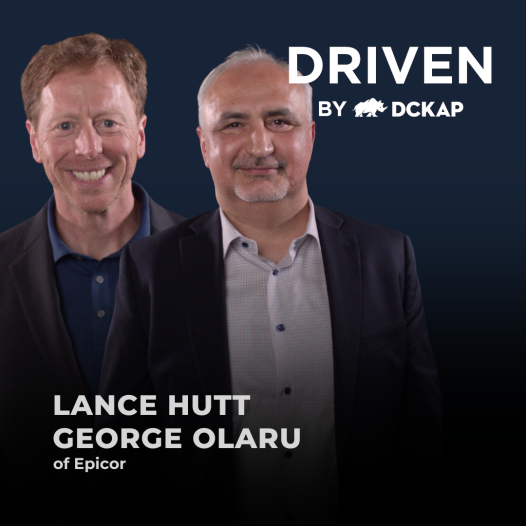
The conversation covers how Epicor is fundamentally rethinking what an ERP platform can be. George breaks down headless ERP architecture and Epicor’s Agent Foundry — a new AI-powered framework that allows companies to build custom agents and consume ERP data through their own preferred interfaces, without sacrificing governance or data security. Lance explores the growing portfolio of strategic applications — from EDI and inventory planning to connected worker software and CPQ — that companies like Anheuser-Busch and Johnson Controls are using to scale operations, many of them as standalone solutions outside of Epicor’s ERP ecosystem entirely.
Together, they dig into the consultative philosophy that drives Epicor’s go-to-market strategy: the MEDDIC sales framework, the Customer Value Exchange Workshop, and why the best question a customer can ask isn’t about features, it’s about business challenges. For anyone in B2B distribution, manufacturing, or ERP-adjacent tech leadership, this is a practical look at how modern ERP strategy is evolving well beyond the system of record.
OR LISTEN ON:
Karthik: George and Lance, thank you so much for joining me, and I'm excited
for this conversation today.
Lance: We are as well, Karthik. Yeah. Thank you so much for the invitation.
Karthik: Thank you so much.
George: Yeah. Good to be here with you.
Karthik: George, let's start with you. What's new at Epicor?
George: Sure. Well, I mean, you saw the big announcements coming out today.
We are literally changing the way we think about ERP in general, and it's
all driven by the feedback we see in the marketplace and by our strategic
investments, but primarily by our customer base. So, you know, looking at
how AI can continuously shape our customers and help them tap into the
make-move-sell data structure they have and, but really enabling that as,
you know, that whether you are in our applications or you prefer to tap into
the whole data from outside Epicor, that's something we can deliver right
now.
So we are very excited.
Karthik: You're tapping into data from even outside Epicor. It could be
tapping into data from Claude or ChatGPT.
George: Yeah. We think that, and we've seen customers being on a very large
spectrum when it comes to AI adoption. Some of them are very advanced, and
they have their own AI initiatives, and they want us to work with them to
enable data access.
And others really look at us as business advisor, where we do believe we
have our competitive advantage by being in 50 years in the ERP space, and
they come to us waiting for a solution. So we can offer both, right? We, we
allow them to consume our ERP data in a way that makes sense for them.
Karthik: But then, , when you're exposing your ERP data- Mm-hmm
to other systems like, let's say, a Claude or a ChatGPT or a
Gemini, then there are also security concerns.
George: There'd always be security concerns. Right? So we try to
do this through our own infrastructure, right, our own ACP layers that will
really ensure that the data governance and the trust go along for the ride,
which we believe right now is really the responsibility of the software
provider, ensuring that you have governance, auditability, traceability,
reversibility, um, that all stays with us, and that's what we feel is really
important and critical for all the customers regardless of what AI strategy
they wanna deploy.
Karthik: And Lance, you work on the sales side of things.
Lance: I do.
Karthik: You know, so it's really cool to have both of you in the same room.
Karthik: So when you talk to customers, or when you talk to
prospects, are they already updated on the latest and greatest which is
happening? Or are you mostly, , educating them with respect to, "Hey, you
know what?
This is the new thing. You should try it," or customers are demanding that
from you? What do you see?
Lance: Yeah. Yeah. So I'm responsible for our strategic applications, of
which we have 20. And I'm responsible for nine of those applications
that have come to us by way of acquisition over the years. They're products
that get sold both independently as well as within our ecosystems.
And so we, we look to understand in a consultative way, what are the key
KPIs that our customers are looking to drive against, and then how do those
strategic applications or, or other applications fit within that? And then
we drive our recommendations against what their priorities.
Karthik: And strategic applications are applications like GROW, the GROW
platform would be-
Lance: Yeah
a strategic application. That would be one of several,
right? So GROW, EDI, IPO, which is our inventory planning and
optimization tool. You know, there, there's a host of them that we can talk
about.
Karthik: And our customers today can they need not be Epicor ERP
customers, but they can just be your strategic application customers?
Lance: Yeah, exactly. So I host a session tomorrow where I'll be speaking to
about 100 and so influencers that are here at the show, and one of the
points that I'll be making is that when you think about Epicor, don't just
think about us as an ERP solution provider, but also as a, a strategic
application provider with standalone solutions that get used by companies
that y- would surprise you, from Adidas to Johnson Controls
Karthik: And, when you talk about these strategic applications, right?
So you find a lot of... I mean, one thing I love about your strategic
applications is it's not just the Epicor solutions, but you also allow your
competition to compete with Epicor products. Yeah. So that's something I
really like- Yeah ... and we appreciate that.
Lance: Yeah. There was an- I think that was one of the themes from today's
main stage presentation, is that we have an open architecture, a headless
ERP-
and this agent foundry solution that was presented, , enables, , really an,
an open architecture and, and the same with our applications.
Karthik: And George, you know, talking about headless ERP. Sure. So what is
the headless ERP about?
George: Well, I mean, the headless ERP, which, you know, again, it's an
industry term that's becoming fairly popular, it's the intent of letting the
user experience the whole ERP processes using their own interface, right?
So you're no longer subject to learning how to navigate an ERP solution,
which may be, you know, difficult to learn for some, but instead you can
consume that data and all that business ontology using your preferred
interface. So you can actually design your own interface and connect it back
into Epicor data while still retaining that level of trust that we need to
resp- be responsible for.
Karthik: And where are you getting all these ideas from, right? So do you
get feedback? I mean, you have- Mm-hmm ... a customer workshop or something,
you know, which we talked about.
George: We do, we do get a lot of feedback from our customers. Yeah. They're
a primary driver for our roadmap. We have customer advisory boards.
Every time we come up with a new release, we typically do early release
early adapters or a control release to get additional feedback before we go
and, you know, make a product generally available. But in general, we are
also looking at where the industry's heading. There are all these inflection
points that happen in the world of AI, and Epicor has always been an
innovation company, so we try to, to point to north for our customers,
thinking that, you know, eventually they will feel that we are a partner for
them in enabling them to tap into the latest technologies as well.
Karthik: And what is the inflection point you're seeing, , happening with
ERPs today?
George: Yeah. Well, I think a lot of, a lot of changes happened maybe, like,
December last year when, you know, some of the f- you know, most common
LLMs, they, they, they went one level above in what they can do with Claude,
you know, Code or Codex and such. So, you know, customers see that, and ERP
companies and software companies in general see that, and they expect the
same level of, you know, flexibility, if you will-
from their traditional ERP provider. And I think Epicor today make a bold
statement by, you know, the announcements we made to being the first, you
know, company to embrace it fully. Our Agent Foundry and, you know, the
vision for a market space that, , I think will give customers, as well as
business partners, right, as we are talking, the possibility to develop
their own agents and really connect everything in an ecosystem that I think,
you know, makes the, the sum of all parts stronger than what an individual
can do.
Yeah, the marketplace
Karthik: is great. I mean, I think that's gonna add a ton of value to
customers. Yeah. We're really looking forward to that. What's the Agent
Foundry, -
George: Agent Foundry, if you will, is, um, you know, we still put forward
this lux design principle, which in a way will ensure that all these
applications will have a common user look and feel, right?
It's more of a set of guidelines, not necessarily, , you know, a predefined
template you need to fit into. But at the same time, the Agent Foundry
allows you to use natural language and really create an extension that might
be extremely useful in your business. Think about it, I want to look at my
customers in a different way, or I want to generate a dashboard that helps
me monitor exceptions, and then I wanna, , maybe even share that with other
customers or partners as
Karthik: well.
And Lance, I was talking to some customers, , some Epicor customers, and
there is this big push on the move to cloud.
Lance: Yeah.
Karthik: And like a few- Yeah ... years from now when you're not gonna be
supporting the on-prem versions-
Lance: Yeah ...
Karthik: anymore. So how- Yeah ... are customers reacting to it from your
perspective- Yeah ... and what are you hearing from the market?
Lance: Yeah. Well, it certainly has created a lot of interest, and, , we had
a record attendance, I think, in part- Mm-hmm ... because of that
announcement, and everyone wants to understand, all right, what does this
mean for me? Mm-hmm. When do I have to move? And, you know, what are the,
what are the benefits of doing so?
And I think today's main stage conversation helped alleviate many of those
concerns, and that they see the value add in being in a, in the cloud, where
they will be maintained on the latest version of our software ongoing.
Karthik: So there's a thin line between sales and solution selling. But
Lance, you know, so there would be instances where Epicor may not be a great
fit for a particular customer.
Yeah, yeah. Or one of the strategic applications you're selling may not be a
great fit, right?
Lance: Yeah.
Karthik: So when do you walk off or when do you tell the customer- Yeah ...
"Hey, you know what? You should look for another solution"?
Lance: Yeah, that's an interesting question. Last year, we as a sales
organization went through a book called Let's Get Real or Let's Not Play,
and it talks about transforming the r- the buyer-seller relationship.
The whole premise of the book is simple. It's about addressing real problems
that the customer... Last quarter, actually, a, a large hardware retail, ,
manufacturer i- in the, in the hardware space, big, big outfit, they're
implementing an ERP man- competitive ERP across 18 facilities over four
years, and they acquired a business in the meantime, and they don't have the
capacity to add that business.
And so longstanding EDI customer, they asked us, "What would you recommend
we do?" And after a little bit of discovery, we identified very quickly that
Kinetic was the right fit. And within 30 days, we were up and down in the
sales cycle on a, on a Kinetic sale, which is all based on the trust that
we've built over the years with the customer.
Karthik: And George, would you like to add anything to that as well?
George: Yeah. I, I think, you know, the other thing we, we try to do
particularly from a solution engineering perspective is really look early at
all opportunities and realize, ask ourselves, "Can we make that a successful
customer? And not only that, can they be a reference for us in the future,"
right?
And that's, that's a very guiding principle that we take in sales. And as we
know customers look at us, we also look at that opportunity internally. I
actually manage a process called account success review, where we get
together product and implementation teams and sales and pre-sales, and we
all look and try to figure out, hey, if we need to walk away from this
opportunity because there are major areas where we don't provide the
functionality needed, we do that in agreement.
But if there are workarounds, we can then collaborate, maybe find an
alternative solution, propose an integration. And that, over time, has been
really successful in us making sure early on we look at the opportunities
and pick the ones that are really going to allow us and the customer to
reach that finish line.
Karthik: But sometimes, you know, the amount of time you spend on a
particular deal, , sometimes you question, "Hey, am I investing the right
amount of time?" Yeah. So Lance, you know, how do you decide? You know,
because- Yeah ... your time is limited. Yeah, yeah. And you have multiple
applications to sell.
Lance: Yeah, yeah.
Karthik: Hey, am I going overboard?
Should I spend this much time? Do you ever have those questions? Because
sometimes-
Lance: Yeah ...
Karthik: I mean, you know, when I talk to customers, "Hey, am I ..." You
know, I obviously, I mean, I wanna educate them. It wants to, it needs to be
consultative selling.
Lance: Yeah.
Karthik: But then, you know, you wanna spend time with the right customers,
right?
Yeah. So do you encounter those issues?
Lance: Yeah. Yeah, so we follow the MEDDIC principle, which I'm sure your
listeners are familiar with, right? It's, you know, metrics. Do we, do we
have, do we have answers to each one of those questions? Do we have a, a
clean, a clear economic buyer? Do we know what the decision process is, the
decision criteria?
Do we understand the metrics and will it pay back? And with strategic
applications, the sales cycle isn't as involved or long typically as an ERP.
So we don't necess- You know, if we can get answers to those questions, we,
we really, um, can decide pretty, pretty quickly as to whether or not
there's a fit.
And, and if not, we exit quickly.
Karthik: Yeah, one of the big advantages of moving to the cloud is the
Prism.
George: Yes.
Karthik: Yeah. So are you seeing a lot of use cases where- Epicor customers
are adopting Prism really well, and are they seeing a lot of strategic value
in the product?
George: We do. We do, and it started to become of almost like a snowball
effect.
Um, I spent some time today in what we call the Leaf Zone. It's our central
area, and I got customers who are on premise who came to talk to us because
of what they've seen on the main stage, right? So it's what Prism can
deliver now, which is an agentic network that does tasks as developer, is
also able to provide the typical answers with reasoning agent and such, but
also where we are heading, right?
Like, the vision that we, we, we wanna invite our customers to join us in
that journey. Um, so yes, Prism, it's a, it's a primary motivator, but
overall, innovation happens in the cloud nowadays. So we want customers to
be on the latest, you know, best solutions we have out there, and that's the
primary reason why we think cloud is the, the default platform that everyone
should go for.
Lance: Yeah. And to add to that, so the, the customers that are best suited
to take advantage of Prism are those that have an integrated solution across
multiple platforms. So it's not just the ERP, but the ERP is the backbone,
and then the multiple applications that surround that ecosystem, when
they're integrated, that data, if it's accessible and it's quality data,
then they can take better advantage of, of our AI tools and our GROW, um, BI
tool.
Karthik: No, well said, right? So integration is a key. You know, you, you
wanna make sure the systems talk to each other, right? That's right. Well
said. And, um, both of you have been with Epicor, , for a long time, you
know. Yeah. You came from an acquisition. You've been with Epicor for over
20 years. Mm-hmm. What keeps you going?
George: I mean, for me, the, one of the firm, you know, beliefs that I have
is really the continuous improvement, right? The way we, the way we do
things as a team, the way we serve our customers, either pre-sales or
post-sales. Um, and really taking that and applying it down to our internal
processes, to the way we, we show up at every meeting.
The fact that we are firm believers in preparing and aligning into the
customer value, , driver. So innovation in itself, , in the world of ERP
continuously... is continuously happening. And, um, you know, both, , from a
personal, as, as I said, as a business perspective, that's one of the things
that keeps me going.
Lance: What keeps me going are the people. , our teams, our cu- the, our,
the people that are customers. You know, one of the few business books that
I come back to time and time again is called Leading from the Heart by Mark
Crowley. Mm-hmm. And it's a book that highlights very compellingly that the
best, highest performing organizations are those where the employees feel
emotionally connected with their leaders and with the work they're doing.
They're, they feel trusted and empowered. And you'll get folks that'll go
the extra mile when nobody's looking, when they feel emotionally connected-
Mm ... to the people that they work with.
Karthik: Yeah, you build a culture, and culture goes a long way. And helps
in-
Lance: Exactly. Yeah
Karthik: a long-term business. So Lance, you talked about the different
strategic applications- Yeah you sell. Yeah. And we talked about Grow, which
I'm familiar with. Yeah. And a little bit about EDI. So what are the other
applications which you
Lance: sell? Yeah, yeah. So, so maybe just a little bit about how, um, the
strategic applications came to be. So there are 20 or so applications, of
which we consider 10 strategic, and these are applications that came through
ac- acquisition and are sold on a standalone basis as well as...
So standalone meaning into non-Epicor ERP customers as well as, you know,
into our ecosystems. And so these include products like EDI and Grow, like
you mentioned, but includes IP&O, our inventory planning and
optimization tool. Um, it includes Acadia, which is our connected worker
software. It includes ECM, our enterprise content management and AP
automation solution.
It includes automation studio, Grow- CPQ. So our, our configure price quote
tool. What am I forgetting?
George: Kiclo product information management.
Lance: Yeah, so our PIM. Our PIM and e-commerce solution is Kiclo. And these
products get used by customers that you wouldn't think of. So, tomorrow as I
mentioned, I'll be sharing a story about Anheuser-Busch, or AB InBev.
They came to us several years ago, and they said, "We have one best way that
we want all of our frontline operators to, to execute whatever they're
manufacturing. How do we best enable our employees all around the world to
do this?" And it started with a local North American, test that,
fast-forward to today is now across all five continents, 160,000 users,
higher quality, reduction in, in costs, and a faster implementation of best
practices as they roll them out.
Karthik: Yeah, George, you know, I mean, Lance talked about the strategic
applications- and during one of our earlier conversations, you brought up
value exchange workshop or something like that you were talking about, yeah.
George: It's as, as I said, you know, my team, we, , we don't only do
pre-sales, we do post-sale- and we do customer engagements. And we are firm
believers that's very important, and it's a way for us to build that
relationship and that trust with customers. Um, typically what we do about
18 months after they go live, we create this event which is a non-billable
event, so it's free of charge, and we bring in product experts from solution
engineering.
We bring in their, , you know, customer account manager. And typically, over
a day and a half, we sit down and give them an opportunity to share with us
how their business has evolved, right? Through the implementation and then,
you know, one year of running on our solutions. Things change. There are,
you know, economy, you know, economy changes, the business model, they may
acquire a company.
So we look at that in a very pragmatic way, and then we interview their
major stakeholders, right? We pretty much do a health check. As an outcome,
we provide a list of recommendations where we have immediate opportunities
for short-term improvement, something that maybe a module they purchased,
they never got to implement it because they were so focused to, you know,
time to value and delivering something really quick, and they said, "Yeah,
we'll get back to that," they never got back to it.
Another way that we s- we help them is we identify maybe medium-term
opportunities that will make transformational changes for their business.
And then as an outcome of that, there are strategic initiatives, right,
where they may want to really partner with us to really create a roadmap or
a footprint for their expansion.
And we find that very rewarding. It, it gives us a lot of insight. It does
create opportunities for us to go back and maybe deepen our relationship.
Um, so there are companies who've been through two, three cycles of this
because they feel it's such a value-add event and, , definitely something we
learn from as well.
Karthik: And this is called the value exchange workshop?
George: Customer value exchange workshop. Yeah, that's the, that's the- And
you
Karthik: do this one-on-one or?
George: We, we do this one-on-one with accounts, yeah. We, we cannot do it
with all of them- ... but we, we identify them, the ones that need more help
or the ones that are facing some, you know, business transformation changes
and they want our help.
And we, we enjoy doing them. And it's again, it's a collaborative effort.
Lance: It really changes the conversation from, you know, how do I maintain
my system to how do I long term get the greatest value out of what
everything that we can offer? And we- because we're, one of the distinctives
of Epicor is that we are so vertically integrated, and we bring that
expertise to bear in these workshops, and we have deep resources across our
organization.
And so it gives our customers exposure to our ex- executive leadership team
in many cases, as well as other experts within their, their specific
vertical and industry, which is really powerful.
Karthik: And in terms of the sales, right? So when you talk to prospects or
customers, um, so you get a lot of important feedback from them.
Is that process you have in place to ensure that that feedback is passed on
to the Epicor team or the solutions team so that they can incorporate that
feedback-
Lance: Yeah ...
Karthik: In the same feature into the product?
Lance: Yeah. We have a system called Aha-
Karthik: Mm-hmm
Lance: that we use to capture- Albeit inconsistently, customer feedback, and
there, those are votes that actually impact our roadmap, across all of our
strategic applications and organization in general.
We're using Salesforce as well, but yeah, the, the system of record is Aha!
Karthik: So Lance and George, what questions do you think customers should
be asking you but that they are not asking?
Lance: Yeah. So when, when we're asked, you know, w- , "Of all the
applications, whi- which should I pursue next?" We, we typically go back to
the organizations and ask, "So what are your key KPIs over the next year?
What are your strategic initiatives?" And then we try to plug in w- where we
have solutions that would help enable them to achieve what is most important
to that organization. Our organization, the, our customer base is, you know,
really runs the gamut in terms of AI readiness, um, their, , where they are
in terms of integrating different solutions across their ERP.
Many customers have invested in the ERP solution, but they haven't invested
in the ecosystem around the ERP, and until that happens, they're not gonna
get as much value out of the AI solutions that we're bringing to bear.
George: Yeah, I think what, what I will say, too, is, um, you know,
companies come to us from the perspective of an ERP provider historically-
Mm-hmm
and then don't realize to an earlier point that we are really a portfolio
company, right? And, , you know, our job is to really build that end-to-end
solution. Sometimes they may not wanna talk about how they plan to do their
configure price quote exercise. They rely upon spreadsheets or, , you know,
they may have these procedures that are written on Word documents that are
not really, you know, easily trainable for new employees.
So we do have solutions that can help fill those gaps, and I think the best
question is, let's talk about the business challenges rather than
necessarily ask us about features and functions, right? It comes out that-
Let's talk
Karthik: about business challenges. Yes. Well said. So George, , my last
question, right?
So what is one thing you're doing to keep yourself updated with so much
happening out there?
George: Yeah, I'm trying to, I'm trying to read as much as I can. I'm trying
to listen to podcasts, right? It's a way to keep a sense of what's going on
in the industry. Sometimes you go back to basics when it comes to sales
engineering.
We have people who in my team have been doing this wor- this work for
30-plus years, , people who have, like, the 10 to 20 years, you know,
tenure, and then we have people who are coming, you know, they maybe started
at Epicor making phone calls, and then they want to transition into
pre-sales, right? So, that spectrum gives us a lot of insight into, you
know, how to keep everyone learn from each other and sharing all that
information and knowledge.
So, personally, as I said, I'm trying to- Whenever I have time, listen to an
AI-related podcast or, you know, learn about trends in manufacturing and
also, you know, talk to customers. We learn a lot from talking to them.
Karthik: Yeah, talk to customers, listen to them, and I also like going back
to the basics, right?
Yeah. Sometimes, you know, it really helps. Hey, you know what? Let's get
back to the basics. Read, get more thorough on the basics and, you know, it
really helps.
George: Yeah. One, one of the books that, you know, we train on is called
Made to Stick, and it's all about, you know, how ideas become memorable in
the mind of a customer or prospect even more so, and how to convey that in a
sales presentation.
It's all about, you know, value engineering and making sure people really
understand you are trying to help them. And for us, the most important
feedback we get is when customers look at us, both from a sales and
pre-sales perspective, and say, "The reason we bought from you is because we
like the interaction that your team had with yourselves and also with our
team."
So that's, that's the biggest compliment we can receive sometimes.
Karthik: Awesome.
Lance: Two things I would add to that. I... One, I'm, I'm a runner.
Karthik: Yeah.
Lance: And I, I love to, to run and listen to Audible books and so things
like listen, you know, , the, the book that I just shared or, um... The
second thing that I would say is just working with folks like George and
across our organization, we have so many talented individuals, and as my
role has expanded, just being exposed to, , to, , collaborating with, , our
solution engineering team, our product teams, um, our AI teams.
There's just a lot of great value that comes from the collaborative work
that happens within Epicor.
Karthik: People make all the difference. So George and Lance, thank you so
much for joining me on this conversation. Really great chatting with both of
you and also learning more about Epicor. Thank you.
Lance: Thank you, Karthik, for the opportunity. Yeah. It's my first time.
George: Thank you. I enjoyed our conversation.
Sign up to receive email updates
Enter your name and email address below and I'll send you periodic updates about the podcast.