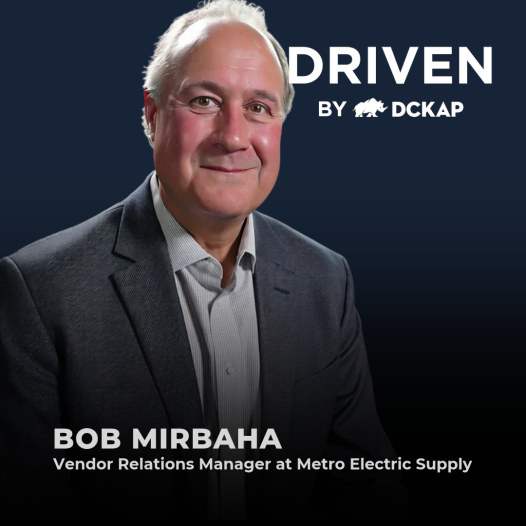
In this conversation with DCKAP CEO, Karthik Chidambaram, Bob breaks down his B2B relationship building philosophy from the ground up: why he goes straight to manufacturers rather than relying on reps, how he decides which vendors deserve his loyalty (and which don’t), and how he approaches vendor management and consolidation in a market where too many partners can actually weaken your position.
Bob also shares what it takes to stay connected as industry contacts move from company to company, and why LinkedIn notifications aren’t enough for real B2B sales success. He makes the case for industry associations like EBMI as the irreplaceable fabric of a regional distribution market, and explains why AI Adoption will free up more time for face-to-face contact, not replace it.
Whether you’re in electrical distribution, wholesale, or any B2B business, Bob’s hard-won wisdom on building lasting business relationships translates across the distribution industry.
OR LISTEN ON:
Karthik Chidambaram: Bob Mirbaha with Metro Electric. Bob, great to see you
today.
Bob Mirbaha: Good to see you.
Karthik Chidambaram: Bob, we are gonna talk about vendor relations. This is
the theme of the conversation. But before that, you've been in the
electrical industry for over 30 years.
You started in distribution 30 years ago, and when you started things were
different, and now things are definitely different. Yes. So what's changed
and what's not changed?
Bob Mirbaha: A lot of things have changed, obviously, and in fact, probably
more so in the last couple years than they had in the previous 28.
But the things that are the same with business, in any business you're in,
is people buy from people they like. And, developing that relationship is
something that I've learned over the years. And to be very inclusive and be
very aware of what are important to people and what's important to them
professionally and, and a little bit socially too, get to know the person as
well, without being prying or anything like that.
And then, A- and it's also a layered effect too, you're not gonna create a
50-year relationship, With one, one meeting, right? Usually. Maybe you do,
but m- mostly at times you don't, and it's really, it's something that you
just build on. You build the foundation of a relationship.
Maybe you know the sit- the company or the family or the wife's name or
something like that, and then you build onto the next time, "Hey, how is
your family?" Or, "How is your company doing? Where are you from?" A- and
then find out things in common, mutual interests, and build upon that as
well.
Karthik Chidambaram: Yeah, like I asked you, where are you from? You said
your family's from Iran and then you moved here or you were born here, and
then went back for a little bit to Iran and then came back. Yeah.
Bob Mirbaha: And next time we see each other- we're gonna say, we're
gonna start from there, right?
Yeah. And we'll build up on that.
Karthik Chidambaram: Yeah. We talk about long-term relationships in
business, or we talk about relationships in business, and essentially what
you're doing is you're truly doing that. You're building those long-term
relationships because, the companies you were doing business with 30 years
ago, you might still be doing business now.
Or there could be companies who have gone out of business. There are lots of
ups and down cycle we have seen through the years.
Bob Mirbaha: Yes, and to that point the people that you meet maybe are in
the same business for 10 years, and maybe they move to another company,
which creates an opportunity to either, learn more about that company or
support that company.
And it seems like change is becoming more often than it has in the
past. Where once, on- somebody might switch a job every 10, 15 years, now
people are switching jobs every two, three years, or five years, and they
don't really get out of the electrical industry. They stay in the electrical
industry.
So they're- my daughter has been in the electrical industry for five or six
years now, and I told her, "Be careful because once you're in, it's very
hard to get out."
Karthik Chidambaram: Yeah, I was talking to Kathryn. But she works for a
manufacturer, OEC Americas.
Yeah.
Bob Mirbaha: Yeah she's done real well, and she's embodies a lot of the, the
things that when you're starting to learn about people, she's an athlete,
and what's important to her competitiveness, and but we were just had a
vendor lunch and we're talking about travel schedules, and this younger man,
he's like, "Gosh, I travel a lot. I even go to St. Louis a, a, a lot, and
even though it's not my territory. My territory's in the New England area."
And I go, "Let me know when you come into St.
Louis, because we've got baseball tickets." "And I know you're a Chicago
White Sox fan, so if they come to St. Louis, I can hook you up with those
tickets. You can check it out." So he's already thinking, "All right. Metro
St. Louis." "I'm gonna, I'm gonna go see Bob or talk to him."
And or at least he'll say, "At least he's nice enough to offer me some
tickets."
Karthik Chidambaram: No, totally, but how do you find the time to do it,
because you're running a business and you're taking care of vendor relations
at Metro Electric, and then you're busy at home as well. But how do you find
the time to accommodate this?
Bob Mirbaha: Ah, you carve it out, a lot of people say, "I don't do business
lunches because they're too distracting." The point of the business lunch
isn't to be fed, it's to get to know the person on the other side of the
table, or participate in activities that are after work or during work,
maybe, during work hours.
Electrical board the industry associations that have the NAD, the electrical
board. And then there's other things too that, that are based socially.
There's golf leagues, there's other events that are tangently associated
with the electrical industry, and just try to attend one or two of that,
participate in them, because they're there to help make you a bigger part of
the whole industry, and
Karthik Chidambaram: you're also the chairperson of the board at EBMI.
Bob Mirbaha: Yes. Yeah. And EBMI is something that has really enhanced my
career over the years. It's it's, EBMI is the Electrical Board of Missouri
and Illinois, and what that does, it encompasses all facets of the industry
from manufacturers to distributors to manufacturer's reps, and to the
customers themselves, and it's based soundly on education, so we have code
classes. We have classes that help contractors earn their their points so
they keep their licenses up. And every three years we have a e- electrical
expo where, which is attended by hundreds of vendors, and it's just t-
state-of-the-art what's going on in the electrical industry as it pertains
to St.
Louis, St. Louis general area, the electrical, Missouri and Illinois.
Karthik Chidambaram: Yeah, we love the EBMI organization as a whole, we were
a part of it last year.
And we are continuing to support the organization. So great work you're
doing there. But talking about vendor relations you also talked about people
moving jobs, especially that's true right now than it was in the past, but
people still stay in the electrical industry. But how do you keep in touch
with that, right? So let's say somebody's working in a company and then
they're moving to another company. How do you keep track of all this? Is
there like a trick or any tips you would offer around that?
Bob Mirbaha: A lot of ways is through ind- is through associations like
this, where you come and I just saw somebody in the hallway. I'd actually
saw him last night passing by. And so I saw him today, I go, "Hey, TJ, I
just learned that you weren't with Sero anymore. You know- Yeah you're
with your own rep agency."
So he says yeah." And so we talked a little bit about that, and he's out in
New England, but we had a really good talk. It's just, it's more common than
not, so it's the new norm, right? People are gonna move, and then you take
that relationship, which is independent of really w- what they were, where
they're at, and you can build upon it anew.
And it's an opportunity, I think.
Karthik Chidambaram: Yeah, I really like this. It's not just about LinkedIn.
In a LinkedIn, when you're LinkedIn, I use LinkedIn, but then, it gives a
feed, right? Hey, this person has changed jobs. But then, hey, we
congratulate the person, "Hey, congratulations on this new position," and
then sometimes forget about it.
But then, like you rightly said, going to events, conferences, you meet
people, then you remember. Hey, you know what? Okay, you have a conversation
and then, "Hey, okay, you've changed jobs. Okay, we understand." I think
that's exactly how you stay in touch, and I think this is really practical
advice out- outside.
Bob Mirbaha: And then those people are resources too, not exploitive, but
just as a resource say, "Hey, when we had that problem with this situation,
we, you were able to handle it this way. You think they'll be open to
handling it this way?" The person rep- replaced you, or maybe they had, "No,
but I know somebody who can."
So you never lose that. It's like a book on a shelf, and after a few years
you've got a lot of books on the shelves, and you every now and then you
just gotta pull one off and remember what that was all about.
Karthik Chidambaram: And you're also sharing the story of Carl, right? So
one of your-
customers. I thought that was very interesting, he still calls you when the
order is ready.
Bob Mirbaha: He got my number- this is during post-COVID. So COVID
and all the disruptions that it caused their supply chain to be disrupted
and they were struggling.
They're struggling to fill orders and it was down to the point where we're
in critical situation where we needed some of the product because we were
several months behind. And Carl left a message on my phone and Wow, this,
this guy's reaching out- letting me know that the order's ready.
He's real proud of it. He's got it all stacked up and things like that. So I
called him up. I go, "Carl, thanks for the phone call. Keep my number. Let
me know about these other n- things too. But I tell you what, I bet you
don't have a Metro Electric shirt, and he goes, "No, I don't have a Metro
Electric shirt."
Ah, I go, "What size are you?" So I had the drivers deliver a Metro Electric
shirt to him and when they picked up the order, and he called me on that
number and thanked me, and he's just so happy about it. And he wears it, and
when the boys go pick up orders- he's usually wearing his Metro Electric
shirt, and he's real proud of it.
So we've given him a couple more and and but I tell ya, when there's
discretionary orders to be filled, he fills Metro's first, and and he's he's
happy, and our warehouse guys see the value in that too, they're picking up
the order, and they see a guy wearing a Metro Electric shirt, and then
validates that, "Hey, yeah, I'm working for a pretty good company.
These guys are wearing our shirts," and it's just a minor thing like that,
but it really it kinda all helps,
Karthik Chidambaram: it's usually these small things that make a big
difference.
Bob Mirbaha: I think so, and, that, that vendor of ours that had the
problem, they're still having a little bit of problems here and there, but
they're solid.
We're not going anywhere, and they're not going anywhere, and it's just a
minor example of how we try to solidify our relationships with our key
vendors.
Karthik Chidambaram: Talking about vendors, the one thing is to work with
existing vendors like Carl, and, and making sure that you build a great
relationship.
But then you also have to find new vendors because things are always
changing in the market and all that. How do you find new vendors, and what
is your approach there?
Bob Mirbaha: So I don't think there's a really one standard way of doing it,
but we're do- we're going through that process right now where I we sit down
and we identify let's just say eight points that are val- that are paramount
concern with this type of vendor that we're looking for.
And then I'll draft a, a letter, and I'll send it to eight manufacturers
that we have relationships with and say, "These are the things that we want
to talk about, and what are you gonna, what can you do for us?" And so when
you're making vendor conversions, it's important to get as many people
inputting as possible, okay?
So we get the, of course the general managers, and then we get the
president, and we get the warehouse manager too, 'cause maybe the product
doesn't stock as well as the other products or something. We get some
information on that. And we try to get that first round done, extract the
data, present it back, to, the four or five people that need to have an
input on that, and then we d- we whittle it down because really- And I think
a lot of distributors are going through this right now.
We have too many vendors, and when we have too many vendors, then we're not
as important as we could be to the ones that really have our backs, and I
really believe that.
Karthik Chidambaram: And do you work directly with the manufacturer or
through the manufacturer rep?
Bob Mirbaha: No, I will go straight to the manufacturer.
The manufacturer rep is there to facilitate when needed. But my philosophy
and strategy has always been to have a good relationship with the
manufacturer's executive team.
Karthik Chidambaram: Okay, so you work directly with the manufacturer, and
then once you finalize on the manufacturer, then you work through the rep to
get the orders?
Bob Mirbaha: Yes. But sometimes I influence the manufacturers on which reps
are worth their while. Because there's some- I'm very strongly
opinionated that through, 30 years of experience, I know who's who, and what
does, who does what, and where the value is and I can back it up with
facts and reasons that are sound.
Karthik Chidambaram: And what should a distributor look for when it comes to
choosing a manufacturer rep?
Bob Mirbaha: It's, I think in St- Every market's different. Some markets
have a lot more distributors than others. In St. Louis, I think it's
important to have somebody that's organic, from the area, grew up in the
area.
Could be generational, where there's, the second or third generation. And I
have a reluctance to choose any other type of rep other than something like
that. Why
Karthik Chidambaram: is that?
Bob Mirbaha: Because the, the reps that have a multi-state, they're, they
cover different markets. They're not necessarily familiar with the St.
Louis market, and they try to do a one-size-covers-all type of- philosophy,
where they have a tremendous inside staff, but That's good for
support, but when you're out on the streets in the trenches, you need
somebody that knows St. Louis, you need somebody knows that, who the
decision-makers were, who they grew up with, where, what high school they
went to.
Those type of things, because it really makes a difference, again, going
back to relationships. Because those guys have relationships that somebody
coming in, say from Chicago or somewhere else, they're starting from less
than zero, 'cause they gotta not only know where the business is, but then
they gotta meet these people and develop some sort of rapport with them
because people like to buy from people they know and
Karthik Chidambaram: and who do you define as the vendor in your business?
Who would be the vendor?
Bob Mirbaha: The vendor? What do you mean?
Karthik Chidambaram: Like for instance, your vendor relations, right? So you
manage a, you manage vendor relations. Is it like the manufacturer you refer
to as the vendor, or who do you refer to as the vendor?
Yeah.
Bob Mirbaha: Yes, I would think the manufacturer. So- Okay like a
Siemens or, you know-
Karthik Chidambaram: Okay. Yeah. Yeah. That's what I was asking.
Bob Mirbaha: Okay.
Karthik Chidambaram: Okay. But then, I also think so vendors are like
partnerships, they are very important. And like you rightly said, whoever
you work with on the vendor side, pretty much it's like, it's as important
as an employee, because the, that, it's a true partnership in a way.
Bob Mirbaha: So philosophy we have is try to be one of the top, distributors
for that vendor where- when possible. Sometimes it's- you can't because
everyone has a certain, a vendor and, you know, and it's the size of
your company that dictates that. But there's, there are some vendors that we
are key with- and we're the largest and therefore we can do the
discretionary stuff falls to us. We can do the things that require
extra effort because, we're the strong partner. And, and we're, on our side,
we're exclusively selling their product and doing a good job at we have
eight electrical counters, six lighting showrooms.
So we have 14 profit centers that we can market some of these goods through.
Karthik Chidambaram: But then you would work with multiple vendors and-
would, they would also compete with each other.
Bob Mirbaha: Yes.
Karthik Chidambaram: So how do you- you become more friends with
somebody else and less- how does that work?
Bob Mirbaha: That's a good question. So really you have to balance that,
right? I make it very clear to some vendors that sell, you know- eight
different items that six of these items I'm buying from them, but two of
these items I'm buying from someone else. And they said you should buy it
from us." I go, "I have a great relationship with them.
We do v- they do very well. I have a great relationship with you. You guys
do very well, and I'm not" I got more priorities than disrupting
something that's doing very well. I would concentrate my time and energies
on what needs to be corrected, and so that helps, too. But at the end of the
day, you've got, say you're dealing with 100 vendors, and 80 of them are
locked in.
It gives you, it frees up some time to deal with the other ones.
Karthik Chidambaram: Sure, totally. But then it also boils down to the cost.
Let's say you have a great relationship with a particular vendor, but then
you're paying a few percentage points more. But then another vendor comes
up, "Hey, I'll sell you the same product, but I'm gonna offer it to you a
little less."
But then, it could look small, but if you're talking about big volumes- Yes
the numbers add up.
Bob Mirbaha: No, that comes up all the time. And it depends on the product,
of course, and the situation. But I've had vendors come in and say, that I
have no relationship with, unsolicited, and say, "I'll sell you this widget
for $25, and I know you're paying $33."
And that might be true, but the intangibles come into play. What's, what
kind of warranty, what kind of backup, what kind of, stock rotation? What
about defectives? Or, where I say, "Listen, I don't care if you're gonna
sell it to me for $4. I'm not gonna buy it from you, all right?
Because I've got this in place. I know how to do it. I can make money doing
this." But where there's a discrepancy Between two established vendors, then
usually you can negotiate down the price to a satisfactory level because
they know that their competition is competition, not one, one-shot deals.
Karthik Chidambaram: For the other distributors watching this, what advice
would you give for them to manage vendor relations?
Bob Mirbaha: Just keep an open mind and be very inclusive and be open to do,
Take that lunch meeting, do the guy a favor. He's coming from out of town
and he's trying to fill his slate- and he just wants some time, and it'll
build some good returns because he'll go, "Okay, I met somebody
down in St. Louis. He gave me some, some time, some feedback." Sometimes I
won't be able to do business with them. I'll point them in a direction where
they can do business, and I just think that the not shutting doors is
probably the best ad- advice I can give.
Karthik Chidambaram: And what do you mean by be inclusive?
Bob Mirbaha: Instead of shutting Carl off and just dumping his call- Sure
invite him in and say, "Hey, listen, I'm ta- I'm talking to you," and
he's a warehouse guy, and he just happened to have my number during COVID-
to give me. Or go to lunch, and even though y- you don't wanna go to lunch,
it's distracting or something like that, but you're spending time with
somebody that, that you're getting to know better. And and then find out a
little bit more about, what's important to that person, whether it's sports
or...
I don't think we wanna talk about politics, but- kids, family, sure.
Something you guys have in common, 'cause there's always someone you can
find something in common with.
Karthik Chidambaram: Totally. I go take the extra step, I also believe in
this, especially when I am thinking, "Oh, should I meet this person or not?"
I always say, "You know what? It's okay. Let me go meet the person. Let me
make the effort. Let me take the effort to go meet the person," and it
always pays off,
Bob Mirbaha: Remember our conversation- Yeah we were talking about India
and then- Tamil, and I was telling you- Yeah I want to go to Sri
Lanka.
You goes no, you just- You can get the same thing in- down there. So just- yeah just go there. So now-
I'll remember that. And when I- when I go there or have
some good Tamil food, I want to say, "Hey, remember?"
Karthik Chidambaram: Definitely. Yeah. Bob there's a lot of talk about
distributors using AI and automation that is happening in the industry, but
you are taking it with a pinch of salt.
So what is your approach to it?
Bob Mirbaha: AI is it's definitely an accelerator in, in the business world.
And I've been using it with Copilot, Microsoft Copilot to great effect. But
it just can't- You know, it can't replace the handshakes or the fa- the
eye-to-eye contact and the face, face recognition.
It's in a little bit of ways, it's what happened in COVID, where people are
trying to, you know- exchange face-to-face meetings with Microsoft Teams
and, Zoom. And it worked short-term, but it's not a good long-term strategy.
Karthik Chidambaram: I think it's a great example.
And comparing AI with COVID probably is the first time I'm hearing this. I
relate to this really well, right? Because I think COVID was pretty tense,
it wasn't easy. And we thought, "Okay, everything could be done virtual." So
the world's gonna be like this.
That, maybe that's the very short-term thinking.
But fast-forward a few years we have leveraged that. Maybe we have moved
forward multiple years, maybe multiple decades with remote and distributed
work. But still, the face-to-face meetings, the handshakes, they matter, and
they go a long way.
Bob Mirbaha: I agree. I agree. And I think what AI will do, amongst a lot of
other things, is it'll free us, free our time up for more of the
face-to-face if, the, the associations like the NAED and the EBMI will never
go away because you need that interpersonal contact.
Karthik Chidambaram: Yeah, I also like it in a way because let's say if I'm
doing work, right? I'm able to do a lot of work in meetings. Let's say even
if I wanna talk to you or something, it's not required for me to come to St.
Louis all the time. I can just pick up the phone, call you, or we can have a
Zoom meeting and see each other and talk, have a good conversation, maybe
even do business. But then, you come to association meetings or you go to a
conference. I'm not able to just meet you, but I'm able to meet a lot of the
people.
So- I think it really helps, and it's very productive, too, that way.
Bob Mirbaha: I think you have to use both of them, right? Because if I never
met you face-to-face or in person and only had conversations with you
through Zoom or Microsoft, I think that it wouldn't be as effective as this.
Karthik Chidambaram: Yeah. So Bob, really enjoyed this conversation. Thank
you so much for joining me today.
Bob Mirbaha: Thank you. Yeah.
Sign up to receive email updates
Enter your name and email address below and I'll send you periodic updates about the podcast.