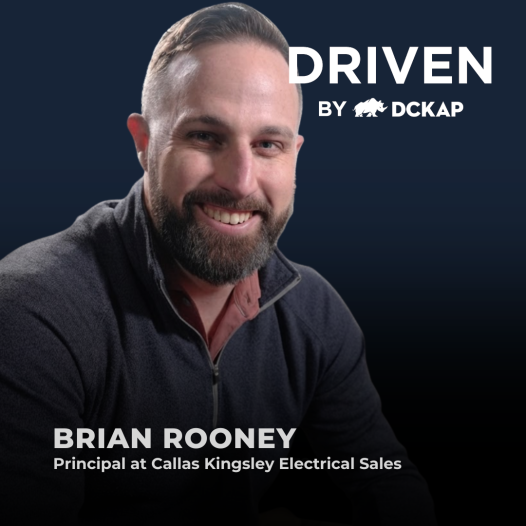
In this episode, Brian explains why the manufacturers’ rep model is uniquely positioned amid the current AI technology race, and how the surge in data center infrastructure is creating a gold rush moment for the electrical industry. As major tech companies race to expand AI data centers and electricity demand hits unprecedented levels, Brian sees the electrical industry as the picks and shovels of this generation’s resource rush.
Brian pulls back the curtain on how the rep model actually works, why distributors rely on reps for specialized product expertise across thousands of SKUs, and how Callas Kingsley approaches long-term relationships with both manufacturers and distributors. It’s a model built entirely on trust, and Brian makes a compelling case for why that’s more valuable now than ever.
OR LISTEN ON:
Karthik Chidambaram: Brian Rooney. Callas Kingsley Electrical Sales. Brian
thank you so much for joining me today.
Brian Rooney: Yeah, thanks for having me.
Karthik Chidambaram: So Brian, tell us about Callas Kingsley. What is that
you do?
Brian Rooney: Yeah, so Callas Kingsley Electrical Sales is an electrical
manufacturer's representative based in Chicago. We're in Wood Dale, just
west of O'Hare Airport, and we get contracted by electrical manufacturers to
handle all their sales, marketing, customer service in a specific geography
For us, that means Northern Illinois, Northwest Indiana, Eastern Wisconsin,
and the UP in Michigan.
So we're tasked with driving all their sales, promoting their products and
for some of them, we also handle some of their lo- local logistics from our
warehouse in Wood Dale.
Karthik Chidambaram: So there are a lot of students who listen to our
podcast as well, a lot of them do industrial distribution, and oftentimes I
wonder too, when we were getting into the market, what does the manufacturer
rep do, right?
So why does the manufacturer need a rep to represent them? Why can't they
sell direct?
Brian Rooney: Certainly, and those are... They can sell direct. Those are
two kind of options that a, a, d- any sales leader needs to make if they
wanna have a direct sales force or if they wanna use a rep, what we would
call a rep network.
Since reps handle different geographies in the United States, it's kind of a
network of reps, 'cause you can't have one or two reps really covering the
whole country effectively. Now, couple things that a rep brings to the table
for a manufacturer that maybe a direct sales force would be a little
different is, one, a long-term tenure, local knowledge people in the market,
also people that are seeing opportunities that are coming from various
product categories.
Because we all handle various product categories across a bill of material
that you might see on a construction job, we find ourselves coming across
more opportunities that can help these manufacturers be successful. Also,
frankly, financially it can be a good move for them, too. How man-
electrical manufacturers' reps work is we generally work on a commission
basis with these manufacturers, so they're paying us a flat percentage of
their sales as far as our compensation goes over time and that remains
consistent.
So if we sell nothing, we make nothing. If we sell a lot, we might make a
little more. So it's a unique kind of way to go to market that is
financially advantageous and also, we'd like to think helps their sales a
little more than having a direct sales force.
Karthik Chidambaram: And you would represent more than one manufacturer for
the same product?
Brian Rooney: So we would represent only one manufacturer for each product
category. We try to make sure that we don't have any overlap, because that
can become a, a, a really big conflict of interest. So in a perfect world,
you try to have, the best manufacturers you can possibly have in each
category so you can cover a full bill of material on a job or for a
distributor.
Karthik Chidambaram: So you essentially stay in the middle between the
manufacturer and the distributor. Is that a right way to put it?
Brian Rooney: Yes. In the electrical channel we're all generally selling to
distributors on behalf of the manufacturer, so we're a link in that sales
chain that helps get the product to the end customer.
Karthik Chidambaram: And you also have your own warehouse where you source
the product from the manufacturers and store it?
Brian Rooney: Yes. So we'll have manufacturers, you know, if they wanna have
products that are closer to the customer base, sometimes, they don't have
enough time to order it from the manufacturer, ship it, might take one, two,
three days to effectively get there.
Sometimes they need it in a matter of hours. That's why a lot of
manufacturers will use our warehouse locally in the Chicago area to store
product so it's closer to the customer. We also provide some other services
for manufacturers around performing a regional distribution center for them.
So we may service, larger portions than just our state of Illinois and
Wisconsin.
We may be shipping around the Midwest or to other places for them. That kind
of helps those manufacturers have some cost savings around their logistics
strategy.
Karthik Chidambaram: And in electrical distribution, pretty much all the
time do distributors buy through manufacturer reps, or do they also go
direct, or it's a mix of both?
Brian Rooney: So it all depends, it depends really on what the
manufacturer's doing, what their sales force is. All the money flow is going
directly to the manufacturer, so none of the distributors are paying us.
They're, that money's going directly to the manufacturer, and then the
manufacturer is paying us a commission on those sales,
Karthik Chidambaram: oh, so the distributor pays the manufacturer directly,
so they don't pay you.
Brian Rooney: Correct, and then the manufacturer pays us. So we don't
collect any money necessarily from the distributors. We do consider them our
channel partners, our customers but no, they're not paying us directly. The
manufacturer's is giving us commission on those sales.
Karthik Chidambaram: And do you typically work just with US manufacturers,
or do you work across the globe, or what is your mix here?
Brian Rooney: We work with any manufacturer that makes a really quality
product that we think we can sell. We're very lucky at Kalz Kingsbury. We
have 16 manufacturers we represent. Nine of those make at least some, if not
all of those products in the United States.
So we do have a pretty good base of American-made manufacturers, but we work
with manufacturers that may make product anywhere.
Karthik Chidambaram: So what are some of the challenges you face, as a
manufacturer rep? What is- Your biggest challenge, yeah
Brian Rooney: I think our biggest challenge is probably the same challenge
that a lot of entrepreneurs and business managers run into, and staffing.
It's getting the right people in the right seats making sure that you can
hold onto people long term. It's something that we like to think we're
pretty good at, but it's constantly a challenge, especially when you
experience growth to find the right people that can help you support that.
Karthik Chidambaram: And for the distributor so there's always a lot of
product knowledge, because let's say I go to a counter and, if I'm not sure
on what I wanna buy, the counter salesman really helps me explain the
product better than somebody at a Home Depot would do, right? So that's why
I go to a distributor.
There's a lot of product knowledge. Is that kind of knowledge needed for
your team as well, or?
Brian Rooney: Definitely. We have to be the local experts for them in our
market to support those distributors and to support those contractors and
end users. When you look at a distributor, they may have, shoot, tens of
thousands of SKUs at any one time that they're selling.
So it's really hard for them to be experts on every single category of
product, so that's where we try to step in, be the experts for them, help
support and make sure they have all the information they need to make the
sale.
Karthik Chidambaram: How did you get into this business?
Brian Rooney: So I'd been in this business since I was 15 years old.
My first job ever was working in a warehouse for a guy named Mike Mulcrone.
He owned a company called Mulcrone and Associates, which was a
manufacturer's rep that's in Chicago. I actually, ironically enough, compete
with that company today. But I started there. I worked in distribution for a
while. I interned for a couple national manufa- or distributors in CED, and
then I worked for Crescent Electric Supply for about seven years.
And about seven years ago, I was offered the opportunity to be a part of the
succession plan at Callis Kingsley, and the rest was history. So I've really
been doing this my whole professional life.
Karthik Chidambaram: And what's next for Callis Kingsley, right? So you guys
are a manufacturer rep, so what's next?
Brian Rooney: So I think we continue to d- We're, we've been on quite a
hockey stick growth trajectory now for the last five years, certainly since
my partner and I have owned the company.
So we wanna continue that growth continue to represent the best
manufacturers in the space. We feel like we do represent those today, and we
wanna continue that on. Continue to service our core markets, which are
Illinois and Wisconsin. We think that we're, we really understand those
markets deeply, the customer bases, the needs and really ride this data
center wave that we're seeing.
It's been huge these last few years being involved in some of these larger
data center projects. We have an unprecedented amount of growth coming in
Illinois and Wisconsin, too, over the next couple of years, so we wanna
continue to be a part of that and be a part of this tech revolution that is
Karthik Chidambaram: AI.
Tell us about the data center projects. This is something I'm hearing a lot,
right? Yeah. So any distributor I talk to, especially in electrical
distribution, they're saying they're trying to serve the data center-
Opportunity of data center market. So what's really going on there?
Brian Rooney: It's, so it's a massive opportunity.
So when you look at these tech companies like OpenAI, Google, Meta
Microsoft, they're all having these, this revolution around artificial
intelligence, and they need infrastructure to back that up, and that comes
by way of data centers. So these data centers are popping up all over the
country because it's truly a race in tech for who's gonna come out with the
best model, who's gonna come out with the best agent that can, that can
support, whatever software it is that they're trying to build, and these
data centers are the backbone of that.
And they require a tremendous amount of electricity and other utilities like
water. The HVAC business is very involved 'cause they may be cooling
cabinets, so there's just a tremendous amount of opportunity here. It's
really a, i've likened it to a gold rush in the past. There's a lot of
opportunity. There's a lot of of building going on, and I'd like to think of
the electrical industry as the picks and shovels of the gold rush. At one
point in time, everybody went west to get gold. Not many people made it rich
mining gold, but the guys selling the picks and the shovels, they all made
it rich, and that's something that in the electrical business we're all,
we're the picks and shovels, and we're really benefiting from this gold rush
right now.
Karthik Chidambaram: Yeah, it trickles down. Let's say OpenAI, Google does
well. They need data centers. It trickles down to HVAC. It trickles down to
electrical distribution and- Plumbing and other- Exactly ... stuff, yeah.
Tell us some tips on how do you choose the right manufacturer.
Brian Rooney: Yeah, so we want to f- the main thing in our business is it's
all based on relationships.
The, B2B is really, at the end of the day, it's P2P. It's person to person.
We want to work with manufacturers, number one, that have, good
infrastructure, have a good product have a good reputation, but we also
wanna work with the people that we trust. So that's the people at these
manufacturers that we rely on day in, day out.
Are they honest? D- do they have integrity? Are they doing the right thing?
So we are evaluating these manufacturers based on the products and the
businesses themselves, but really above all else, we wanna have people that
we trust that we wanna work with that we think can help us be successful and
we can help them be successful.
Karthik Chidambaram: As you're working with many manufacturers, what's some
innovation you are seeing in the industry which is happening right now?
Brian Rooney: Oh, wow. That's a great question. I think some of the, a lot
of the innovations that are coming out are probably not as much new products
per se as maybe tools. We have some manufacturers that have come out with
some very unique tools for contractors on job sites that help lower their
man hours or help them get off the job quicker.
There are some manufacturers also that are coming out with software tools
that are helping, their customer base select the right products or, find the
thing that is the right fit on a job that maybe they haven't thought of
before or make it easier to get technical information like spec sheets,
things like that.
So it's not always necessarily a new product. Sometimes it's software,
sometimes it's tools. Yeah, I'd say that's pretty much it.
Karthik Chidambaram: Yeah, it's not one or the other, it's everything
together, yeah. Exactly. So Brian, thank you so much for joining me. Thank
you. Great chatting with you.
Sign up to receive email updates
Enter your name and email address below and I'll send you periodic updates about the podcast.