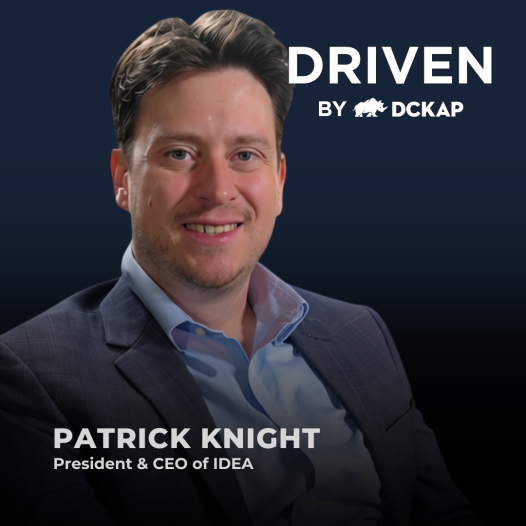
Patrick Knight, CEO of IDEA, joins Karthik Chidambaram to talk about what makes IDEA unlike any other company in the B2B supply chain space: it’s not VC-backed, it’s not chasing an IPO — it’s owned by the industry it serves (NAED and NEMA), and everything it builds is aimed at making electrical distribution smarter and more efficient.
In this episode, Patrick unpacks how AI is reshaping supply chain data management, why data accuracy matters more than speed when wrong specs can cause real physical harm, and what IDEA’s digital transformation into a full SaaS company looks like over the next five years. He also breaks down IDEA’s flagship products (IDEA Connector and IDEA Exchange), newer offerings like DataWhispers and Cross-Check, and the push to adopt ETIM North America standards across the supply chain.
If AI, supply chain innovation, or the future of B2B distribution is on your radar, this one’s worth your time.
OR LISTEN ON:
Karthik Chidambaram: Patrick Knight, CEO of IDEA. Patrick, great to be
chatting with you today, and thanks for joining me.
Patrick Knight: Thanks for having me. Happy to be here.
Karthik Chidambaram: Patrick, you started with IDEA about a year ago, so you
were an outsider and then you got in as the CEO of IDEA. So what was it
like? So what were your expectations coming into IDEA, and then how were the
first few months like?
Patrick Knight: So yeah, so I came to IDEA just over a year ago. I was
previously at Rexel. I've been interacting with IDEA like I think most
people in the industry have been since I started my career, well aware of
the products and the challenges that IDEA is facing or that IDEA is trying
to solve.
And it's great. The team's really awesome. It's a really good solid culture
there which I've appreciated coming into. And, they've embraced my sort of
eagerness to grow. But it's really what I've been brought in to do is grow
the company a little bit and change our mindset.
IDEA's been around for twenty-eight years or something and we have our
reason for being, the IDEA Connector and the product data syndication within
the industry. But we're also looking at growing as a SaaS company, right?
How do we expand into a really more aggressive growth-focused organization
as opposed to an association style organization as we have been previously.
So and that's the task that the, the industry and the board have asked for
us. So it's been fun. It's been a lot of fun the first year.
Karthik Chidambaram: So IDEA started in nineteen ninety-eight. It's an
association between NAED and NEMA. So those two organizations came together.
They say, "You know what? Let's create IDEA."
Is that how it came about?
Patrick Knight: Yeah. There was a coalition of maybe forward-thinking
distributors or manufacturers that, you think about what the world was like
in, in the late nineties, right? E-commerce was in its infancy, and a lot of
distributors were starting to develop websites.
Like what a concept that an electrical distributor would have a website. And
how they were displaying product data from manufacturers was a little bit
convoluted, and we're running into issues where product data wasn't
matching. Distributors weren't gonna be able to load data. Basically
manufacturers were saying, "Hey, distributors, you're not displaying my
product data right."
And distributors were saying, "Hey, you all give me crappy data," and it
comes in thirty different formats. So this concept of a many-to-one to many
organization to generate and manage product data kinda came to be. Back then
it was called the IDW, Industry Data Warehouse. And on top of that we
have the, was the IDX, which is now the IDEA Exchange, which is an EDI
van.
So how do you send information back and forth as, as an industry, and how do
you syndicate product data, right? Through a central hub, through a single
shared language to help reduce sort of the redundancies of, or the
difficulties of sending, product data back and forth, right? Especially back
in the nineties, that was tough.
And you don't really think about the electrical industry as being
technologically advanced but we really were very forward-thinking. A lot of
industries struggle with product data to this day. And the electrical
industry is pretty far ahead of a lot of industries.
Karthik Chidambaram: And IDEA Exchange and IDEA Connector are your two
flagship products.
Patrick Knight: Correct. Yeah, so the Connector is our product. What used to
be IDW used to be the internet, the Industry Data Warehouse. And it's...
Yeah, so we take product data from manufacturers, we syndicate it and we
syndicate out to distribution rather for their PIM or their ERP or their
e-commerce system.
And then the Exchange is an EDI VAN. So VAN's a value added network, right?
It's how we transact EDI via the industry. So distributors send their POs
via EDI, so it's a direct connection from a, a B2B standpoint.
Karthik Chidambaram: I'm an electrical distributor. Let's say I'm an
electrical distributor. I use the IDEA Connector product- get data from
IDEA. How do I differentiate? Because there are lots of other electrical
distributors getting data from IDEA. So what do you see successful
distributors do? How should a distributor approach IDEA data?
Patrick Knight: So we have what's called the harmonized data model, right?
And so we take all the different ways that you can say, you know, the word
volt, right?
In our industry, which is like 40 something, right? And just standardize it
to the letter V. So manufacturers send us their data, we syndicate it down
to the harmonized data model, which simplifies for distributors and say, "I
can always trust that my data's gonna look exactly the same for every single
manufacturer."
The competitive advantage is really in just having the data, right? Having
as much data as possible, as accurate as possible.
Karthik Chidambaram: Let's talk about some distributors- Some electrical
distributors who leverage IDEA really well. What are they doing well which
other distributors can copy from?
Patrick Knight: Distributors that use us really well are engaged across the
board. So we have the Connector and we have the Exchange. We also have a
very variety of other products as well that we're selling that are more on,
support of the data side. We also have our professional data services team,
which is our consulting group which helps solve data related challenges.
So the distributors that work with us really well are the ones that are
engaged with us across the board. These are cross check programs, these are
volume metrics programs which is helping to crowdsource packaging data,
right? So we have a partnership with Cuba Scan. Distributors can, actually
m- help us measure and weigh and dim- provide dimensions for packages will
help automate warehousing and transportation systems.
And then DataWhispers, which is our new data analytics and sales analytics
tool. Our distributors that work with us really well are engaged with us
across the board, right?
Karthik Chidambaram: So that is for POS, right? DataWhispers is for POS?
Patrick Knight: It's- it can be used for POS but it's really it's taking
point of sale data and trying to say, "Okay, how do I make my customers the
best versions of themselves?"
So we analyze all of your POS data to say from a sales enablement
standpoint, "This is what your best customer looks like. Let's try to make
every customer look like your best customer," and just try to influence
buying behavior across the board, right? And whether that's a manufacturer
or distributor, right?
For distributors, your end user. For a manufacturer, it's your distributor.
How do you make them the best version of themselves? So yeah, our best
customers are across... They're attending EBiz, which is our annual
conference, and getting the most out of it. We have some distributors and
manufacturers that have been with us since the beginning and they're almost
part of our organization.
Karthik Chidambaram: EBiz happened Tennessee last year, right? Yep.
Patrick Knight: Nashville? Yeah. Yeah. It's in Denver this year.
Karthik Chidambaram: Denver this year?
Patrick Knight: Yep.
Karthik Chidambaram: Okay, cool.
Patrick Knight: Yeah.
Karthik Chidambaram: Yeah, I saw. I was just checking the IDEA website as
you talk about the Denver conference really well as I get in, so that's
pretty cool. So you talked about IDEA being a for-profit organization.
But also, it's an industry-owned infrastructure so the industry owns it. Can
you talk through that?
Patrick Knight: Yeah. So it's, we're a for-profit in that we need to run our
organization, right? We're not like a VC-backed company that's trying to get
large enough we can IPO and disappear, right?
So we're built to provide tools for the industry. We're owned by NAD and
NEMA. Our board is made up of distributors and manufacturers and that's who
we report to. So everything we're doing is trying to move the industry
forward which is, I think a, value add that we have is that everything we're
doing is for the best, the betterment of the electrical industry, not
necessarily the betterment of, Patrick's paycheck, right?
That's what we're trying to do. We're trying to help make the electrical
industry smarter and act in a modern way, right? How do we influence the
supply chain and the backend of our industry, right? That's what we're
trying to do. We're trying to build out as much as we can to leverage modern
technologies and provide them at a lower cost than I think a lot of other
organizations would, right?
And that's part of what being industry-owned means to us is, leveraging
everything we can for the betterment of the industry.
Karthik Chidambaram: Make the industry smarter. Are there competitors to
IDEA? Yeah. And who are they?
Patrick Knight: Oh, well- ... i, I'd say we have a handful of competitors
that are out there that have been around for a long time, and we've worked,
I think DDS and Trimble are competitors. But they're also, you know- I would
say there are also people we've partnered with over time, right? And I
think, again, being industry-owned is that we work with our competitors to
help get the industry smarter and better, right? And we could have
partnerships that have come and gone with many of them over the years.
Karthik Chidambaram: And you are not just in the electrical industry, you
have also expanded into HVAC plumbing. Do you see a lot of adoption there?
Patrick Knight: We're working on expanding to HVAC and plumbing as much as
we can. Like I said, the electrical industry did something really smart in
creating idea, almost 30 years ago.
And we look at product data in the electrical industry and how far it's come
and our ability to provide and modify product data is really high. Plumbing
and HVAC are really far behind. And we're trying to find a way to provide
support to manufacturers, especially those that touch the electrical
industry and are those, right?
That's our inroads saying, if you're an HVAC manufacturer and you're in both
electrical and the HVAC industries, this is a really good time for you to
help us look at your HVAC data. Especially with how far AI has come. We've--
we're in the process of really rebuilding our entire p- front end of our
connector and putting in an agentic AI system so that we can take data from
any format at all and turn it into a harmonized ETIM or HDM format.
And so our ability to take HVAC data that's bad and inconsistent and help
generate standards and integrate it into the connector is exponentially
higher than it's ever been. And we can do it much faster and much more
accurate, as opposed to maybe 10 years ago, it was a pretty manual process.
So that's where we're at with expanding is, it's a goal of ours to try to
help. And as we see sort of the lines blur between industries more
manufacturers are doing more distributors are selling more we see a, a, an
avenue for Idea to provide a service there.
Karthik Chidambaram: Talking about standards you're also on the board of
ETIM North America. What exactly is your role there and what happens, when
you try to come up with these standards? How does that process work?
Patrick Knight: Yeah. So ETIM International is a global intellectual
standard, right? They have electrical, plumbing, and HVAC, but it's really
the standard of how do you-- how do we have a shared language of how we talk
about things, right?
If we're talking about colors, what colors can we talk about, right? So that
way we're not using 30 different shades of brown to describe the color
brown, right? We just wanna say brown, right? And my role with ETIM is
really to help adopt, drive adoption of the ETIM standard in the US. That's
what I'm, trying to help with the board.
And part of that role is, trying to make-- We have, our harmonized data
model, and we use the connector, was founded on what's called CAS, which is
our category attribute standard. And as we've, like I said, as we've got
more technologically advanced, we're able to move the HDM process and create
these harmonized layers of product data.
Our goal is to get as close as possible so that ETIM and HDM grow together.
Karthik Chidambaram: So- What's HDM?
Patrick Knight: HDM is our harmonized data model. harmonized data model. So
trying to get these-- trying to reduce the amount of redundancy we have
within product data, right? And so ETIM is a standard that we support. I
think we're on ETIM 10 now that we just went live with last month.
And so trying to have there be as little redundancy or conflict in how we
talk, right? It's a shared language, and that's what we're trying to do with
ETIM.
Karthik Chidambaram: And what are some of the challenges for distributors
out there to adopt the ETIM model?
Patrick Knight: Lack of knowledge about it, I think is part of it.
In Europe, I would say there's much more awareness of- The concept of a
shared language, right? And I think when you look at manufacturers will say,
"If you're going to display my information, it has to be in ETAM. We require
ETAM as a standard." We don't do that in the US. I think people look at the
amount of investment they've made in their own ecosystems and
infrastructures and say I have competitive advantage because I built it,"
right?
"And so I display things the way I want to display them." Which is a little
bit different of a mentality than a culture and a culture shift. So yeah so
it's a, I think it's a knowledge-based thing. It's saying, why would I? But
I think for a lot of distributors that maybe struggle with product data, you
later, embracing a, a standard language would help a lot, right?
Yeah. And that's where we're trying to get to.
Karthik Chidambaram: That was also my question. Okay, if I'm a small or
mid-sized distributor, okay, I'm cool, right? So I'll a-adopt to the ETAM
standard. But let's say if I'm a really big distributor, I made a lot of
investment. Do you see a lot of resistance from some of the bigger
distributors to adopt these standards?
Not just ETAM, but other standards?
Patrick Knight: No. I think that they just have their own, right? And I
think if you look at, the large, anyone who's large is global, right? They
have some way of talking, right? And I think a lot of it's you grow through
acquisition, so you end up with, your acquired languages and your acquired
product data.
And, honestly the PIMs and ERPs of these massive companies are complex and
convoluted, and they get data from multiple sources because they need data
from multiple sources. They'll have IDM, they'll have DDS, they'll have
trade service. They'll have direct from manufacturer feeds, and they'll
have, PDFs loaded on their, in their ecosystem from somebody that's brand
new, right?
So they have to make the most of their own data challenges that are, I
think, complex and larger than what other people have to face. So standards
help, right? Because they can say, "Hey, I've got this data from five
different sources. I can standardize the way I talk about it internally in
my ERP." But also I think, they've been doing it for so long, they generate
their own way of s- speaking.
So they'll say, "We want the word black to be BLK. We don't want it to be
capital B-L-A-C-K. We want it to be BLK, so we standardize on that." Whereas
their European branches may say, "No, we have to do ETAM." So there's- But
because they're, all growth by acquisitions, they have different reasons
there's different ways of talking.
So I think for the larger distributors, embrace it, but it's a big lift for
how many different data sources they have, how many different PIMs and ERPs
they have.
Karthik Chidambaram: But this is where I think AI can also play a big role,
and it can help.
Patrick Knight: For sure.
Absolutely. Yeah and I think also with AI there's becoming a commoditizi-
commoditization of product data because, AI can generate Product data,
right?
AI can generate standardized language and product data. We use it, right?
And I think some of our competitors will fill in missing data using AI. We
won't do that 'cause that's not our role. We don't wanna write your product
data for you, but, there's the ability to do that out there.
If you're a distributor and you're missing data, you can just use an AI tool
to generate it off of an image, right? To pull out all the specifications
and put that into the, into a standardized language. Is that a good idea? To
be seen, to be determined. I think you risk the, you run the risk of
watering down your content and having errors. But that's, that's one of the
things we talk about too, is, product data matters a lot in electrical,
right? And getting a voltage range wrong at large scale, that there's real
inherent physical harm that could happen if you get that wrong and something
happens and somebody gets...
something gets installed wrong. So you wanna stay away from not having true
data from a manufacturer, is the best way to say it.
Karthik Chidambaram: So get the true data from the manufacturer, but do you
also see distributors adopting a lot of AI with respect to data? Do you see
that happening in the industry or are they still not there yet?
Or are there changes happening there?
Patrick Knight: It's a great question. I think everybody's adopting AI where
they feel like they can. I don't know that I've seen very many distributors
go and look for an AI company to help them solve their product data
standards, product data challenges. I think we see a lot of them coming to
us and saying, "What are you doing with AI to help," "to help make this
process easier, help reduce your costs, help to move faster?"
And I think our competitors are doing the same thing where we're saying,
"How can we adopt AI to help?" But I wouldn't say that product data and
transactional data is the focus, right? And I don't think a large or
medium-sized or small distributor is gonna go out and buy an AI subscription
to something that's gonna help them syndicate product data, right?
I don't think that they're gonna do that. I think they're gonna keep getting
the data from us because it works. And where you apply AI within a
distribution network is always, almost always gonna be an individual
productivity. And I don't think you're generating a lot of individual
productivity gains in product data.
Karthik Chidambaram: So Patrick, where's the industry headed and where is
Idea headed?
Patrick Knight: Yeah, thanks for asking. That's-- So we're, I think I
mentioned, but we're really transforming as an organization. We're trying to
be more of a SaaS-minded company, right? So we're developing a whole slew of
products. We launched DataWhispers last year.
You'll see us over the next year have, I think, a couple of big
announcements on new product lines, some that I think will be pretty
transformative for Idea, some I think will be pretty transformative for the
industry. And I think you'll see more and more of that, right? I think as
product data becomes critical to success, but also commoditized at the same
time we need to look at our organization and say, if we're-- our reason for
being is really the connector.
How do we grow in a way that the connector remains viable but also how do we
grow in a way that our-- as an organization that we remain viable and
necessary for the industry, right? So if I look at the next five years, I
think you'd see us really embracing our core, which is the connector, but
also modernizing it as much as possible, which is an expensive task, right?
So in order to do that, we're also becoming a SaaS company, and we're also
developing tools that we're selling. We're also becoming more ingrained in
our distributors' and manufacturers' business, day-to-day business. And
you'll see us move, I think, a lot heavier into our prot- professional data
services. I think that's an untapped group that we have that are just data
experts that can come in and solve a lot of data challenges across the
industry.
So I think you'll see our consulting side of our arm grow a lot. And then
like I said, I think we've got DataWhispers we launched last year. We have
our cross-check for manufacturer product that just came out, which is like a
bill of material converter. I think you'll see us expand on that product and
expand on that offering and add a lot more AI functionality to it.
I think you'll see a co- you know, there's really I know of three things
that we're going to do this year that you'll see more to come on that. But
it's an exciting time, right? And that's really what we've been tasked to do
is say, how do we look at the next five years as a really growth engine?
And we're hiring a lot of people, we've hired several over the last year,
and a lot of them are in our tech team, right? So we're expanding the
capabilities of our tech team to really be software developers. So it's fun.
There's a lot coming.
Karthik Chidambaram: And the products, the different products you talked
about, is it mostly for the electrical industry, or?
Patrick Knight: No. No. Actually, no. Yes, it's for the electrical industry,
but they're not necessarily saying these are only for the electrical
industry, right? I think we can look at some of the software products that
we can develop as really just tools for distribution and manufacturing
regardless of industry and regardless of vertical.
Karthik Chidambaram: Patrick, I really enjoyed this conversation. Thank you
for being here. It was great to understand about IDEA. I always had
questions on IDEA in terms of where IDEA is really great at, what industries
it serves. So it was great to reflect on all this. Thank you so much for
this great conversation, and thank you for also sharing where IDEA is headed
next.
Great chatting with you.
Patrick Knight: Thank you.
Sign up to receive email updates
Enter your name and email address below and I'll send you periodic updates about the podcast.